Southend United played their first public pre-season friendly of the 2023/24 season on Saturday afternoon, coming from behind to win 4-1 at Bishop’s Stortford.
Jack Wood, who spent last season on loan at Tonbridge Angels, scored a hat-trick after Callum Powell had equalised for Southend.
In this article I will explain how Southend’s formation changed depending on the phase of play, assess Jack Wood’s role in the side, and how this role can also help to get the best out of Dan Mooney.
On paper Southend lined up in a 3-5-2 formation (below). Collin Andeng Ndi was between the posts, behind a back three of Harry Taylor, Ollie Kensdale and Nathan Ralph. Cav Miley sat at the base of the midfield, with Noor Husin and Wes Fonguck either side of him. Gus Scott-Morriss and Jack Bridge were the wing backs, whilst Callum Powell and Jack Wood played up front.

This is just on paper of course, as formations aren’t rigid like this and will change depending on the phase of play, as I will now explain.
In-possession shapes
During the build-up phase, that is, when we had possession in defence and were looking to progress the ball forwards, we kept our back three and formed a front three by pushing our wing backs high and wide to flank the centre forward Powell. The remaining four players formed either a ‘box’ or ‘diamond’ shape in midfield.
When we went with a ‘box midfield’, Husin and Miley would sit as the two deeper midfielders, with Wood and Fonguck pushing forwards as the advanced midfielders (below).
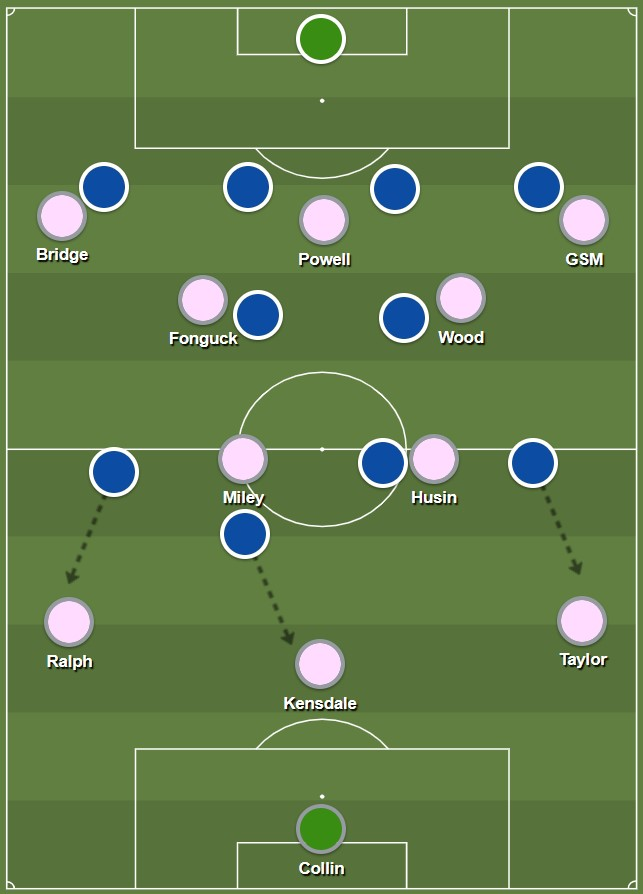
When we formed a ‘diamond’ shape in midfield, Miley would sit at the base of the midfield, with Husin and Fonguck either side but slightly higher up. Wood positioned himself at the top of the ‘diamond’, just behind Powell (below).

Both build-up shapes have their benefits, with the intention being to overload the central areas with the four in midfield, whilst maintaining the width across the last line of defence to provide more passing angles to those players ahead of the back three. By keeping the front three high and wide, you are able to pin the opposition into a back four or five. In addition, having the three players at the back provides more solidity than having just the two defenders, in the event of a turnover of possession if you were to lose the ball during build-up.
The ‘diamond’ midfield also gives the defenders and extra passing option compared to the ‘box’ midfield, and creates different passing angles. In addition, it’s more difficult for the player at the top of the ‘diamond’ to be pressed by an opposing player in the back four or five, meaning they can often find space easier.
Once we had progressed play into the final third, we looked to push Wood and Fonguck into the last line of attack to form a front five. Behind them was Husin and Miley, and the back three remained, forming a 3-2-5 formation (below).
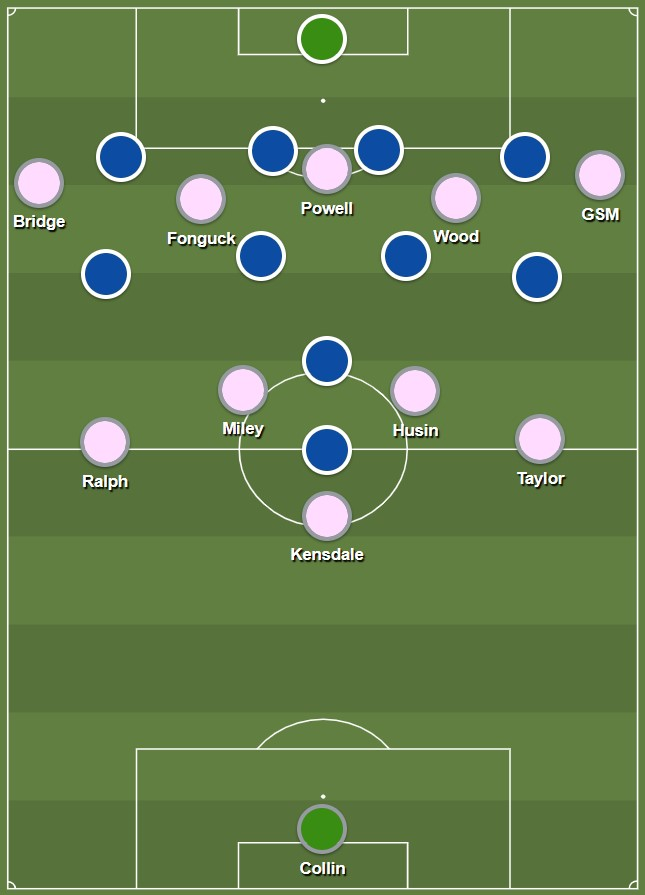
This front five looked to overload Stortford’s back four, meaning the vertical distance between their defence and midfield was reduced to prevent the defence from becoming isolated. In the event of a turnover of possession, because Stortford’s midfield was deeper, it become more difficult for their forwards to hold possession as they were more isolated. This made it easier for us to regain possession and initiate another attack. The 3-2-5 is the shape that all of the elite sides in world football are currently using when in attack.
Out of possession shapes
So what about out of possession? When Stortford had deeper possession, we sat in a 4-4-2 mid-block, and looked to commit the wide players and forwards into our high press. Scott-Morriss stayed deep to form a back four, and Bridge pressed the right back. Husin pressed the left back, whilst leaving Miley and Fonguck to pick up the opposing midfielders. Wood joined Powell to press as a front two (below).
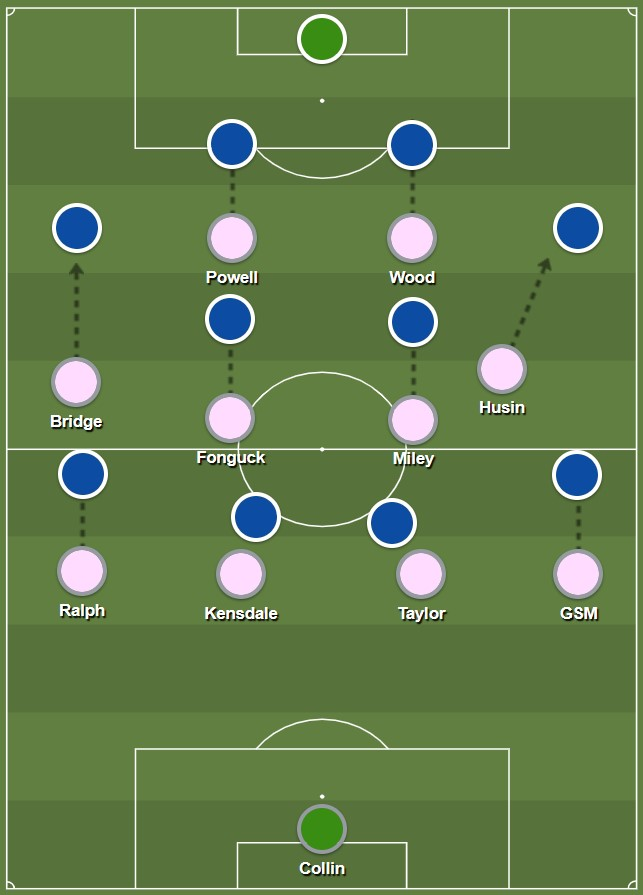
This 4-4-2 shape allows you to commit four players to the high press, whilst having compactness in the centre of midfield. You are also not under-resourced in defence, as the back four can occupy all opposing attacking players.
When Stortford had beat our high press and forced us to defend deep, we used Bridge to help us form a back five in a 5-3-2 low-block. Wood often dropped deeper to bridge the gap between the midfield and attack, basically forming a 5-3-1-1 shape (below).
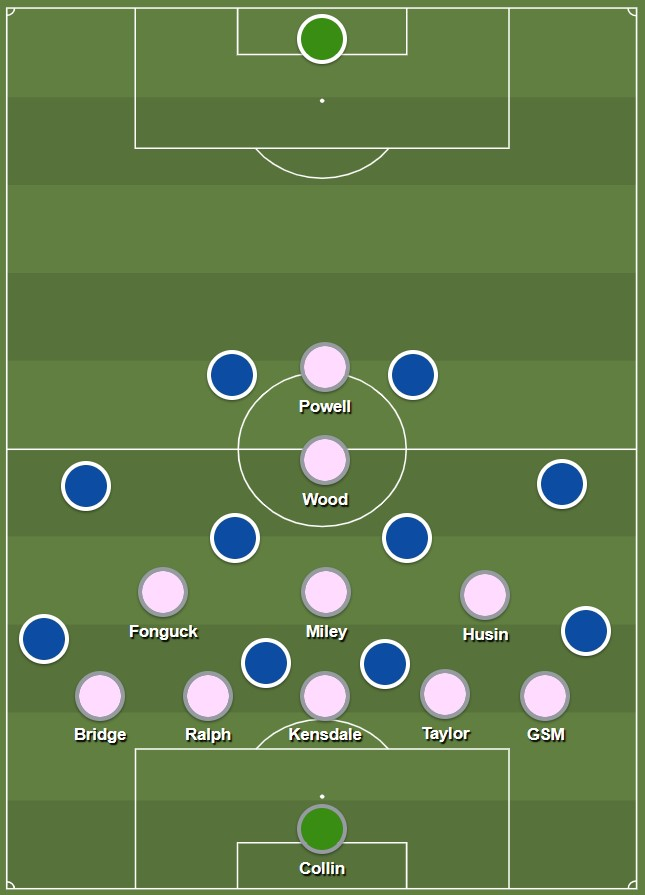
The 5-3-2 low-block is the defensive shape that we used for the vast majority of last season. Unlike the 4-4-2 shape, the 5-3-2 allows you to cover the width of the pitch better, and reduces the horizontal distances between the players in the last line of defence. It means that gaps that could open up between the full back and centre back in a back four are less likely to be exploited, as you have an extra player to cover the space once the wing back has moved to the touchline. The 5-3-2 also allows you to have two players in attack to hold the ball up in the event of a counter-attack (similar to the 4-4-2), and gives you compactness in the centre of the pitch with the midfield three.
So now we can see how one formation can be flexible depending on the phase of play. Sometimes we’ll have a back three, other times a back four, and others a back five.
Jack Wood’s role
Jack Wood was very impressive against Bishop’s Stortford. He scored a hat-trick, all with his weaker right foot, adding to the eight goals he scored in the National League South for Tonbridge last season.
During the build-up phase, he was used either at the top right of the ‘box midfield’ or at the top of the ‘diamond’ shape. I also think he has the technical capabilities to play on the right side of the ‘diamond’.
When we had settled possession in the final third he was in the last line of attack, often in the right half-space – that is, slightly to the right of the pitch, in between the centre forward and right wing back. I think that this will potentially allow him to be able to rotate with Scott-Morriss at times, allowing him to receive the ball on the right touchline where his 1v1 ability will give us greater threat from the right side compared to Scott-Morriss. This will also enable Scott-Morriss to find himself more central where he can get on the end of crosses, as we know he can do. In theory this should give us greater threat from both sides of the pitch, as last season there was an over-reliance placed upon our left side with Jack Bridge to create chances, in my opinion.
Out of possession, Wood pressed with Powell as the second striker in our 4-4-2 high press. When we were defending in our 5-3-2 low-block, Wood dropped slightly deeper to reduce the vertical distance between the midfield and attack, leaving Powell up front on his own, but not so far away that he was completely isolated.
Wood looked stronger and more able to challenge for duels compared to the last time I watched him play. This makes him more suited to this role in our 5-3-2 low-block, where he operated between the midfield and attack when we were defending deep. Together with his obvious technical and finishing abilities, Wood has all of the attributes to go very far. It looks like this is going to be a breakthrough season for him, and if possible I think he needs to be one of the first to be tied down to a longer contract once our transfer embargo is cleared, with his current deal set to expire next Summer.
How to get the best out of Dan Mooney
So Wood was given the freedom to drop into midfield during our build-up phase, found himself in the half-spaces during settled attack (because he has the technical attributes to do so), and gives us the potential to rotate with Scott-Morriss on the right side of the pitch to receive the ball on the touchline.
All of the above sounds very similar to what Dan Mooney can do.
I’m fully aware of the rumours surrounding Mooney’s future at the moment, and although I’ve been reluctant to write about this for a while due to the uncertainty surrounding the club, Wood’s performance on Saturday has given me the opportunity to now do so.
Quite often, when there are attacking midfielders who lack the required physical attributes to effectively defend as part of a central midfield block, they are pushed out wide to defend as wingers. This removes them from the chaotic nature of the centre of the pitch, before coming inside the pitch when their sides are in possession. Alternatively, they are asked to defend as a striker before dropping deeper when in possession.
This is essentially what Dan Mooney’s role was at Altrincham in the 2021/22 season before joining Southend. Altrincham usually defended in a 4-4-2 or 4-2-3-1 formation, with Mooney on the right side of the pitch. When Altrincham were in possession, Mooney was able to either hold the width on the right side, where he could use his 1v1 ability to beat the opposing full back, or drift inside the pitch to create chances or shoot.
The problem, in my opinion, is that Mooney hasn’t been the perfect fit for our out of possession system. We don’t play with wingers, Mooney isn’t able to defend effectively as a wing back, and I’m not convinced he has the correct physical profile to defend in a midfield trio. We essentially signed someone who was used to defending as a wide player in a midfield four, and asked them to defend in a central midfield three, when they don’t have the physical attributes to do so.
We also went long from goal kicks quite a lot last season, and this doesn’t suit Mooney as it means there are more second balls for him to challenge for in the central areas. This requires a strong physical presence, which he doesn’t have.
So this begs the question: how do you get the best out of Dan Mooney?
I’m going to stick with the out of possession focus before turning my attention to the in-possession side of things.
So we’ve already identified that Southend use a 4-4-2 mid-block when the opposition have possession of the ball in their own half, and this turns into a 5-3-2 low-block when we are defending on the edge of our penalty area. Mooney would be the perfect fit for that right-sided player in our 4-4-2, however this player is then asked to defend in a midfield three in our low-block once Bridge has dropped in the back five. That means that the only other position to use Mooney in, in our out of possession system, is up front.
This is the role that Wood had on Saturday; pressing high as a second striker, before dropping slightly deeper when we were in our low-block.
The only other alternative would be to change our out of possession system to match Altrincham’s in the 2021/22 season, rather than using our 5-3-2 low-block. This means that Mooney would be asked to defend as a winger in both our mid-block and low-block. The problem with this is that our back five low-block was the cornerstone of our defensive solidity last season; Southend only conceded 45 goals in our 46 league matches last season – the fourth best in the division. Would it be worth jeopardising that for one player?
In terms of when we are in-possession, as far as I’m concerned I’m happy to write last season off for Mooney and give him the benefit of the doubt.
Last season, Mooney scored two goals against an expected figure of 4.70 (xG). This means that he underperformed by a couple of goals. Compare this to the previous season where he scored 12 goals against an expected figure of 7.56 (xG) for Altrincham. These stats are slightly misleading as he played roughly half the amount of minutes for us as he did in 2021/22 for Altrincham. I do think that there was a bit of over-excitement around his goalscoring ability when he joined, as he scored around five goals more than expected in the season before he joined us. This makes his underperformance in front of goal for us less surprising; one season a player may score more than expected, the next season fewer than expected.
When we think about how he attacked for Altrincham, yes he was used as a wide player for them, and as an attacking midfielder for us, but he was asked to come inside the pitch for Altrincham as well. Mooney’s a different type of player to, say, Jack Bridge, and he’s able to come inside the pitch more often to assist our build-up or play those creative passes, rather than just being a touchline winger. Of course, you don’t want to completely eliminate the influence he can have from wide areas, but in our system to get him out wide we rely on Scott-Morriss to have the tactical awareness to come inside the pitch to rotate with Mooney. This is something that I think can be worked on.
Finally, when we think about why Mooney may not have had his best season last time out, we have to consider the intangibles. Mooney moved the length of the country to join Southend into a new area, to join new teammates, under a new Head Coach, struggled with injuries, and was faced with all of the off-pitch uncertainty that we encountered last season.
All of the above is why, when we think about why Mooney may not have performed to his true level last season, it’s not just as simple as the fact that he wasn’t playing as a winger.
To conclude, as I mentioned above, I’m happy to write last season off for Dan Mooney and let him start on a fresh page. I think if we can get that rotation between himself and Scott-Morriss working to perfection then that will help him to maximise his 1v1 ability in the wide areas as well. In terms of out of possession, if we were to use Mooney in the same role as the one Jack Wood had against Bishop’s Stortford, I think that would also help to reduce the defensive responsibility placed upon Mooney, whilst allowing us to keep our preferred shape.
 Shrimper Stats
You must be logged in to post a comment.