Southend United played out a 1-1 draw at The Shay against a Halifax Town side who currently occupy a National League play-off place, on Saturday afternoon.
In this article I will detail how the game went, look at how Southend attempted to progress the ball forwards, and how Halifax tried to cause us problems during these moments.
First Half
In the first half, Southend built play from defence in our usual 3-4-3 Diamond shape. However there was a slight tweak to the system as Callum Powell pushed up alongside Harry Cardwell as a second striker. This pinned Halifax’s three centre backs.
Halifax used a 5-2-3 defensive block; Southend’s wing backs and strikers pinned Halifax into a back five, Halifax went man-to-man in midfield, and pressed Southend’s back three and #6 (Cav Miley) with their narrow front three. The below image illustrates how it looked on paper.
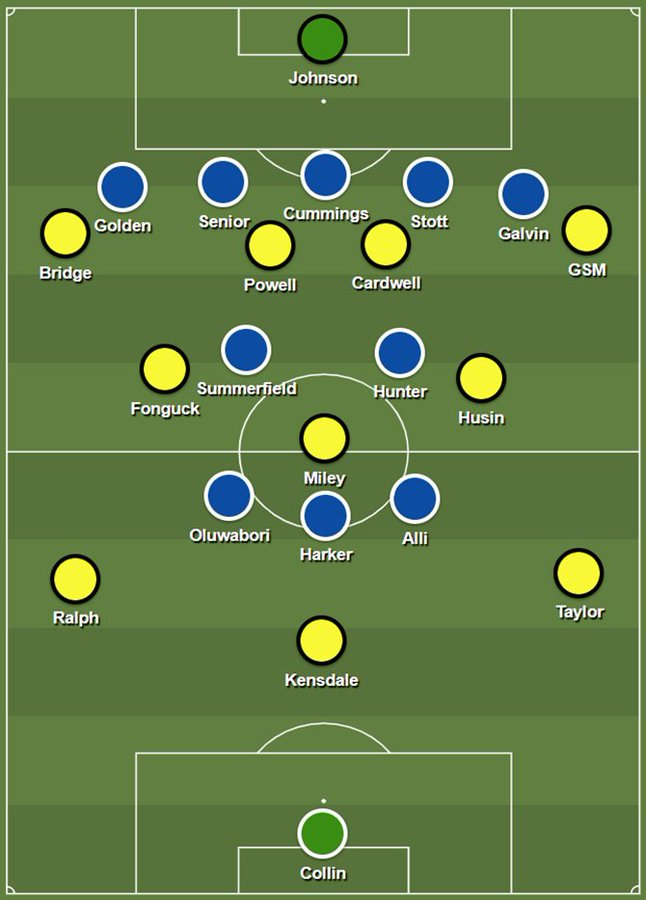
The reason for Halifax positioning their front three narrower was to cater for the absence of a third midfielder to mark Miley. Their centre forward Rob Harker was just in front of Miley, and their two attacking midfielders helped to prevent us from progressing play centrally. This forced us out to either Harry Taylor or Nathan Ralph. Once the ball went out to them, Halifax’s near-side attacking midfielder pressed him. The remaining two attacking players continued to prevent us from going into Miley.
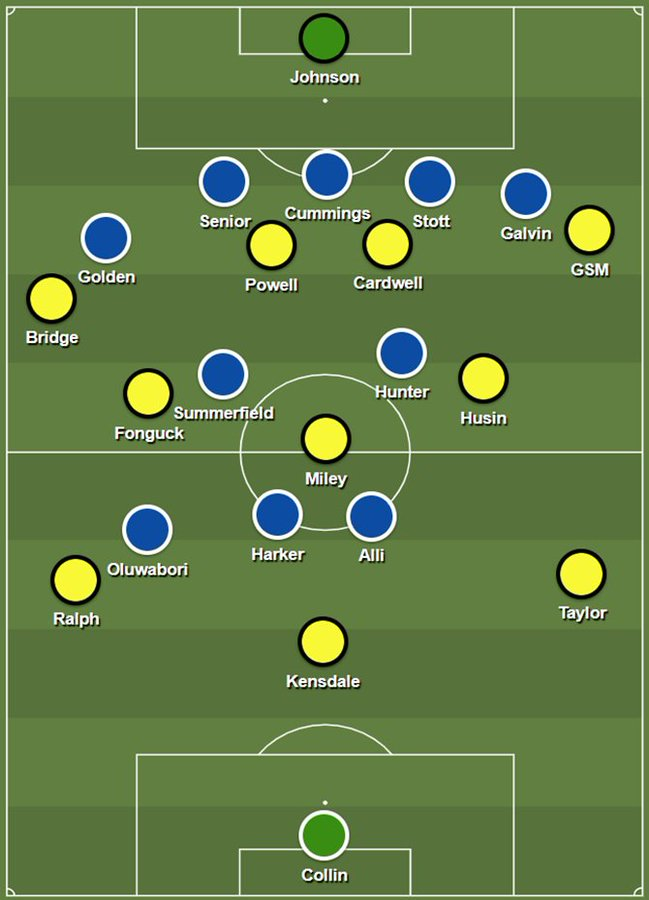
If our near-side wing back dropped deeper, his opposing full back would follow him to press. I also noticed we attempted to play through Halifax’s press more effectively by dropping Noor Husin deeper into the right back area. This in theory would have given us a 5v3 in the first phase of build-up. However, Halifax just used one of their midfielders to follow Husin and press, as illustrated in the below image.
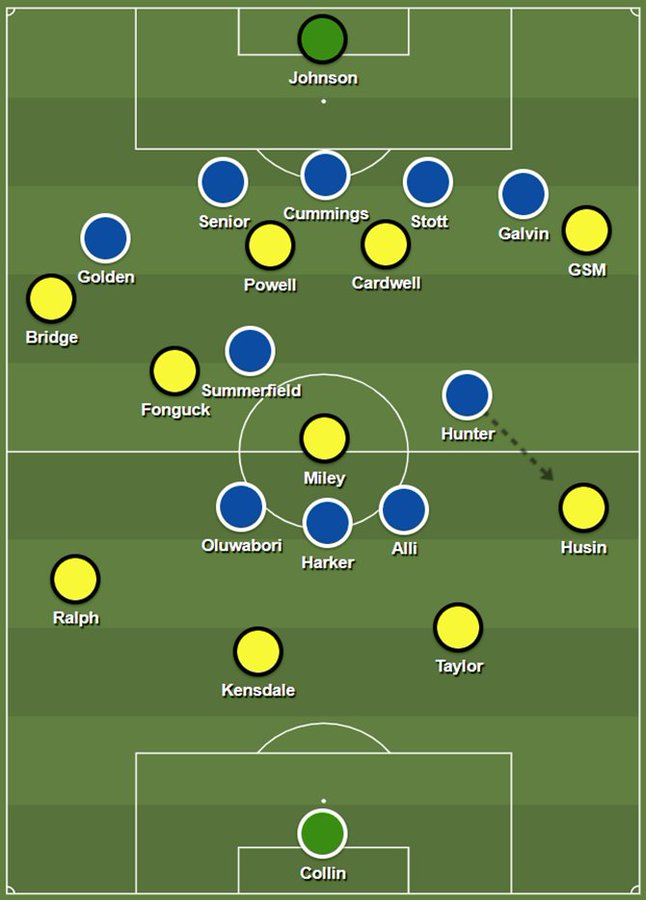
Halifax’s out-of-possession structure made it difficult for us to progress safely through the thirds, and we had lots of possession in non-threatening areas. This would often force us to play long passes over the top of the press. Either, mainly, Cardwell had to challenge for aerial duels, or someone could make a run in behind the defence. A lot of the time these long passes helped us to gain territory and begin attacks further up the pitch. However this method is sub-optimal as, if you fail to win these aerial duels, you concede possession, have more defending to do, and ultimately fail to control matches.
This in particular wasn’t the case on Saturday, as we had over 70% possession, but it won’t always work against every opponent.
When we did get the ball into the final third in the first half, we couldn’t cut Halifax open. We only accumulated an xG of 0.36 before half time, with the best chance coming after we had won possession back high up the pitch, rather than coming from a settled attacking phase.
Second Half
After half-time, we scored with our first shot of the half through Wes Fonguck in the 51st minute. This change in game state, coupled with Halifax’s red card in the 56th minute, made it easier for us to create better chances; now behind and down to 10 men, Halifax had to commit more bodies forwards which gave us some opportunities through transitions.
Out-of-possession, Halifax kept the same structure that they had before the red card, but just had one player fewer in the first line of their press. This gave us a 4v2 numerical superiority in the first phase of build-up, and we could progress the ball forwards easier.
In the second half compared to the first, we made more forward passes (103 vs. 78), had more penalty area entries (30 vs. 18), and took more shots (11 vs. 6). We also accumulated an xG of 1.02 in the second half alone.
However, Halifax scored with their third and final shot of the match, from the resulting corner to their second shot, and after this point we couldn’t take any of the chances that we created for ourselves to win the match.
Conclusion
There’s no need to panic after this one. Perhaps we could have found better solutions during build-up earlier on. Perhaps we could have created more chances, in the first half in particular. However, as is so often the case, you have to take your chances when they come.
We’ve still had over 70% possession, created enough chances to score at least one more goal, dealt with the transitions, and defended well when we had to, other than for one or two moments. All of this, despite the current situation surrounding the club.
Onto York City next weekend.
 Shrimper Stats
You must be logged in to post a comment.