Southend United have started the 2023/24 National League season in fine form – on the pitch at least.
We have picked up 13 points from our first eight matches, scoring 15 goals and conceding nine in the process. In fact, we only scored 16 goals in our final 15 matches of last season.
So what exactly can this improvement in our goalscoring ability be put down to? Many factors will come into play, but in this article I wanted to focus specifically on how our system has changed to accommodate our off-field situation.
Harry Taylor’s change in role
As has been well-documented, we’ve been unable to sign a player for a whole year now, and after our squad size was significantly reduced in the Summer, it’s left us vulnerable in the event of injuries and suspensions.
After Shaun Hobson’s departure for Oldham Athletic, Louis Lomas would have been the obvious choice to replace him in the right-sided centre back spot in our side. However, at the time of writing, he has been unavailable for selection so far this season, and it has led to Harry Taylor being used in that particular role instead.
Taylor does have the experience of playing in a similar role previously in his career, however since he joined us, he had been used exclusively as a central midfielder. In fact, Taylor had been selected in midfield as part of our 3-5-2 formation in 10 of the last 15 occasions that we had used the formation last season. Nevertheless, Taylor has fitted into his new role very well, and he’s been arguably our best performer at this early stage of the season.
So why may having Taylor in defence rather than in midfield benefit our attack? To answer that question we need to consider how we set our side up in different phases of play.
Final third
So far this season, when we have had settled possession in the opponent’s third of the pitch, we usually see us in a 3-1-6 shape. This consists of Cav Miley ahead of the back three, our two central midfielders push up into the attack, our wing backs hold the width on either side of the pitch, and we have two strikers in the penalty area. This is just on paper, as our players have the freedom to rotate to cause confusion for the opposition. For example if Gus Scott-Morriss were to come inside the pitch, a midfielder would take his place on the right side.

Where this differs to last season is that, in the matches where we selected Taylor as part of our midfield three, we didn’t have the right personnel to make the 3-1-6 as effective as it should be. Although Taylor is a very good ball-winner, and can win possession back for us in either midfield or defence, he doesn’t have the same technical ability as either Noor Husin or Wes Fonguck – who have been our two more advanced midfielders so far this season.
In addition, as Scott-Morriss doesn’t have the same 1v1 ability as Jack Bridge does on the opposite side of the pitch, our right side lacks the ability to create chances through take-ons, which is why I think a lot of our attack comes down our left side where Bridge is. This means that there’s an over-reliance on creative passing ability and off-ball movement down our right side to create chances. Husin is far more suited to this aspect of the role than Taylor is. In fact at the time of writing, Husin and Fonguck have scored a combined three goals in our opening eight matches, further illustrating the need for technical ability to effectively contribute during attacking phases in this role.
Of course it’s still early in the season so it’s a very small sample size, however the data backs up our improvement in attack from last season. Per 90 minutes, at the time of writing so far we have scored more goals (1.88) than last season (1.24), have a higher expected goals value (1.61 compared to 1.58), and are making more penalty area entries (33.25 compared to 28.43). We’re also taking more touches in the opposition’s penalty area (24.50 compared to 21.33), and are making more passes to the final third (72.38 compared to 61.28), with a better accuracy (61.7% compared to 58.9%).
All of the above statistics show that we’re more effective in the final third of the pitch so far this season, and I believe that having the correct profiles in each zone of the pitch is helping with this.
Build-up
However it’s not just in the final third where we’re seeing the in-possession benefits of having Taylor in defence rather than in midfield.
At the time of writing we have averaged a 59.50% possession share, which is up from 53.24% last season. Additionally, 11.62% of our total passes are classed as long passes, which has reduced from 16.45% last season.
Why are these statistics significant? Well, it’s clear from the last couple of years that Kevin Maher wants us to be a side who can control matches through possession, as much as we can whilst considering the limitations with regards to squad building due to the transfer embargo. The idea of having possession is that, obviously, the better you can keep the ball, the less defending you’ll have to do. If you can defend the transitions well when you do lose possession, you can initiate another attack straight away and have relentless pressure.
It’s also clear that, when we are able to, we like to pass out from defence. Again, this is all about having control of possession. The more you go long from defence, the more 50:50 duels your centre forward has to challenge for. Some of these will be won, and some will be lost, meaning you have to defend. Obviously there’s a time and place to build play from defence, and you need a fair bit of pragmatism.
Going back to Harry Taylor, last season when we built play from defence, he was often used on the right side of our midfield three, or in a midfield pair, with another of our midfielders pushing forwards. This issue with this is that Taylor was then expected to receive the ball from our defence, turn, and pass to a teammate further forwards, all whilst being closed down by an opponent. However he doesn’t have the technical ability to be able to do this consistently enough across a whole season. So much so that there were times when Husin would drop alongside Miley, with Taylor pushing forwards into a more advanced midfield role, just to make us more technically secure in the first phase.
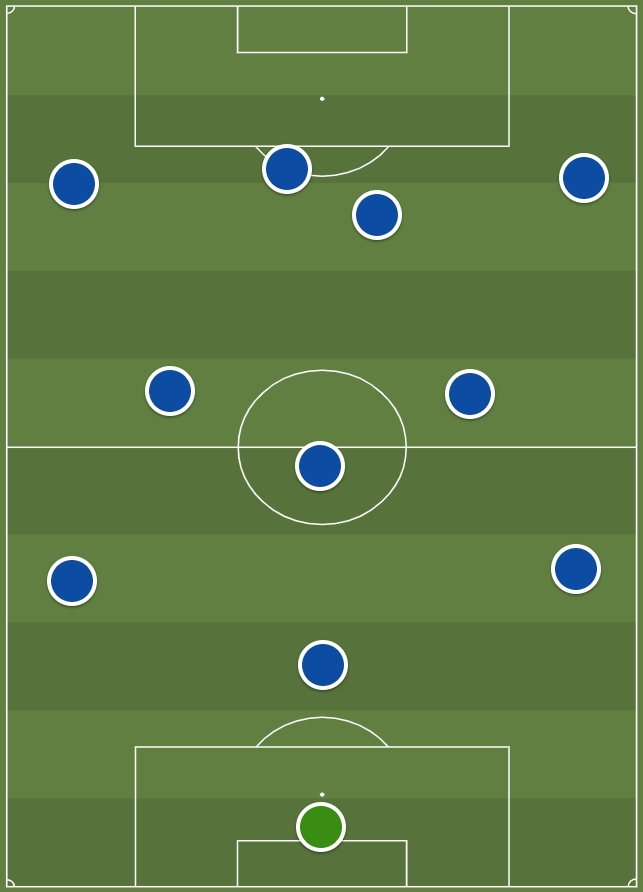
This season we have had usually Husin and Fonguck either side of Miley, all three of which are much more consistent with their ball retention and progression. This all helps us to become more secure in-possession, and allows us to have greater control on matches.
Taylor’s role in build-up now, as he’s playing on the right side of our back three, means he has more time on the ball, and is already facing all of his teammates as soon as he receives the ball.
 Shrimper Stats
You must be logged in to post a comment.