Using data, I have identified Ebbsfleet United goalkeeper Chris Haigh as a potential transfer target for Southend United.
Haigh – 26-years-old and a former Concord Rangers player – is currently on loan at Oxford City, and has made 17 appearances so far this season.
In this scout report I will assess Haigh’s performance so far this season, look into his strengths and weaknesses, and explain why I think a potential transfer to Southend would make sense.
Current goalkeeping situation
Southend currently have Collin Andeng Ndi out injured, and he has been replaced in our 16-man squad by player-coach David Martin. Ipswich Town goalkeeper Nick Hayes came in on loan for a month whilst Martin was also injured, but he has since returned to his parent club.
When Andeng Ndi returns from injury and our transfer embargo is eventually lifted, a decision will have to be made regarding what is the best way forwards. Twenty-year-old Andeng Ndi made 23 league appearances for Southend last season, and if he were to drop down to our second-choice option for either Martin or a new goalkeeper, it would slow down his progress. Andeng Ndi is one of the most promising up-and-coming goalkeepers at this level when you consider his age, however I do believe that in terms of current level there are better goalkeepers out there. Whether these would be available considering it’s mid-season now, I’m not sure.
One option could be to continue with Andeng Ndi as #1 until the end of the season, at which point we re-assess his current level and look at who is available elsewhere, and then make a decision. Or perhaps we’ll look to bring in a new #1 before the end of the season, if we think that could be the difference between securing a Play-Off place or not.
Shot-stopping
Haigh has conceded 34 goals so far this season versus a post-shot expected goals (PSxG) figure of 35.81. This means he’s conceded slightly fewer than he would’ve been expected to based on the shots that he’s faced.
Although Haigh has been conceding at a rate of 2.00 goals per match, only Ebbsfleet United have allowed more shots per 90 minutes than Oxford City in the National League so far. When the players ahead of Haigh aren’t doing a better job of limiting the amounts of shots he’s facing, it’s no surprise he has faced a high xG, and subsequently conceded a lot of goals.
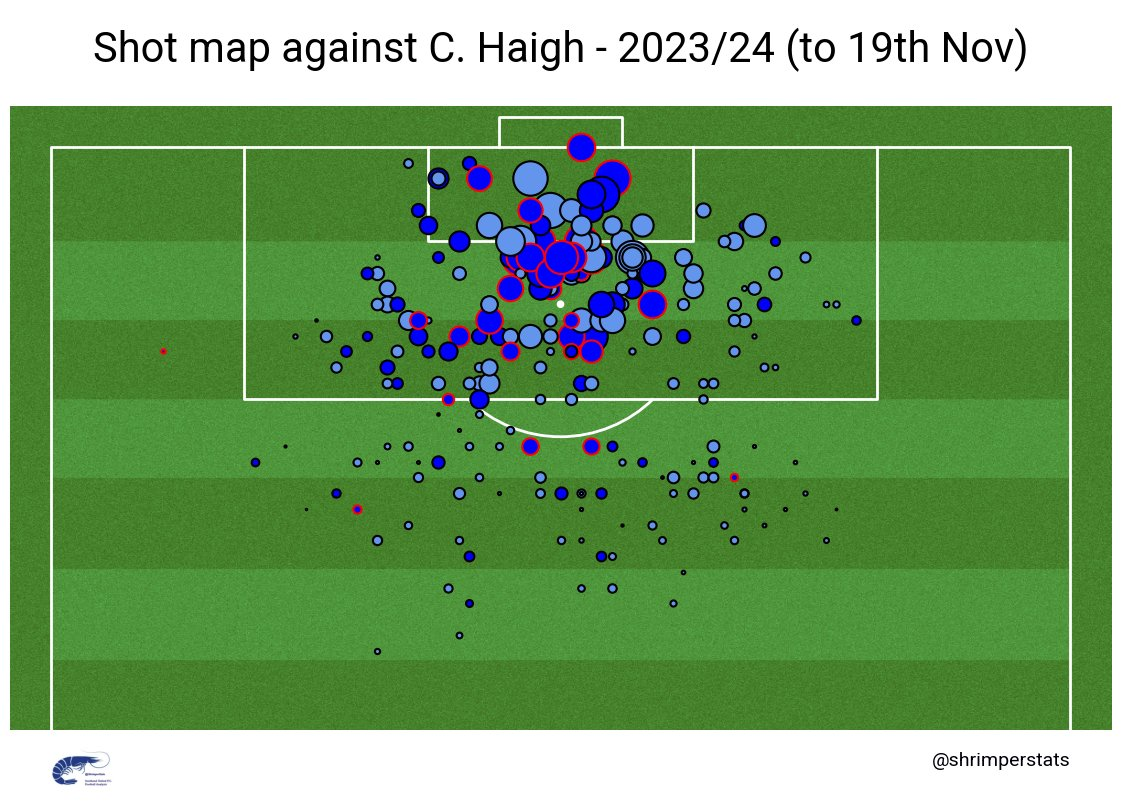
From the below data visual, we can see a shot map of all shots that Haigh has faced so far this season. The larger the dot size indicates a larger xG value for each shot, dark blue dots represent shots on-target, light blue dots represent shots off-target, and dots with a red border represent shots that resulted in goals. Notice how there are a lot of shots here in and around the six-yard box with high xG values (larger dot size). These types of shots typically have a greater likelihood of resulting in a goal, and are therefore more difficult for goalkeepers to save. This perhaps explains why Haigh’s save rate (%) is average despite ranking well at prevented goals per 90.
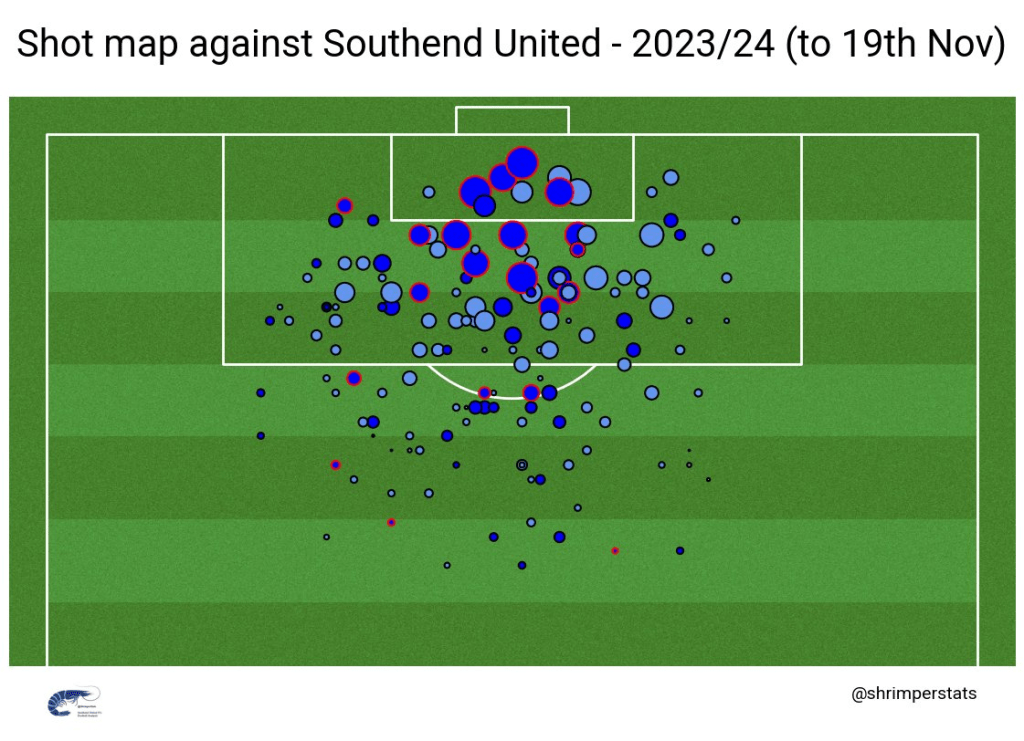
When we compare Haigh’s shot map to a map of Southend’s shots faced (below), we can see a clear difference. We can see how there are far fewer shots against (even though we have played 20 matches so far compared to Haigh’s 17), and in particular from in and around the six-yard box compared to the shots Haigh has faced. This shouldn’t come as much of a surprise when we consider that Southend allow almost half the amount of shots that Oxford City allow. On average, Southend allow 8.20 shots per 90, whereas Oxford City face 15.24 shots per 90. Southend also allow 18.55 penalty area entries per 90 compared to Oxford City’s 30.52, and allow 12.40 touches in their penalty area per 90 versus to Oxford City’s 25.71. All of these statistics tell us that Southend are doing a much better job at protecting their goalkeeper than Oxford City are.
One more thing that I would say with regards to his shot-stopping, is that Haigh seems to position himself quite wide when the opposition have the ball to the side of his penalty area. Obviously as a goalkeeper you have to shift across to cover your near-post in these moments, but Haigh seems to position himself sometimes even outside of the post so that there’s a lot of space left in the goal if the ball is cut back to a striker. This positioning makes it more difficult for Haigh to shift back across in the event of a cut back cross, which goes some way to making him look quite slow to shift back across goal.
Distribution
From the below data visual, we can see that Haigh ranks well across the board at all passing metrics. Not only in terms of accuracy, but also in the sense that Haigh has the consistency to play a high volume of passes. Being able to play a high volume of successful passes means Oxford City are able to reliably use him during their build-up phase. Oxford City like to build play from defence, and from goal-kicks. They rank 6th for attempted passes per 90 minutes, 5th for pass accuracy (%), and 2nd for passing rate (passes per minute of possession).

Southend have so far averaged a 56.2% possession share, which ranks 6th in the National League. We also rank 7th for attempted passes per 90 minutes, 9th for pass accuracy (%), and make on average 14.23 passes before our opponents make a defensive action (PPDA against) – which ranks 4th. Although we don’t place as high an emphasis on playing out from defence as some other sides do, it’s clearly something we’ve been building towards over the past couple of years since Kevin Maher took over as Head Coach, and a top ball-playing goalkeeper could help to take us to the next level.
From Haigh’s own video compilation (below) we can see how he demonstrates a good range of passing at different angles with both feet. He’s comfortable under pressure, can play line-breaking passes, and can hit the channels or space in behind the defence for the #9 to run onto. He also has the ability to quickly release the ball with an accurate drop-kick to initiate a counter-attack after a defensive set-piece.
There aren’t just passes across his defensive line in there. Haigh can step up in-possession to act as a situational central centre-back during the build-up phase, with two Oxford City centre-backs splitting to form a back three. This could potentially give us another player further forwards and could enable us to become more tactically flexible during the first phase of build-up. From his video compilation, we can see how Haigh can use his body position to play disguise passes. He also possesses good ball-striking technique to clip passes over the opposition, rather than just passing along the ground or hoofing up field. These points make his ball-playing game look almost effortless.
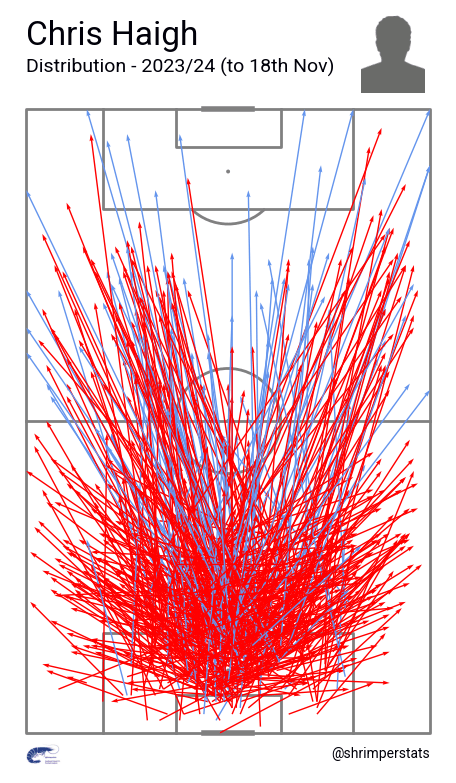
Below is a pass map illustrating Haigh’s accurate passes for Oxford City so far this season (accurate passes in red, misplaced passes in blue).
Sweeping
Haigh makes a very large number of exits (which is how often a goalkeeper leaves his line). Being able to come off your line is a crucial attribute for goalkeepers to possess for possession-based sides. It means they can sweep effectively to help deal with counter-attacks after possession has been turned over further up the pitch after an attack. If you are a side who likes to control possession, the chances are you will be facing a great number of counter-attacks, and having a goalkeeper who is consistent in his ability to sweep effectively is vital.
This sweeping ability also makes the implementation of a high defensive line easier. The high defensive line allows you to push your players forwards which reduces the vertical distances between the lines, making a counter-press more effective if possession is lost high up the pitch because your players are closer together. If you counter-press successfully, you can win possession back quickly and initiate another attack – allowing you to sustain pressure and maintain possession of the ball, increasing your control on the match.
Having control of matches is the end-goal for possession-based sides, and part of it comes from the implementation of the high defensive line. If you can’t push forwards as much, there’s larger spaces between the lines and it makes a counter-press disjointed, reducing the chances of you winning possession back quickly. This ultimately means you’ve got more defending to do as you haven’t maintained possession well enough yourselves.
Aerial Duels
Haigh also attempts a high amount of aerial duels. This may be partly due to Oxford City allowing on average 19.38 crosses per 90 minutes – which compared to Southend’s 10.50 is significantly higher. Because Oxford City allow a lot of crosses into their penalty area, it forces their goalkeeper to leave his line more and/or challenge for a greater number of aerial duels.
Nevertheless, Haigh does seem keen to come off his line and attempt an aerial duel against an opposing player. Due to his eagerness and subsequent high amount of aerial duels, I feel that it puts him in a position where he has to attempt to punch at a cross more frequently than is ideal, as these moments aren’t as safe as if he were to catch the ball after a cross. This is backed up when we consider that Haigh ranks average at aerial duels won (%), although as he attempts a very high volume this may skew the data.
One more thing to mention is that, although Haigh is still six-foot tall, he isn’t the tallest of goalkeepers. This may potentially make it more difficult for him to win aerial duels against a big, physical #9, or from set-pieces when there are a lot of bodies in the penalty area and he would have to battle his way through to claim the cross. This again may be why he seems to attempt a fairly large number of punches from crosses, and why he ranks average at aerial duels won (%).
 Shrimper Stats
You must be logged in to post a comment.