Dan Mooney and Southend United parted ways last week. When Mooney joined in the summer of 2022, it was a transfer that sparked a lot of excitement amongst the fanbase. However in truth, we failed to see Mooney perform to the standards he set at previous club Altrincham on a regular basis.
In this article I’ll look back on Mooney’s time at Southend to assess why it didn’t work, despite his obvious quality.
Profile and role at Altrincham
To analyse why it didn’t work out for Mooney at Southend, we first have to consider what type of player he is, and why his role at Altrincham allowed him to perform to high standards.
Due to his close control and ability on the ball in tight spaces, Mooney was able to drop deeper and assist Altrincham’s build-up on occasion, offering some second-phase presence. Moving inside the pitch from the right, he could find space as either his left-back marker was often unwilling to follow him into the centre of the pitch, or he’d go unnoticed by opposing central-midfielders who were already occupying Mooney’s teammates, as Altrincham looked to overload the midfield. However, he was very much a final-third player, and his performances would be judged on how he contributed to Altrincham’s final-phase play and his goal involvements.
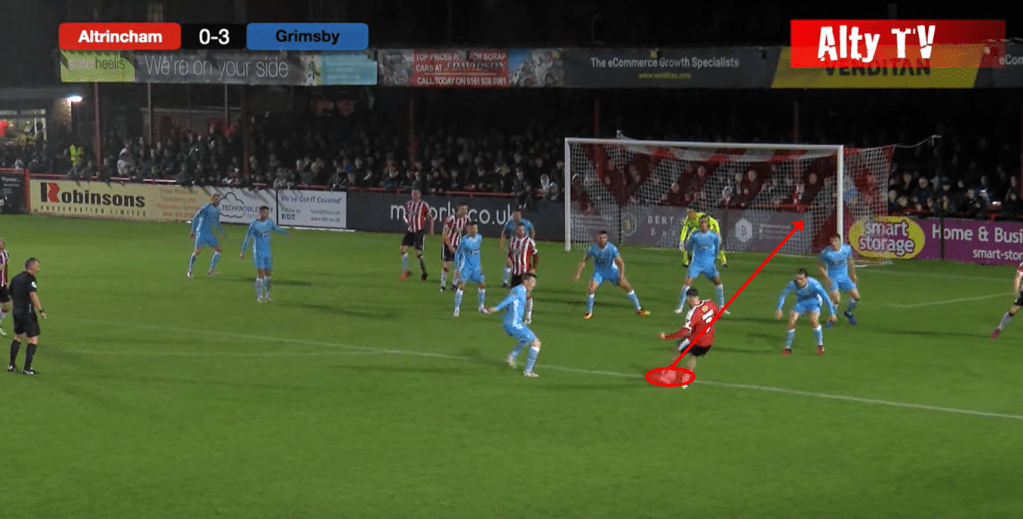
Mooney was used on the right-side of Altrincham’s 4-2-3-1 formation during his final season at the club in 2021/22. However, just the fact that Mooney was used as a right-winger for Altrincham doesn’t provide us with enough context for what his role was; player positions are often just starting positions. Starting on the right side, Mooney liked to move inside the pitch. He’d often do this by receiving the ball out wide before carrying inside, where his low centre of gravity coupled with his ball control allowed him to withstand pressure from opposing players once he got moving. Alternatively, Mooney could drift inside the pitch to find pockets of space, often looking for cut-backs from the opposite flank.

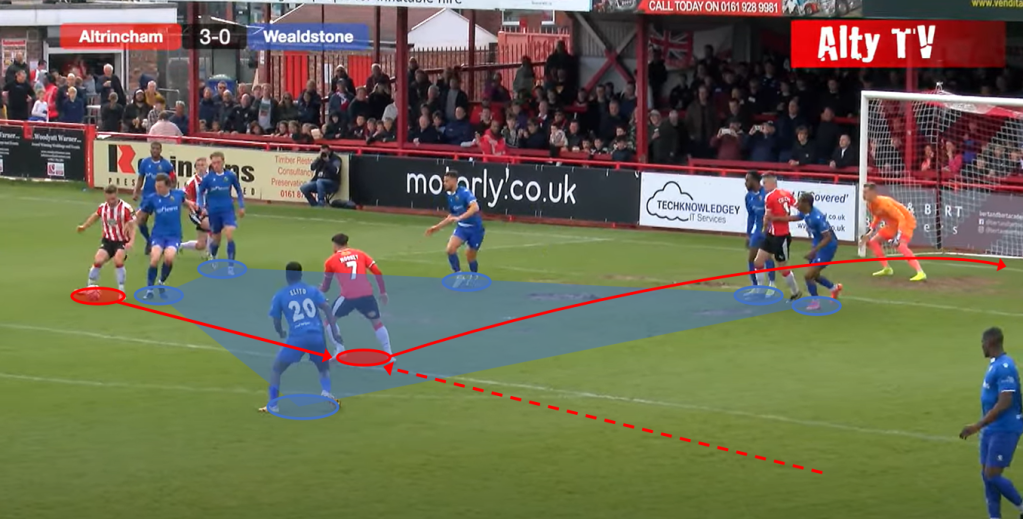
Where Mooney differs to someone like Jack Bridge for example, who is very much a touchline-winger, is that he likes to come inside the pitch more, get more shots away, and create chances and attack from the right half-space (between the goal-posts and right channel). In the 2021/22 season whilst at Altrincham, Mooney took on average 3.03 shots per 90 minutes, whereas in 2022/23 for Southend, Bridge took 1.21 shots per 90 minutes (including penalties).
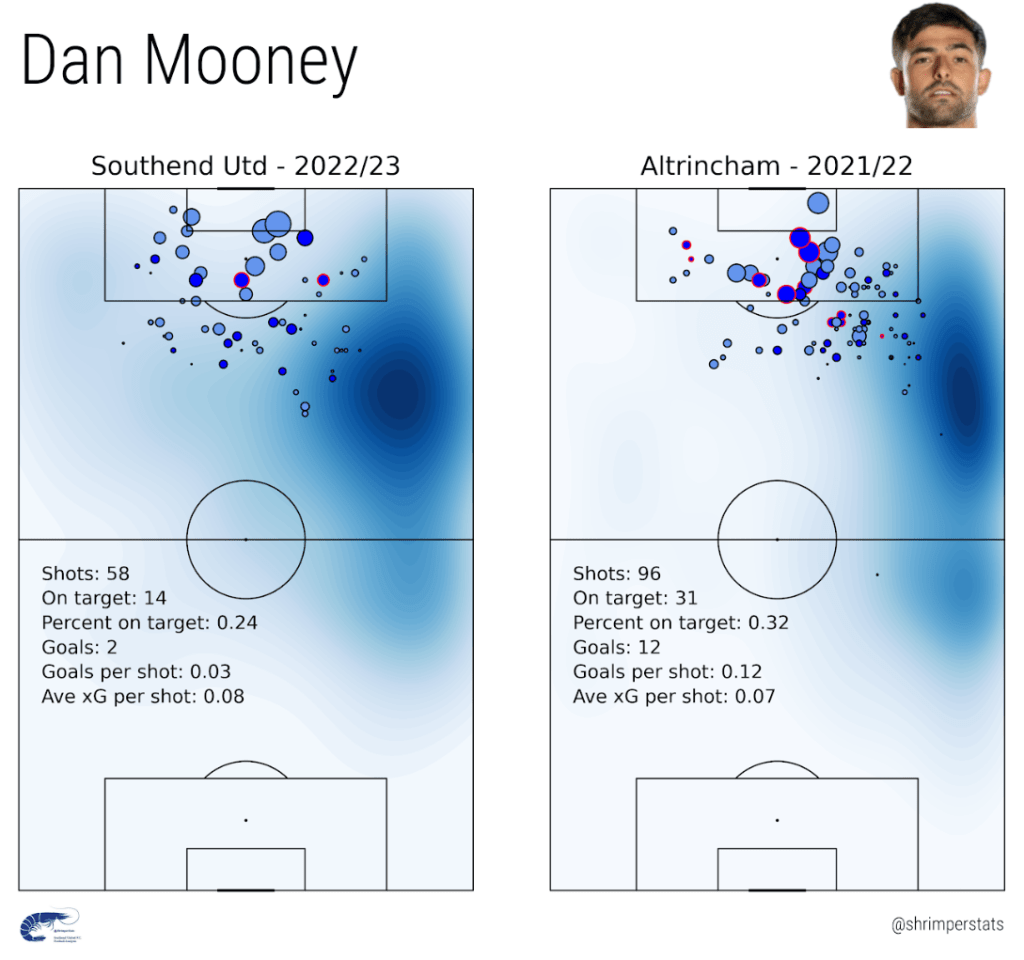
When we look at the below data visual to see where Mooney took his shots from in 21/22, it’s clear that there is a bias towards the right-side of the pitch towards that right half-space.
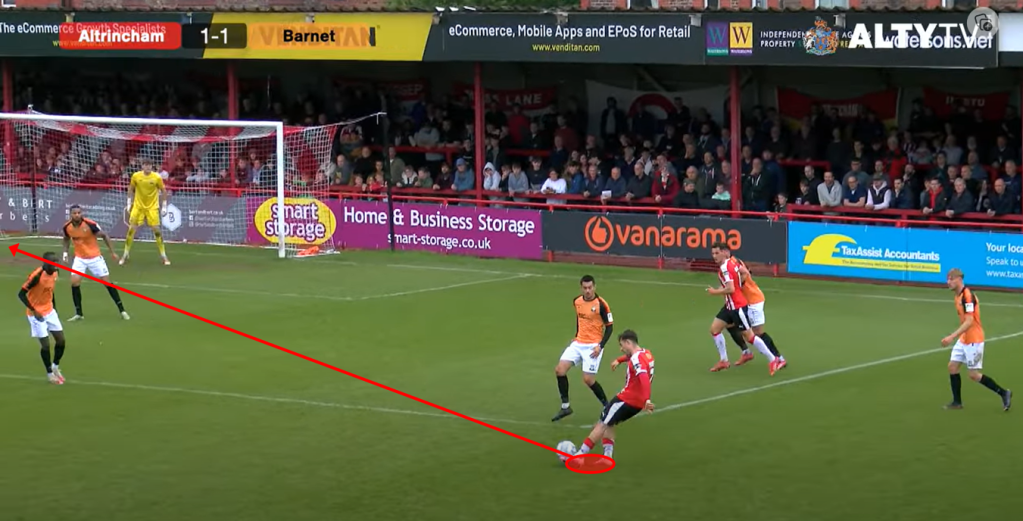
Bridge on the other hand likes to hold the width on the left-side of the pitch, positioning himself high and wide, whether that be through playing as a wing-back, wide midfielder, or as part of a front three. Once Bridge has the ball in this area of the pitch he likes to get 1v1 against the opposing right-back, and once he’s beaten him on either side he’ll get a dangerous cross into the penalty area. Although Mooney can hold the width on the right, he’s not as consistent as Bridge in his ability to beat his marker around the outside, and as a result is far more comfortable cutting inside to get a cross into the penalty area. In the 2022/23 season for Southend, Bridge attempted 7.6 dribbles per 90 minutes with a 61.5% success rate, whereas in 21/22 for Altrincham, Mooney was only successful with 44.5% of his 6.74 dribbles per 90. Bridge also attempted 5.24 crosses per 90 minutes with a 40.2% accuracy, whereas Mooney attempted 2.47 per 90 with a 37.5% accuracy for Altrincham in 21/22.
The above meant that Mooney was often not the one holding the width for Altrincham on the right during settled attacks. If they could hold possession for long enough, Altrincham’s right-back would push forwards to hold the width, with Mooney inverting and crossing from the right half-space.
Out-of-possession, Altrincham would defend in a 4-4-1-1 mid-block, with Mooney being used on the right-side of the midfield. He would occasionally have to track back to help his right-back defend opposition attacks down their left-side, but he was often kept higher up the pitch during defensive phases to be ready for counter-attacks after turnovers of possession. Additionally, as he was positioned out wide, there was minimal responsibility placed upon him to win duels and challenge for second-balls, as opposed to if he was playing in central-midfield. This suited his physical profile as, although his low centre of gravity makes him difficult to dispossess, he isn’t the most physical in defensive duels, especially when up against strong central-midfielders.
How Mooney’s role at Southend differed
When Mooney arrived at Southend, he was initially used as the right-sided #10 in our 3-4-2-1 formation (at the top-right of our ‘box midfield’). This was the formation that we had used for the majority of Kevin Maher’s time as Head Coach, and it suited Mooney perfectly. Here, he was able attack from the right half-space, was in close proximity to our right wing-back Gus Scott-Morriss who held the width during settled attacks, meaning the two could rotate positions, and he would be positioned high up the pitch during defensive phases to be ready for counter-attacks.
Mooney’s 2022/23 season at Southend started well; he scored one goal and managed three assists in the first few weeks of the season. However injuries to central-midfielders Noor Husin and Harry Taylor (before he was converted to a right-sided centre-back this season) meant that we had to use Wes Fonguck next to Cav Miley in the double-pivot, with Callum Powell partnering Mooney just behind our #9. Because Fonguck likes to push up into the last line of attack, we would only have Miley ahead of our back three forming our rest-defence during attacking phases of play. This, coupled with the fact that all of Powell, Mooney and whoever was playing as our #9 are all very direct players, meant that we struggled to maintain possession during this time, had more transitional moments to deal with, and consequently had more defending to do. Mooney was also asked occasionally to defend as a right-sided #8 in a midfield three, which he doesn’t have the physicality to do consistently enough to a high standard.
Mooney then picked up a couple of nasty injuries and only made five league starts from mid-October to the end of the 2022/23 season. This meant that he found it difficult to manage regular game time, which is needed to perform consistently. Furthermore, when Mooney returned from injury, Southend had found success after switching to a 3-5-2 formation, with Mooney predominantly being used as the right-sided #8 or as a #10 when he did get onto the pitch. This formation gave Southend an additional body in central midfield, but due to Mooney’s lack of duel-winning ability, the extra man would often be redundant during defensive phases.
Even when at Altrincham, Mooney never showed immense physicality out-of-possession. But this was fine because he was used in a position where there wasn’t as much emphasis placed on winning duels and challenging for second-balls as the chaotic nature of central midfield presents. Mooney’s goal involvements for Altrincham also out-weighed his lack of out-of-possession influence, whereas at Southend, clearly they did not. During the 2021/22 season for Altrincham, Mooney scored 12 goals and managed 5 assists. However at Southend, Mooney couldn’t replicate these numbers. This was partly down to the areas that he was taking his shots and creating chances from, but also because of his lack of composure in front of goal and ball-striking technique. He regularly overhits shots with too much power, or strikes the ball with a lack of accuracy, meaning he’s open to wild fluctuations with regards to his goal involvements against expected levels. In the 2021/22 season at Altrincham, Mooney scored 0.37 goals per 90 minutes compared to an expected goals (xG) value of 0.23 per 90, whereas in the 22/23 season at Southend, he scored 0.11 goals per 90 minutes compared to an expected value of 0.25 xG.
During the current 2023/24 season, when selected, Mooney has been used as a #10 in our 3-5-2 formation. This is something that I suggested during pre-season, one of the reasons being that it would allow Mooney to be positioned high during defensive phases ready for counter-attacks, whilst still letting us defend deep in our 3-5-2 formation.
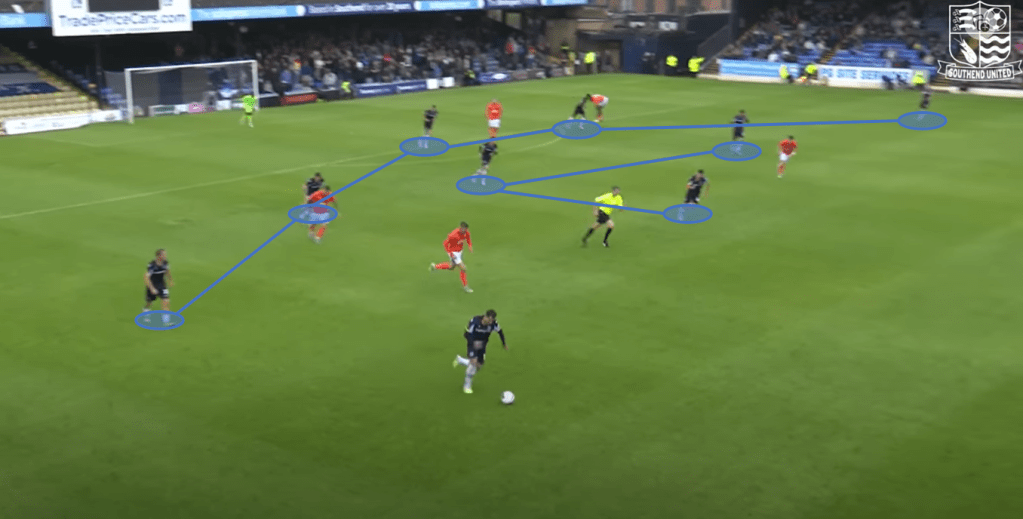
It would also mean that Mooney could drop deeper to offer some second-phase presence during build-up, and could still be positioned in the right half-space that he likes to be in when we’re in the final third.
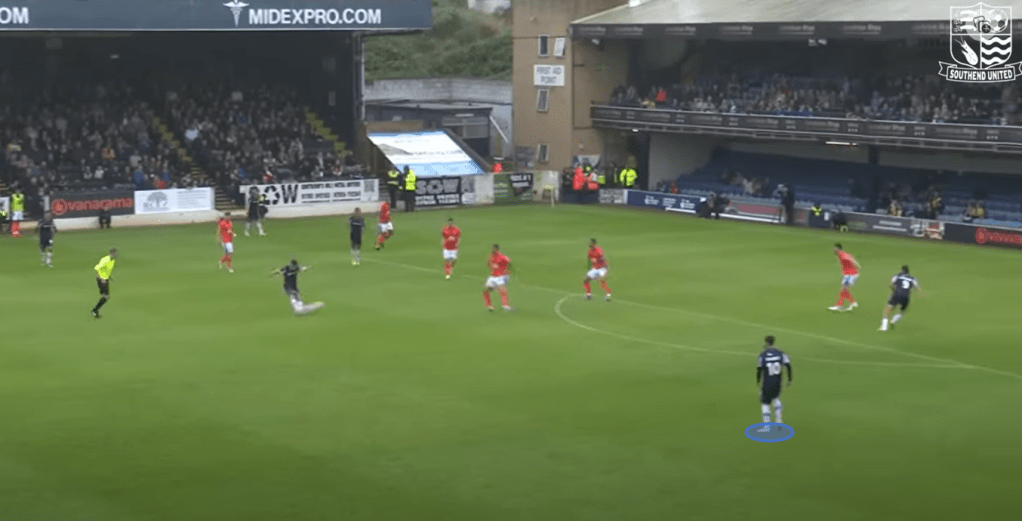
The issue with this, is that it would often leave our #9 Harry Cardwell isolated as we don’t have any central-midfielders who like to arrive late in the penalty area to get on the end of crosses to ‘box crash’. The only player we have who shows this consistently enough is right wing-back Gus Scott-Morriss, but he often has too far to travel from the right flank to get into the penalty area when we attack from our left side, and is asked to hold the width when we attack from our right rather than invert into the midfield, so obviously can’t do both. It also meant that Mooney would often be asked to receive the ball more centrally, whereas we’ve already established that he likes to find space out wide before either carrying the ball inside the pitch, or drifting inwards to find pockets of space by going unnoticed, rather than already being picked up by opposing central-midfielders or centre-backs who are more physical than him. We did try to rotate Scott-Morriss and Mooney when he was on the pitch to find Mooney out wide, but we could only do this consistently enough once we had settled possession in the final-third, once we had time to invert Scott-Morriss from the wing.
The above all makes it extremely difficult to include Mooney in the starting XI regardless of the game-state. If we’re winning and generally have more defending to do for example, we may have to attack through transitions more frequently, presenting us with fewer opportunities to ‘get set’ in our attacking shape, and for Mooney to attack from his right half-space area. In fact, when we were ahead in matches during the 2022/23 season, a higher percentage of our total passes were classed as ‘long passes‘ (19.21% compared to 17.36% when level, and 14.52% when behind). This meant that we’d have more second-balls to challenge for when ahead after going long, which doesn’t suit Mooney’s profile. When we were behind in 22/23, we pressed from the front with greater intensity than at any other game-state (8.4 Passes allowed Per Defensive Action [PPDA], compared to 9.1 PPDA when level, and 11.48 PPDA when ahead), which helped us to have a larger possession share (62.58% possession when behind, 53.62% when level, 47.49% when ahead). This greater possession share allows us more time to ‘get set’ in our attacking shape, and allows Mooney to attack from the zone that he likes to on a more consistent basis.
It therefore makes sense to use Mooney in specific game-states, when we have lots of possession or need to break down a team who are sitting deep, for example. However there was such a huge expectation attached to the signing, that it’s unrealistic to expect him to only be used in certain game-states. I just think that his role in our formation doesn’t allow him to be used in all game-states, whereas Altrincham’s did because he defended out wide as part of a front three where there was less emphasis on physicality, and he was constantly able to find space out wide before moving inside the pitch, whereas at Southend there were fewer opportunities where we could find him in his favoured area of the pitch.
Off-the-pitch situation
To round off Mooney’s time at Southend, we need to consider the off-the-pitch situation at the club, and how this may have affected him. Mooney was just 23-years-old when he joined the club in 2022. He moved from the other end of the country into a new area, playing with new teammates, working with new coaches, and had to deal with a lot of uncertainty around the club for almost his entire Southend career, as well as any other off-the-pitch issues he may have had to deal with. Just because our other players potentially have performed to a higher standard doesn’t mean we can just write-off the effect that the situation at the club may have had on Mooney.
Mooney performed very well for Altrincham in the 2021/22 season, particularly at home, where he scored 10 of his 12 goals and claimed all five of his assists. This is partly because Altrincham pressed from the front with greater intensity at home than they did away (9.57 PPDA at home compared to 11.55 PPDA away from home), helping them to have a greater possession share (55% possession at home compared to 50.67% possession away from home), and attack with more regularity. However, we can’t underestimate the effect that performing at familiar surroundings had for Mooney.
Conclusion
Personally, I’m absolutely gutted that we didn’t get to see the best of Mooney during his time at Roots Hall. There were enough glimpses of quality to prove to me that he has undoubted ability for this level at least, although he did struggle for consistency.
Injuries and trying to fit Mooney into a new formation played a part in why Mooney struggled in his first season at the club, as well as his lack of composure in front of goal and ball-striking technique, especially when he was signed with such large expectations – although I think there was an over-expectation placed on his goalscoring ability when we consider his xG at Altrincham. A new role this season which reduced his out-of-possession responsibility helped to try and replicate his off-ball role for Altrincham, but we were still unable to find him in his favoured area consistently enough. This led to him no longer being a valid option at any game-state, which isn’t good enough for a player who was signed to be a regular starter, and his whole time at the club was surrounded by an off-the pitch situation that he had to deal with as well as all the usual aspects of signing for a new club in a different area.
I have no doubt that if Mooney finds a club where he fits the system optimally, and one where he is able to play within a better environment – which can’t be underestimated – he will thrive at this level once again.
 Shrimper Stats
You must be logged in to post a comment.