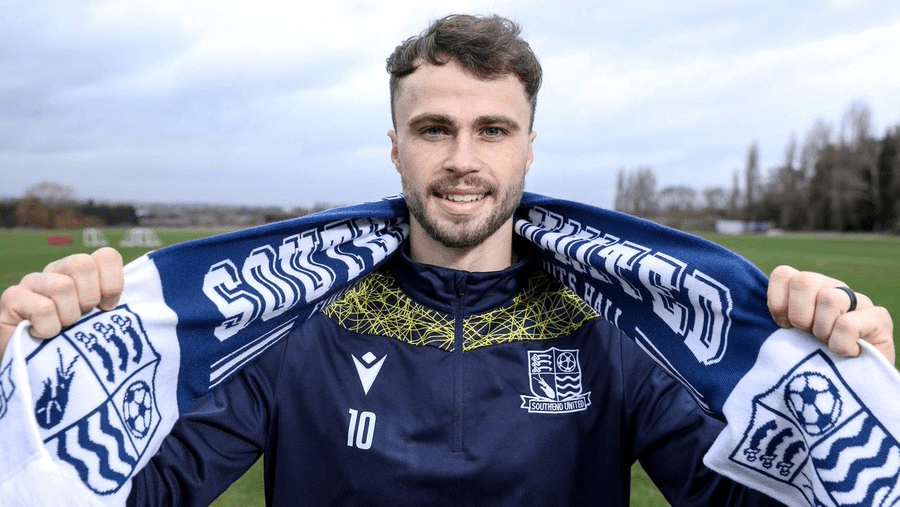
Southend United recently announced the signing of midfielder James Morton from Weston-super-Mare of the National League South – our first signing since the lifting of our 15-month-long transfer embargo.
In this article I will explain Morton’s profile, assess his strengths and weaknesses, and suggest where he may fit into Southend’s system.
Profile
Morton is a left-footed central-midfielder. He usually played on the left-side of Weston-super-Mare’s double-pivot in midfield, in their 4-4-2 or 4-2-3-1 formation.
At 24-years-old, Morton aligns nicely with our recruitment policy where we mainly look to sign players who are at an age where there is still room for improvement and have re-sale value.
In-possession: First and second phases
In-possession, Morton is extremely comfortable on-the-ball, is press-resistant enough to evade challenges from opposing players, and can successfully play a high volume of passes consistently. This last point is important, as – despite playing in a double-pivot for Weston-super-Mare (where the pass volume may be shared between their two central-midfielders) – Morton should be reliable enough to play as the sole #6 at the base of our midfield ‘diamond’ (Cav Miley’s position).
From an interview with Southend United’s official website, Morton identifies himself as someone who likes to receive the ball from the defence during the first-phase of build-up, before progressing it up the pitch during the second-phase.

From the below video compilation that Weston-super-Mare have posted, we can also see that Morton can demonstrate a great passing range. This helps his side to switch the play quickly from one side of the pitch to the other, catching their opponents out if they can’t shift their defensive block across the pitch quickly enough.
Morton can also carry the ball forwards well once space opens up ahead of him.
From the below data visualisation, we can see that Morton ranks extremely well at a range of passing metrics when compared to other defensive or central-midfielders in the 2023/24 National League North and South seasons. He is not only able to attempt a large volume of passes, but can also successfully complete a great deal of them, too.
This is important as it will help us to maintain possession for longer periods. Clearly, if your central-midfielder isn’t able to consistently keep possession, the ball will be turned over more frequently. This will ultimately lead to you seeing less of the ball, and having more defending to do – particularly through dangerous transitional moments if you lose possession closer to your defence. The flip-side to that is, if your central-midfielder can both reliably receive and make a high volume of passes, you’ll be able to exert more control on the match, forcing your opponents to concentrate for long periods as they won’t have as much of the ball. This is particularly important if you use a single-pivot in midfield, as we do.
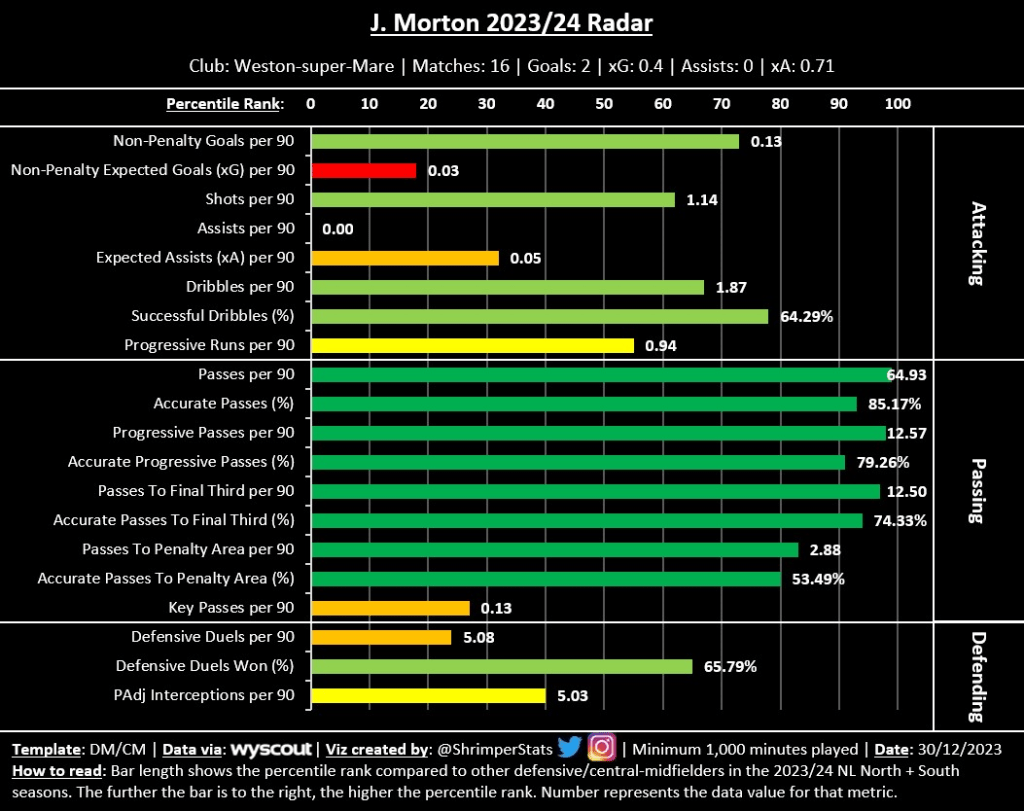
But it isn’t just about having the ability to receive and successfully attempt a high volume of passes. If your central-midfielder is constantly attempting a lot of risky passes, typically over long distances, it’s unlikely that they will all be successful. This has the same effect as if they didn’t possess the ability for play to consistently go through them in the first place, as the result is the same: turnovers of possession.
It’s not just about having the ability to play nice long passes; it’s having the knowledge of when to keep it simple to exert control, and when to be a bit more adventurous if the space is there. The fact that Morton ranks well at both attempted passes and successful passes at different metrics suggests that he is a good fit for this deep-lying playmaker role.
Out-of-possession
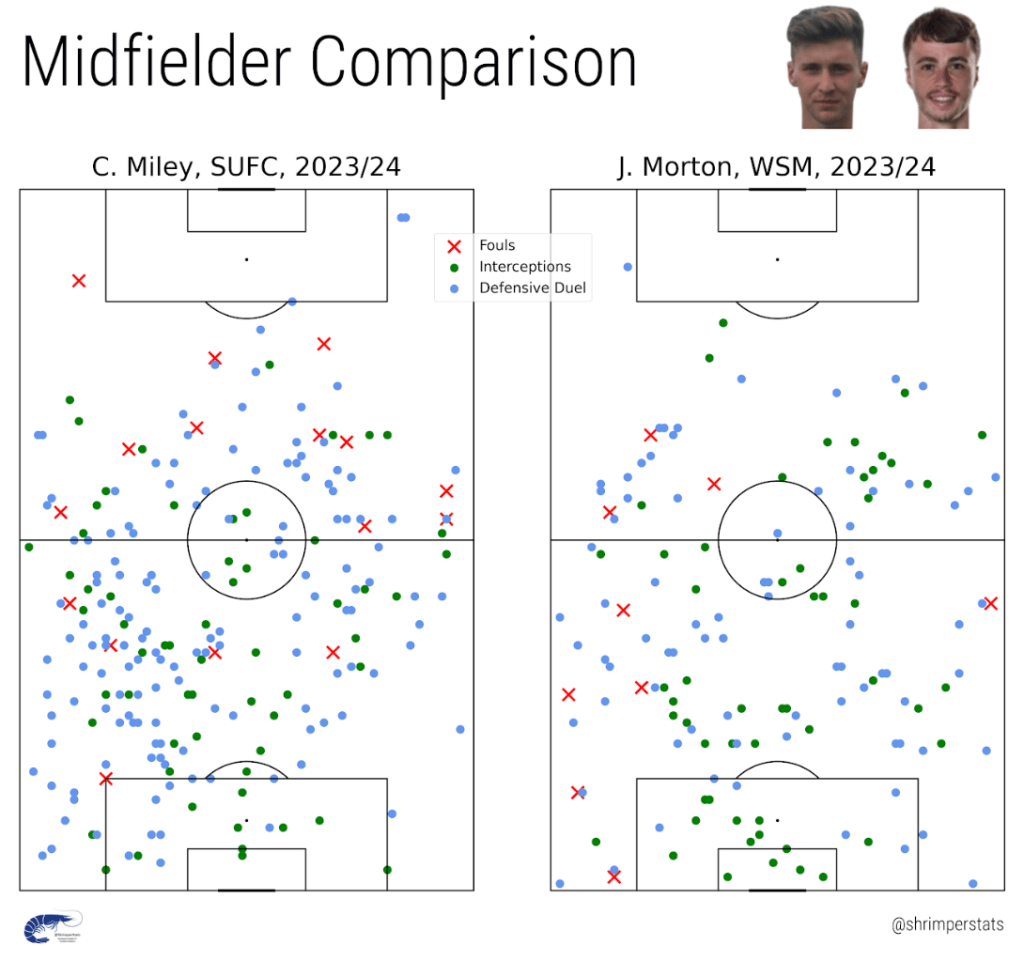
Although Morton is a decent height, he’s fairly slight in build. Cav Miley and Noor Husin (who have both played at #6 for us so far this season) are more compact and therefore stronger when attempting defensive duels.
When we compare Morton’s defensive numbers to Miley’s (who is our first-choice #6), we can clearly see that Miley is the stronger of the two defensively. This season for Weston-super-Mare, Morton won 65.79% of his 5.08 defensive duels per 90 minutes, whereas for us Miley has so far won 77.18% of his 8.79 per 90. Miley has also made more interceptions per 90 minutes (5.71) than Morton’s 5.03.
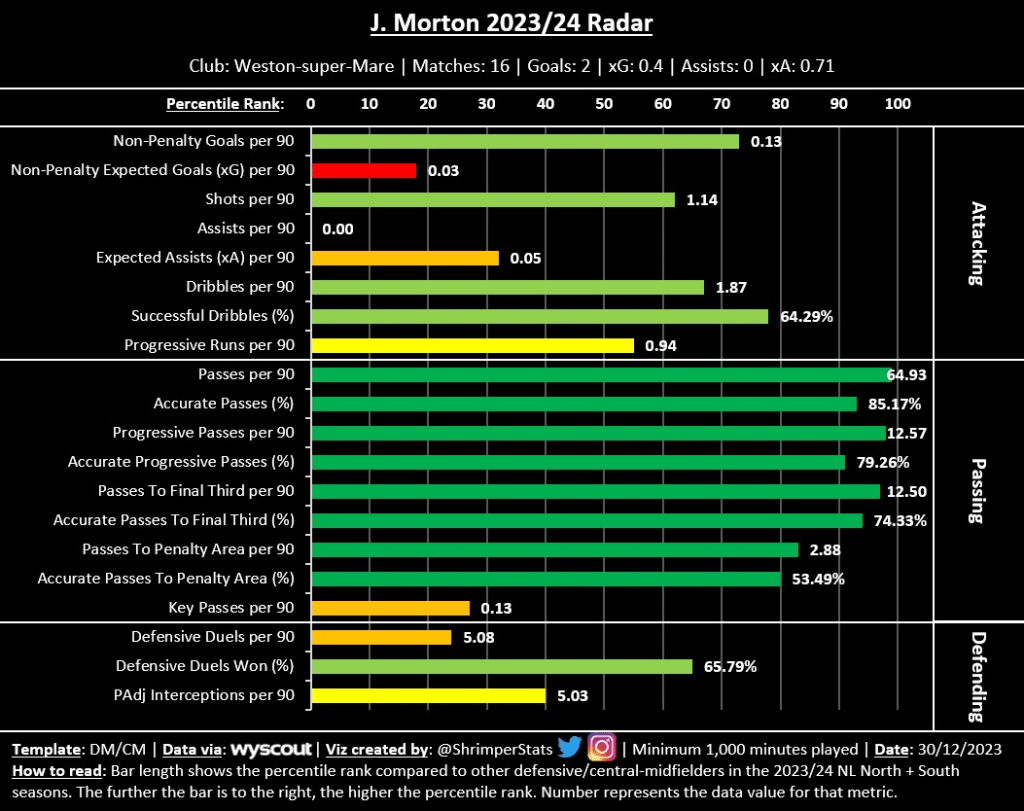
Miley not only possesses top ball-winning ability, but can also reliably play a high volume of passes – a quality that I’ve already explained is vital for a central-midfielder in a possession-based side. It’s this combination of ball-winning and ball-playing ability that makes Miley arguably the best #6 in the National League, and somebody who walks into our side when available.
I don’t think that Morton is strong enough defensively yet to anchor our midfield three as reliably as Miley can. However, he doesn’t turn 25-years-old until the end of the current season, so there’s plenty of time left for him to improve. As I’ve already mentioned, Morton is a decent height, so if he can become a bit more robust in build it will help him to be stronger in defensive duels. We’re also in a fortunate position where Miley is our undisputed first-choice #6, and we can afford to develop Morton into a more well-rounded #6 before he makes that position his own in the medium to long-term.
Final-Third
Throughout this article, I’ve been assessing Morton’s ability as a #6 to play at the base of our midfield ‘diamond’. However, I believe he may also be used further forwards in the left-sided #8 role where Wes Fonguck currently plays. In an old interview with The Athletic, the term “quarterback” was used to describe him, with Morton also identifying that he’d like to develop into more of a #8.

We currently have five central midfield options: Miley, Morton, Husin, Oli Coker, and Fonguck. Kevin Maher may see this as enough depth in this area of the pitch, however I would still like one more option here, as I will now explain why.
Although Morton is extremely comfortable on-the-ball in deeper areas of the pitch, as I’ve already spoken about, he strikes me as a player who likes to play behind the ball when we’re into the final-third. By this, I mean that he seems unwilling to forward runs beyond opposition defences, and is much more comfortable sitting on the edge of the penalty area where he can offer a passing option to help circulate possession.
He seems different to Fonguck, for example, who likes to make forward runs from his left-sided #8 position beyond our left wing-back Jack Bridge, who holds the width on our left-side. This is particularly important, as it helps to drag players away from Bridge, and means he’s less likely to be doubled-up on, if Fonguck were more static. It also creates space for Bridge to cut into, onto his stronger right foot.
Morton doesn’t seem to be this type of player to me, but if he can make these forward runs beyond Bridge, due to his left-footedness he’ll be in prime position to cross the ball into the penalty area if he receives a through pass. Currently, when Fonguck receives through passes after making these forward runs beyond Bridge, he often has to cross the ball with his weaker left foot, or cut back and miss the opportunity to get the ball into the penalty area.
Also, because he doesn’t have a low centre of gravity, Morton doesn’t seem to have the close-control necessary to receive the ball in tight spaces in the final-third, where the space is typically more condensed. He therefore looks more comfortable when play goes through him in deeper areas where he’s able to find space easier.
Morton may also be used in that left-sided #8 role to help us maintain possession better, if certain match conditions needed us to do so. For instance, if we were ahead in a match and needed to control possession better to prevent our opponents from having as much of the ball, we could use Morton there. However it would potentially change the dynamics of how we attack down our left-side, due to Morton and Fonguck’s different profiles.
Conclusion
To conclude, Morton seems to fit in well with our recruitment policy, will massively benefit our build-up play, and is a player who we should be able to afford the time to develop into a well-rounded #6, due to his age and as we already have Miley in that role. I don’t believe that Morton is strong enough defensively yet to anchor our midfield reliably out-of-possession, and if my initial instinct is correct, he may not be able to offer us what Fonguck offers us in the final-third. However, he’s at an age where he can still develop some of these attributes that he’s currently lacking, and I wouldn’t be surprised to see him play in our left-sided #8 role during certain game-states.
 Shrimper Stats
You must be logged in to post a comment.