On Friday evening, Southend United announced the signing on former Rushall Olympic striker Danny Waldron. The 27-year-old has signed an initial one-and-a-half-year contract, and joins having scored 16 goals in 24 matches in this season’s National League North.
In this article, I will assess how Waldron may fit into Southend’s system in each of the following phases of play: build-up, final-third, out-of-possession and set-pieces.

Build-up
Even though Waldron is a striker, he will still have an important role to play during our build-up phase. Southend are a side who aim to play the ball out from defence, before progressing it forwards safely. However, if we are up against sides who implement an out-of-possession approach which makes this difficult for us, we look to play long passes up towards our #9 – usually our top goal-scorer Harry Cardwell.
Cardwell has been injured since early-December, and has yet to return to the matchday squad. Due to the transfer embargo preventing us from bringing in new players up until recently, for a number of matches we were forced to line up without a recognised #9 on the pitch. Henry Sandat, Jack Wood and Mauro Vilhete were all used up front at the top of our 3-5-2 formation. However, Sandat and Wood are far more comfortable playing off of a target-man, where they can challenge for the second-balls which arise after the initial aerial duel, and utility-player Vilhete isn’t a striker at all, really. Our big centre-back Brooklyn Kabongolo was even tried as a #9 for a few matches!
Up until Marcus Dackers returned to the club on loan from Salford City until the end of the season, Southend lacked a recognised #9 in Cardwell’s absence who was able to offer a physical presence up front to effectively challenge for aerial duels, to give our other players a chance of winning those second-balls which they could initiate attacks from.
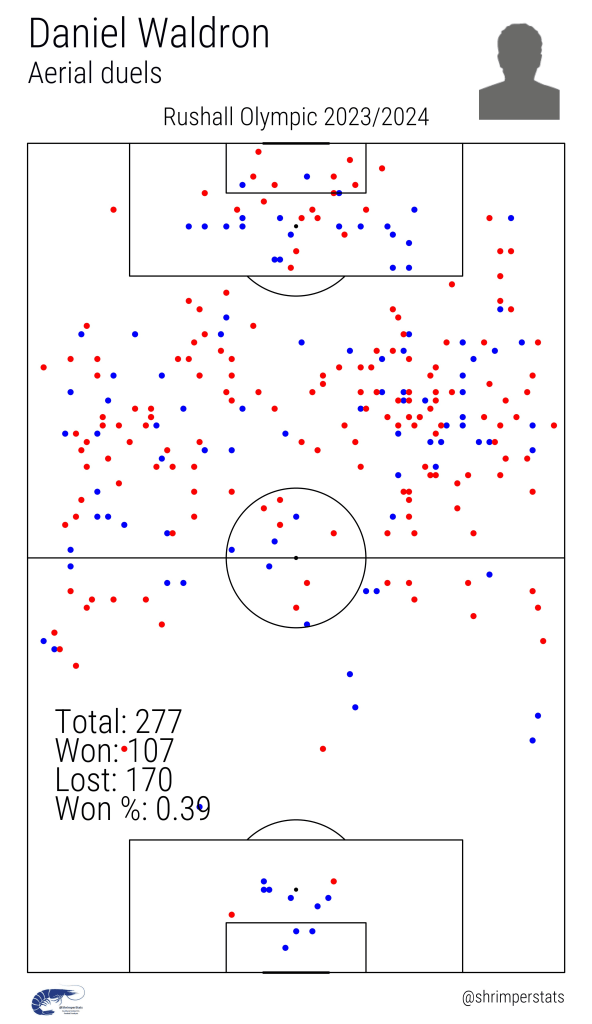
When we look at the below map which visualises Waldron’s aerial duels this season for Rushall Olympic, we can see that there are a good number of aerial duels across the third-quarter of the pitch. This is significant, because this is where the aerial duels that took place once Rushall went long towards Waldron from their defence would likely occur.
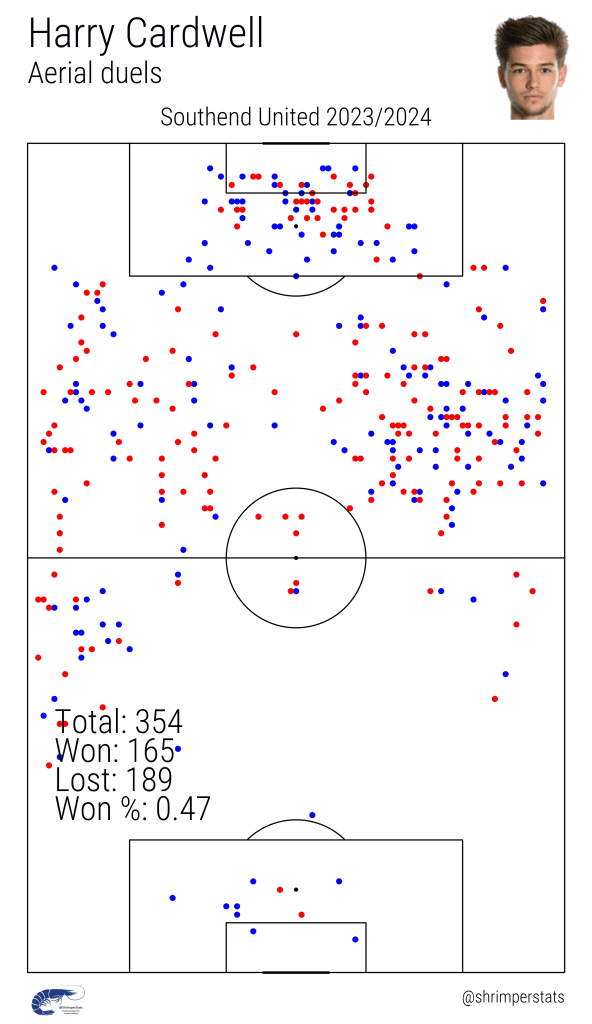
When we compare the above to Cardwell’s aerial duels map for this season, we can also see that Cardwell attempts a large volume of aerial duels right across that same third-quarter of the pitch. Although Cardwell has attempted and won more aerial duels than Waldron so far this season, and has a better aerial duel success rate (%), six-foot-tall Waldron still possesses the necessary height and strength required to effectively challenge for aerial duels in the same way that Cardwell can. As Wyscout (the data provider who’s data I have access to) consider aerial duels won in favour of the player who touches the ball first, no matter what happens next, it’s less about making successful aerial duels, and more about offering a physical presence which allows you to effectively challenge for these aerial duels in the first place.
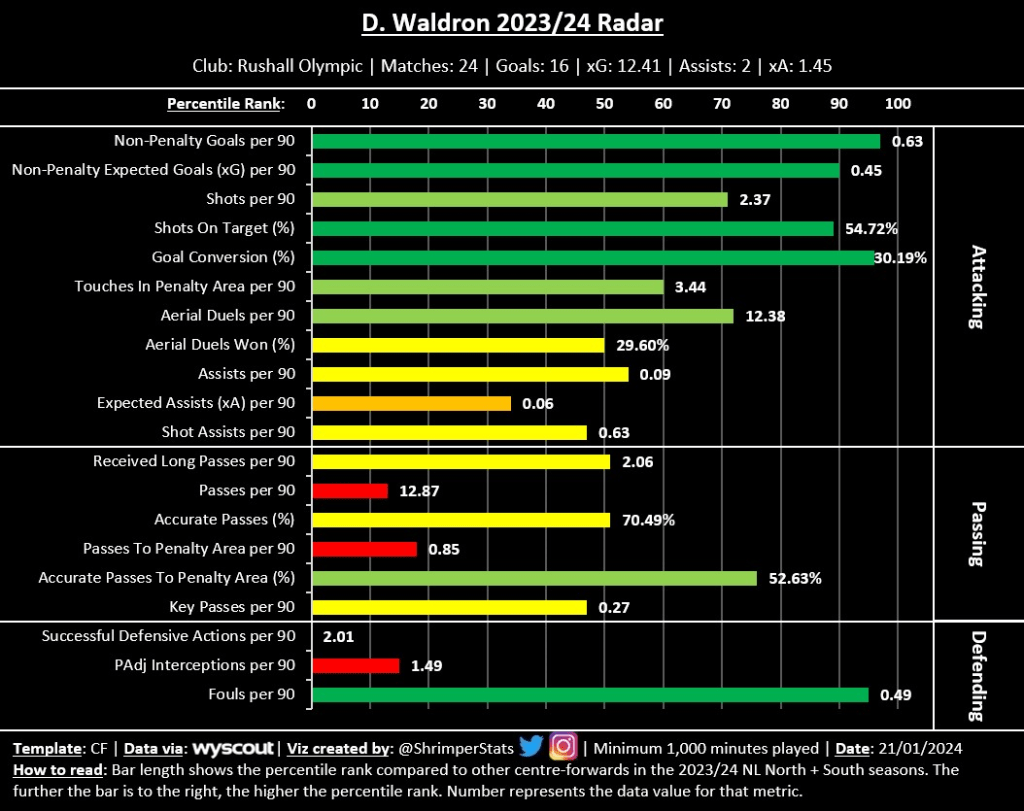
Even if we were focussing on how Waldron’s aerial duel stats aren’t as impressive as Cardwell’s, Waldron still ranks above average at attempted aerial duels per 90, aerial duels won (%) and received long passes per 90, when compared to other centre-forwards in the National League North and South this season, as illustrated below.
In addition to Cardwell’s physicality – which makes him an effective target-man to be able to effectively challenge for aerial duels when we play over opposing sides towards him – he is also athletic enough for us to play beyond defences for him to run onto. This can help us to either gain territory high up the pitch, or find Cardwell running towards goal one-on-one with the goalkeeper.
Although Dackers’ height makes him an effective target-man, he lacks the same athletic profile as Cardwell does, and therefore isn’t able to offer exactly what Cardwell can during our build-up phase. Dackers is someone who is more comfortable using his frame to occupy opposing defenders, receiving the ball to feet, rather than running in-behind. Waldron has a very impressive athletic profile. Although not as strong as Cardwell, his height will give us a target to aim for when we go long from defence, and his stride length enables him to possess good acceleration for those occasions where we play passes beyond opposing defences for him to run onto.
Although we’ve brought Dackers back to the club on loan, and Cardwell seems to be nearing a return to action – so our need for a proper #9 isn’t as vital as it once was, I believe that Waldron also possesses the necessary attributes to lead the line himself.
However, Waldron is also able to play off of a target-man himself. This is possible due to his ability on-the-ball. He’s intelligent enough to drop between the lines into space to receive the ball from the midfield, and his quick feet and physicality allows him to shield the ball from opponents. Waldron is also a powerful runner with the ball.
This signing gives us great versatility. We now have three options who can play as a #9, with Callum Powell, Sandat and Wood as our second-striker options, but we can also go with two bigger, more powerful strikers due to Waldron’s close control, which allows him to drop deeper.
Final-third
Clearly, as a striker, Waldron will largely be judged on his goal return and how he contributes in the final-third of the pitch. As previously mentioned, Waldron scored 16 goals in 24 matches for Rushall Olympic in the National League North this season. However, it’s not only Waldron’s goal return which makes his ability in front of goal impressive.
Waldron scored an incredible 0.63 non-penalty goals per 90 minutes for Rushall this season, ranking him extremely well compared to other centre-forwards in the National League North and South. However, he also generated an expected goals (xG) figure of 0.45 per 90, illustrating that he was able to regularly get into good goalscoring positions to receive high-quality chances. Waldron did outperform his xG when we compare this to his actual number of goals scored (16 goals vs. 12.41 xG), but as he only moved up to National League North level in the summer, we don’t have enough data to infer whether this was down to good finishing, poor goalkeeping, or luck. However, Waldron also got over half of his shots on-target this season, and converted almost one in every three of his shots into goals. These last two statistics allow us to imply that Waldron’s overperformance in front of goal was in fact predominantly to do with good finishing.

Waldron’s output in front of goal is even more impressive when we consider that his former side, Rushall Olympic – who currently sit 17th in the National League North, have only averaged a 48.2% possession share this season. This means that, generally speaking, they will see less of the ball, and consequently struggle to create a high volume of dangerous moments compared to other sides. So far this season, Rushall have an xG of 37.81, average 10.48 shots per 90, and manage on average 14.55 touches in the opposition penalty area per 90 – ranking very average at all three metrics, compared to other sides in the National League North and South.
Below is a shot map, visualising all of Waldron’s non-penalty shots for Rushall Olympic this season. The larger the dot size indicates a larger expected goals (xG) value (i.e. the larger the dot size, the higher the chance of that shot resulting in a goal). Dots coloured in dark blue represent shots on-target, dots coloured in light blue represent shots off-target, and dots with a red border represent goals. As we can see from the below, Waldron was very good at getting into goalscoring positions in and around the six-yard box – where the likelihood of converting those shots was very high.

When we look at Cardwell’s shot map from this season’s National League for Southend, we can see that he also takes a lot of shots from in and around the six-yard box. Waldron also puts up similar numbers to Cardwell, in the sense that they get a similar percentage of their shots on-target, both are similar in terms of how many goals they score per shot they take, and their average xG per shot is also similar.

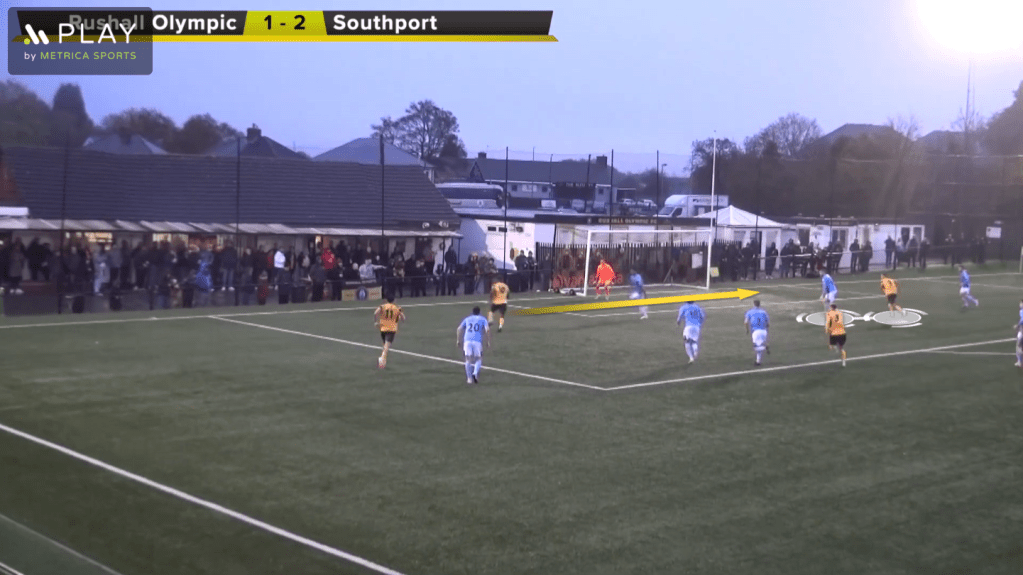
When we analyse Waldron’s game a bit deeper, it’s clear that he has very intelligent off-the-ball movement, where’s able to receive passes in the opponent’s penalty area in space. In the below example versus Southport, Waldron created separation from his marker by making a run towards the back post, where he was found in the six-yard box by a teammate who crossed the ball from the left-side of the pitch.
Although this isn’t the main part of his game, Waldron’s height will also give us a target to aim for from crosses into the penalty area, in the same way that Cardwell does. From the below data visual, we can see that Waldron has attempted a decent number of aerial duels at the top of the pitch in the opponent’s penalty area for Rushall Olympic this season.
Out-of-possession
Southend are a side who attempt to press the opposition aggressively from the front when we are out-of-possession. The aim of this, quite clearly, is to make it difficult for the opposition to possess the ball for long spells. If we prevent our opponents from having the ball, it allows us to have more possession, helping us to have a greater control on matches where we can exert our dominance, and gives us more opportunities to attack, ourselves.
If we’re unsuccessful in our press, or unwilling to press in the first place, all we’re doing is making it easier for our opponents to progress the ball forwards safely, where they can push us back towards our own goal. They can then sustain attacks easier, giving them a greater chance of scoring, and forcing us to concentrate for long spells as we have more defending to do. By pressing our opponents, we try to either turn possession over high up the pitch where we can initiate dangerous attacks, or force them into playing long, risky passes, where we can hopefully win possession back, or win second-balls before initiating attacks ourselves.
Harry Cardwell epitomises our high press, as he is able to not only use his athleticism to move around the pitch quickly, but also has the mental attributes required to have the willingness to be a hard-worker in the first place. It’s one thing having the physical attributes necessary to be an effective presser of the ball, but another thing all together having that determination and selflessness to have the willingness to help the team out out-of-possession. Of course, good coaching will then help to teach players how to press, in terms of their movement, too.
Danny Waldron possesses all of the required physical attributes to be an effective presser of the ball. His long stride length allows him to cover ground quickly, and gives him great acceleration. Despite his height, he is also able to change direction quickly. Once he’s had time to learn what is expected of him out-of-possession, and as long as he has the willingness to be a hard-worker, he should be able to fit into our system in this phase of play with ease.
Set-pieces
As has been mentioned throughout this piece, Waldron’s height will give us a target to aim for when we cross the ball into the penalty area. This will also be the case during offensive set-pieces, whether this be from corners or free-kicks. However, Waldron should also be an asset during defensive set-pieces – if he is brought back into our penalty area during these moments.
Above, we can see a map visualising all of Waldron’s aerial duels for Rushall Olympic during this season’s National League North. Notice how there are not only aerial duels at the top of the pitch in his opponent’s penalty area, but also within his own penalty area. When we compare this to Cardwell’s aerial duel map from this season, he again has a decent number of aerial duel attempts in his own penalty area. Cardwell’s usefulness during defensive set-pieces is yet another phase of play that he excels at, which is only possible due to the all-round nature of his game. Although it looks like Cardwell attempted more aerial duels than Waldron in his opponent’s penalty area, we also have to consider that Southend make on average 17.97 crosses per 90, compared to Rushall’s 12.78 per 90 – therefore giving Cardwell more opportunities to challenge for aerial duels in the first place. Waldron has the physicality to be able to replicate Cardwell’s effectiveness at offensive and defensive set-pieces.
Conclusion
Danny Waldron represents a real ‘statement signing’ for Southend United. Waldron was the joint-top goal-scorer in the division below ours, is at an age where he’s in his prime, fits our system very well, and has a very impressive athletic profile.
Waldron’s height and strength will give us a target to aim for when we go long from defence, and enables him to be effective in both penalty areas. His stride length enables him to possess good acceleration which can be used both in and out-of-possession, and his close control allows him to drop between the lines into space to receive the ball from the midfield, where he can use his strength to shield the ball from opposing players. His unique profile allows him to play either as a target-man or as more of a second-striker, giving us tactical flexibility. In my recent recruitment plan, I identified Waldron as my #1 recommendation when looking for similar players to our top goal-scorer Harry Cardwell.
Of course, it will be a step up for Waldron. This will be the highest level that he’s played at, and the first time he’s been a full-time footballer in his career. However, there’s risk attached to every signing that every club makes, and Waldron possesses all of the necessary physical attributes required to be a success at Southend. His goal return also speaks for itself, and in addition to his intelligent off-the-ball movement in the penalty area, a number of key statistics help us to imply that he is a natural goal-scorer.
 Shrimper Stats
You must be logged in to post a comment.