Southend United recently announced the signing of 23-year-old centre-back Adam Crowther from National League North side King’s Lynn Town on an initial two-and-a-half-year contract.
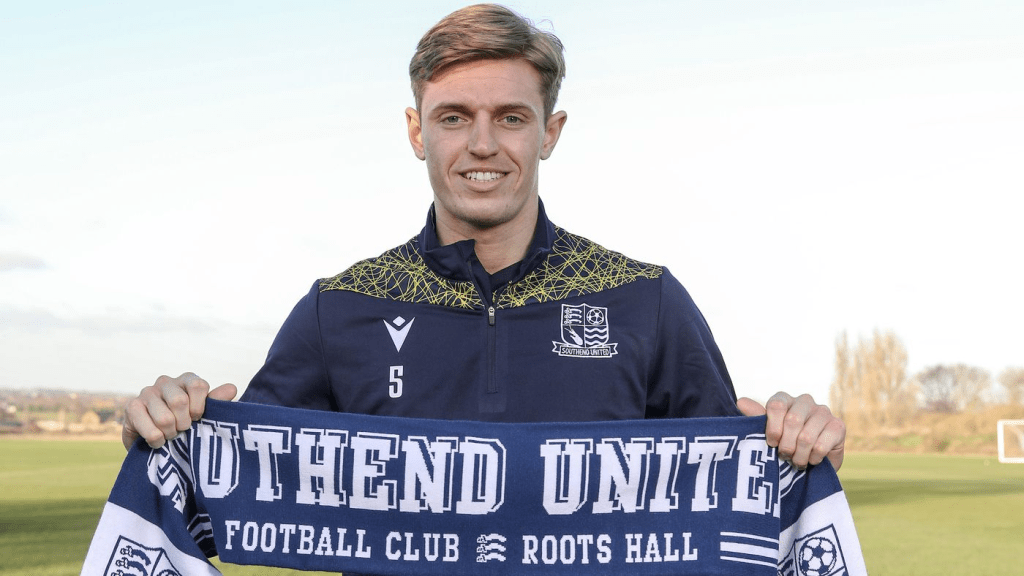
In this article, I will assess how Crowther may fit into Southend’s system in the following phases of play: attack, defence, defensive transitions, and offensive set-pieces.
Attack
Despite being a centre-back, Crowther will still have an important role to play during the first-phase of our build-up. Southend are a side who aim to progress the ball forwards safely from defence, and to fit into this system optimally, it is essential that you’re comfortable on the ball – irrespective of what position you play.
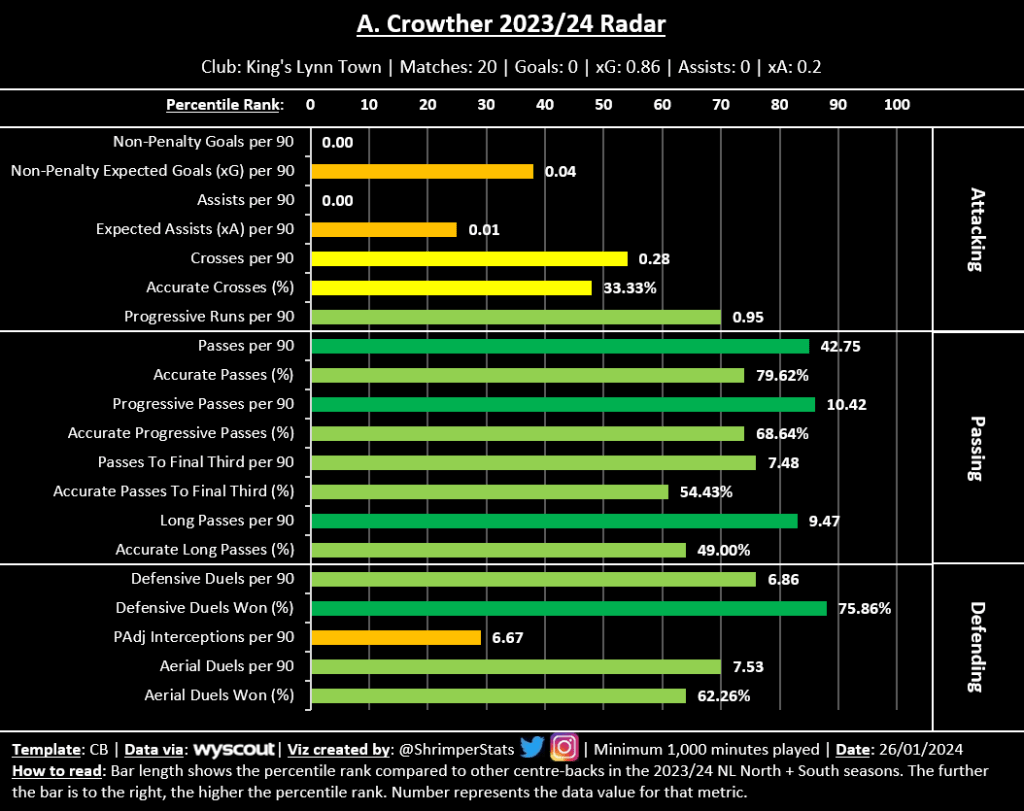
The six-foot-four centre-back ranks well at a range of passing metrics when compared to other centre-backs in the National League North and South this season, as illustrated by the below data visualisation.
The below image visualises all of Crowther’s attempted passes during the 2022/23 season for King’s Lynn. Successful passes are highlighted in blue, whilst unsuccessful passes are highlighted in red. As we can see, there is a high volume of passes on the right-side of the pitch. Crowther played on the right-side of a back three for King’s Lynn, and will challenge Harry Taylor and the currently injured Louis Lomas for a place in the side in the right-sided centre-back position.
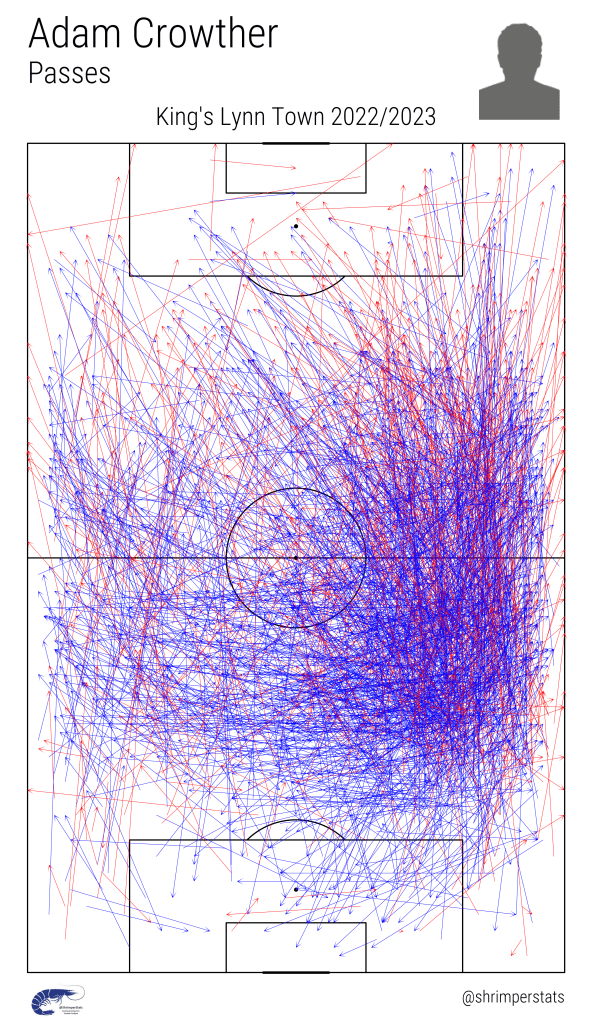
On first viewing, Crowther looks more comfortable than Taylor in-possession. Taylor’s height makes it more difficult for him to move the ball effectively because he doesn’t have a low centre of gravity, but Crowther doesn’t seem to have the same issue, despite his height. Long-term, if Crowther can in fact offer us more in-possession than Taylor, it could mean that he makes this spot in our side his own, especially when we consider that he’s just 23-years-old and still has a lot of room for improvement.
Again using the above pass map, we can see how Crowther is able to successfully play a lot of switch passes from his right-sided centre-back position towards the left-side of the pitch. This is significant, as this ability to switch play effectively is something that we lost when Shaun Hobson departed the club last summer, and it isn’t something that Taylor has been able to replicate. This season, Taylor has completed 40.7% of his 5.91 long passes per 90 minutes, whereas Crowther has completed 49.0% of his 9.47 long passes per 90.
The reason that these switch passes are important, is that a lot of our attack comes down our stronger left-side. This is where Jack Bridge, Wes Fonguck and Nathan Ralph link up, and they offer a much greater final-third creative threat compared to our right-side of Gus Scott-Morriss, Noor Husin and Harry Taylor. If we have the ability to switch play from one side of the pitch to the other, we can find our wide players in space before our opponents can shift their defensive block across the pitch. This space can then be exploited, and we won’t have to rely as much on Bridge’s 1v1 ability, or Fonguck and Ralph’s off-the-ball movement to create separation from opposing defenders, as it will already exist.
One last thing that I want to mention in this section is how Crowther may help us in the final-third from open-play. Crowther is able to carry the ball forwards, or even make overlapping runs beyond our right wing-back Scott-Morriss. However, due to his size, I don’t think he’s athletic enough to consistently make these overlapping runs with the same regularity as Nathan Ralph does on our left-side. Ralph has made 1.85 crosses per 90 minutes this season, whereas Crowther has made 0.28 crosses per 90.
This isn’t necessarily a bad thing, as Taylor has made a similar 0.50 crosses per 90 minutes this season, but I’m not sure that this will help our system longer-term with respects to improving our right-side dynamics in the final-third. The reason that our left-side is so strong in the final-third, in addition to Bridge’s excellent ability to create separation from his marker, is because of Fonguck and Ralph’s off-the-ball movement. If Crowther can’t replicate what Ralph gives us in this phase, it places a huge importance on Scott-Morriss and Husin to improve the creative output from our right-side, and may mean that we continue to offer a far greater threat from one side of the pitch compared to the other, which isn’t ideal.
Defence
As has previously been mentioned, Crowther played on the right-side of a back three for King’s Lynn, and this is where I expect him to play for us. Below is a map showing all of Crowther’s interceptions, defensive duels and fouls for King’s Lynn during the 2022/23 season. Again, we can see a lot of defensive work has come from the right-side of the pitch.
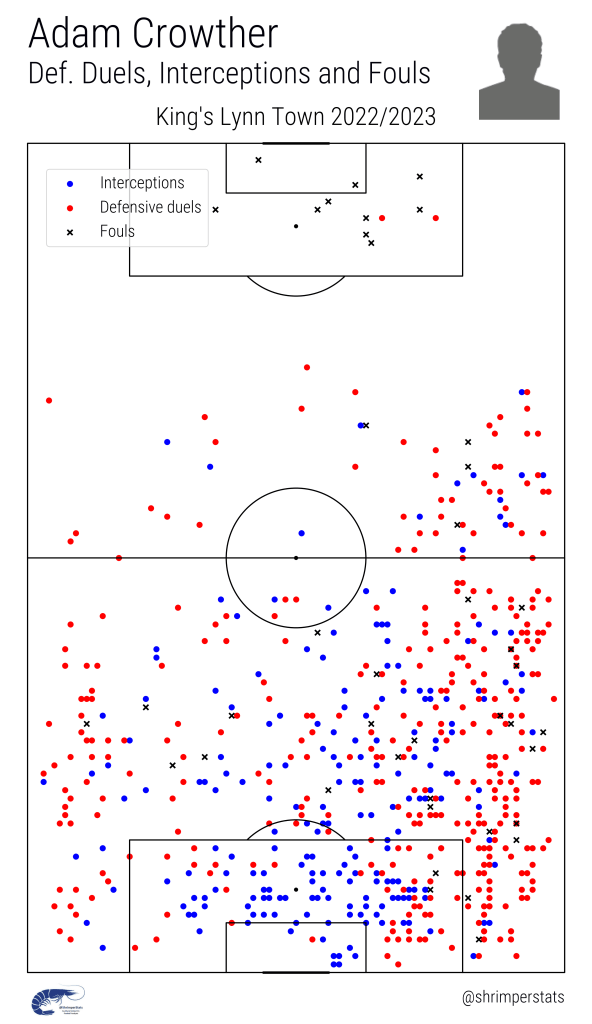
Crowther is six-foot-four and very strong. When we are defending deep in our own penalty area, he is physical enough to be able to win a large amount of defensive duels and aerial duels against physical forwards.
Even though Crowther played predominantly on the right-side of a back three for King’s Lynn, I also believe that he has the physicality and leadership qualities to be able to play at the heart of our defence. Ollie Kensdale is undoubtably our first-choice central centre-back, but with the recent departure of Brooklyn Kabongolo, we are short of cover options for this role. Now that Kabongolo has left, I don’t think it’s wise to bring in a defender who can only play in the middle of a back three, as game-time would be very limited when we consider Kensdale’s availability and place in the side being secure. It therefore makes sense to me to have someone who can cover a couple of positions across the back three, as game-time may more frequent – and Crowther fits this perfectly.
I also believe that, until he has cemented his place in our XI, Crowther may cover the left-sided centre-back role when needed, in the same way that Kensdale, Kabongolo and Lomas have done in the past. However, I don’t think that this is ideal, for reasons that I have mentioned earlier in this scout report, in addition to the fact that Crowther is right-footed and wouldn’t be able to overlap Bridge as effectively as Ralph does currently.
Defensive transitions
Our current first-choice right-sided centre-back, Harry Taylor, is excellent at defending large spaces. The type of space that may open up when defending transitions and opposition counter-attacks. His height gives him good acceleration, and his ability to use his frame to effectively deal with these situations is, in my opinion, his greatest strength.
Although Crowther has a different physical profile to Taylor, he still has very good anticipation which makes up for his slight lack of pace. His ability to read the game allows him to position himself where he may get a head-start on opponents. If, however, he isn’t able to get to the ball before his opponent, due to his size which gives him a slight lack of mobility, he may struggle when up against dynamic players out wide, who may be able to change direction quickly, and are faster than Crowther.
In the below data visualisation, we can see that Crowther made a lot of defensive actions out wide on the right-side of the pitch, demonstrating his ability to defend the wide spaces.

Offensive set-pieces
It isn’t just in his own penalty area where Crowther is able to win aerial duels. His height and strength makes him a threat from crosses into the opposition’s penalty area – particularly from offensive set-pieces. In the 2022/23 season for King’s Lynn, Crowther scored seven goals, and below is a shot map visualising all of Crowther’s shots that he took. The larger the dot size indicates a larger expected goals (xG) value. Dots highlighted in dark blue represent shots on-target, dots in light blue represent shots off-target, and dots with a red border represent goals.
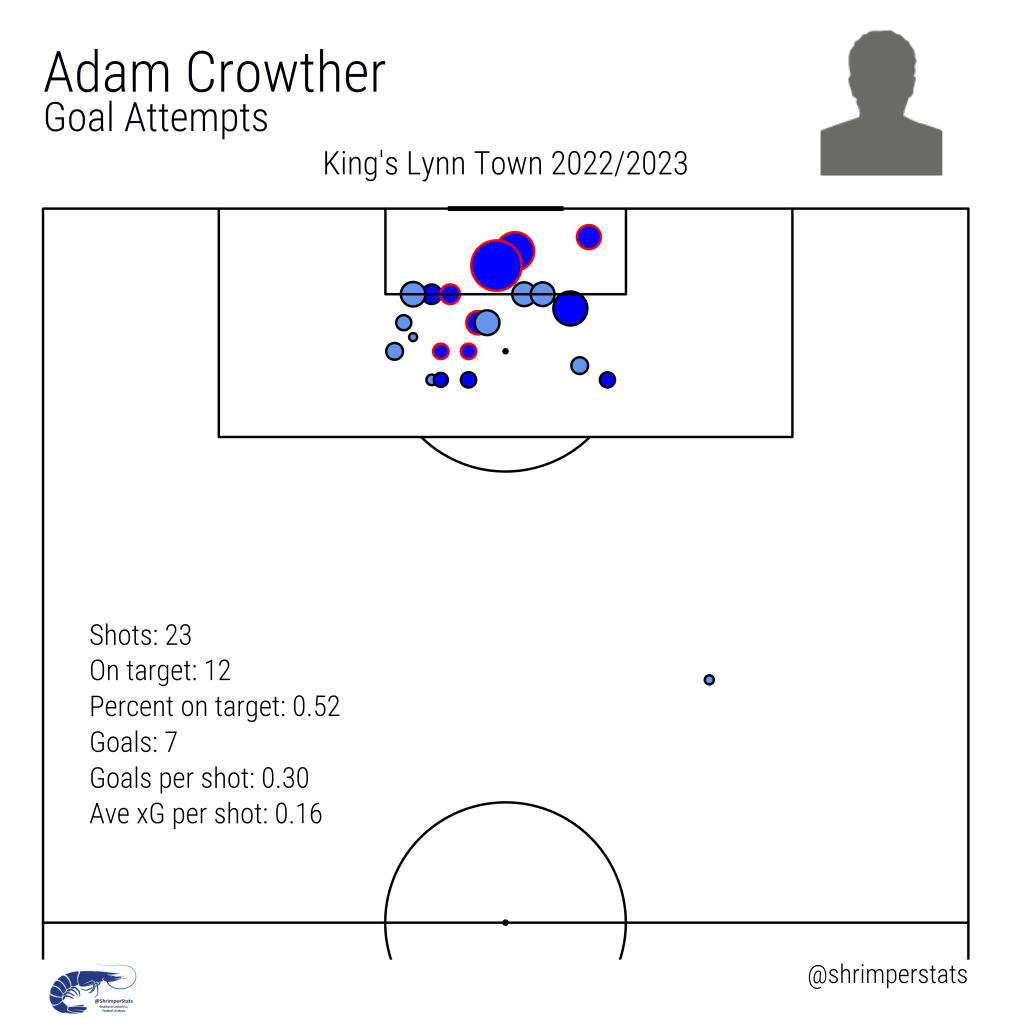
The acquisition of Crowther will give us a greater threat from offensive set-pieces – which is something that we haven’t seen an awful lot of from our other centre-backs. Our other centre-backs – Taylor, Lomas, Kensdale and Ralph – have only scored three goals in the National League in the three seasons that we’ve been in this division, compared to an expected goals (xG) figure of 7.81.
One final thing to mention, is that how we set-up for offensive set-pieces may change once Crowther forces his way into the side. As I mentioned earlier in this scout report, Harry Taylor excels at defending large spaces that are synonymous with transitional moments and opposition counter-attacks. As a result, he is kept back to defend when we have an offensive set-piece. However, if Crowther plays instead of Taylor on the right-side of our back three, he will almost certainly be in the opponent’s penalty area for offensive set-pieces, and somebody else will have to be positioned deeper to defend a potential counter-attack – someone who is potentially not as effective as Taylor during these moments.
Conclusion
To conclude, I believe that Adam Crowther will be able to cover all positions across our back three until the point where he has cemented his place in our starting XI. I see him predominantly playing on the right-side of our defence, where he can help our build-up, switch play to the opposite side of the pitch, and occasionally overlap our right wing-back Gus Scott-Morriss. However, I don’t think that he will go a long way to helping to improve our final-third dynamics on our right-side, so we may have to look for other solutions, here.
Crowther possesses good anticipation to make up for his slight lack of mobility, which helps him defend large spaces during transitional moments, although he isn’t as strong as Harry Taylor is in this phase of play. His physicality makes him an excellent penalty area defender, and coupled with his leadership qualities, he will give us another option to play in the middle of our back three if Ollie Kensdale is unavailable. Crowther will also provide us with a threat from offensive set-pieces, although the dynamic of how we set up to potentially defend counter-attacks from these set-pieces may change if he plays instead of Taylor.
 Shrimper Stats
You must be logged in to post a comment.