Southend United’s third goal in our recent 4-2 victory against Boreham Wood at Roots Hall was a genuine Goal Of The Season contender.
It also demonstrated some tactical aspects which were at play, as detailed in this article.
Southend built play from defence in our usual 3-4-3 ‘diamond’ shape. To counter, Boreham Wood pressed in a 5-3-2, largely going man-to-man across the pitch.
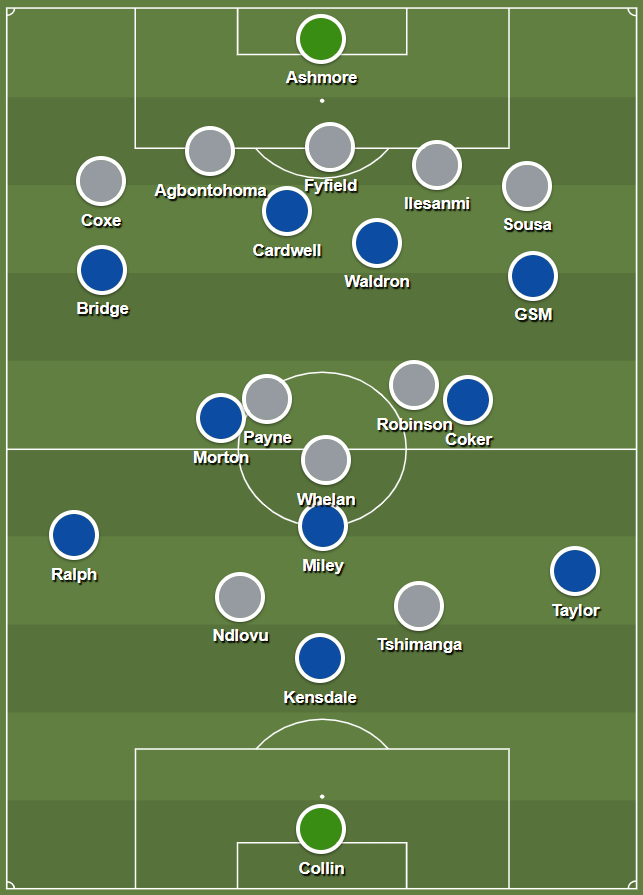
Boreham Wood’s aim was to press with aggression (helped by their largely man-to-man pressing structure), to either turn possession over or force us to go long. Here, they could use their physicality to win duels, to prevent us from exerting control on the match. This therefore asked the question: ‘how were Southend going to attempt to play through Boreham Wood’s press, to exert control on the match to give us the best chance of winning?’.
The first key component was through the inclusion of James Morton. Morton allows us to play a high volume of passes – more so than Wes Fonguck, who was the other potential option in the left-sided #8 role. His inclusion was particularly important in the absence of Noor Husin.
Morton could consistently drop deeper during our deep build-up to play alongside our #6, Cav Miley. The Boreham Wood midfielder tasked with marking Morton (usually Jack Payne) was often reluctant to strictly adhere to his man-marking role, in order to not completely empty the midfield. Consequently, this enabled us to have an additional body closer to our own goal during deep build-up, and it became easier for us to find time and space on the ball in the first and second-phases.
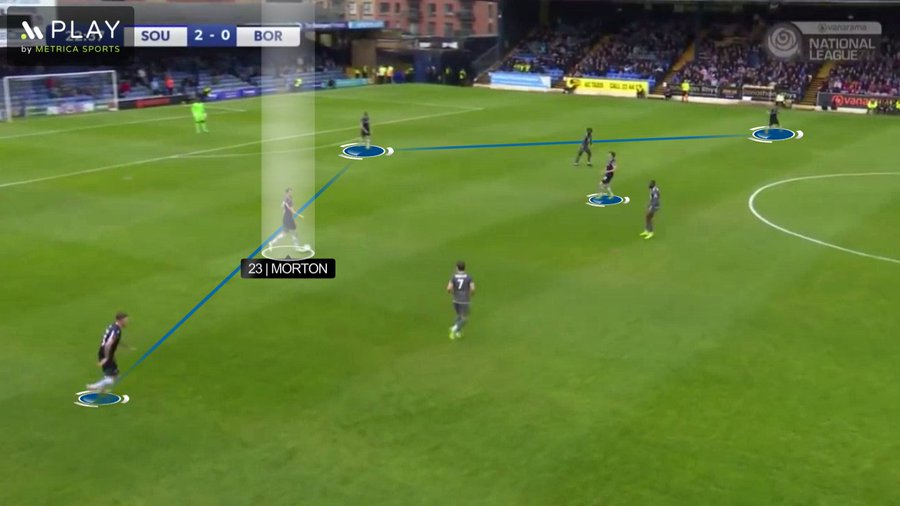
The second component was how we inverted our ball-side (whichever side the play was on) wing-back into the midfield, to manipulate Boreham Wood’s man-to-man press.
Below, we can see that Gus Scott-Morriss has inverted with Oli Coker holding the width (out of the picture). Once Harry Cardwell dropped deeper to receive a pass, he took a Boreham Wood defender with him into the midfield, and Scott-Morriss attacked the space that had opened up, looking for a through pass.
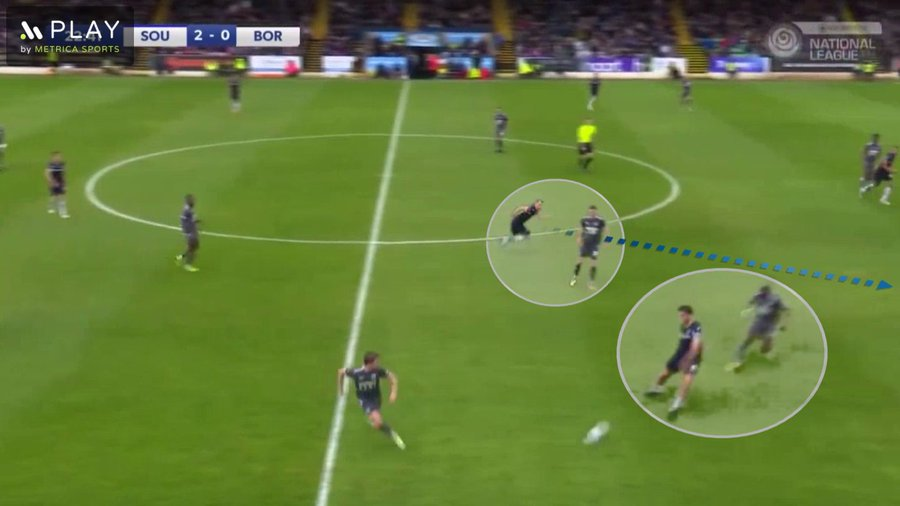
On this occasion the play was recycled instead, but the inversion of our wing-backs was a common theme to the match.
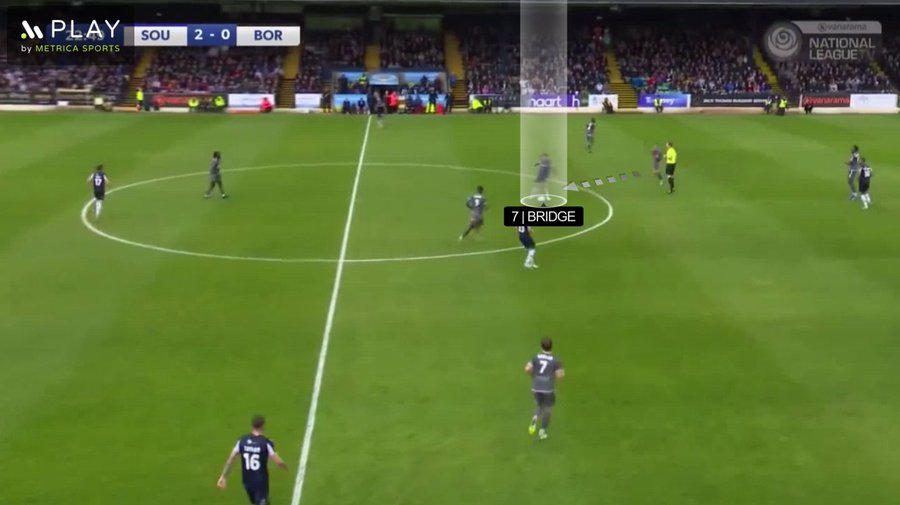
As we started to move towards our left-side, we can see Jack Bridge begin to invert, taking Boreham Wood’s right wing-back (Cameron Coxe) with him. This allowed Nathan Ralph to push up from his left-sided centre-back position to hold the width (although it was difficult for him to do so consistently, as he had a lot of ground to cover).
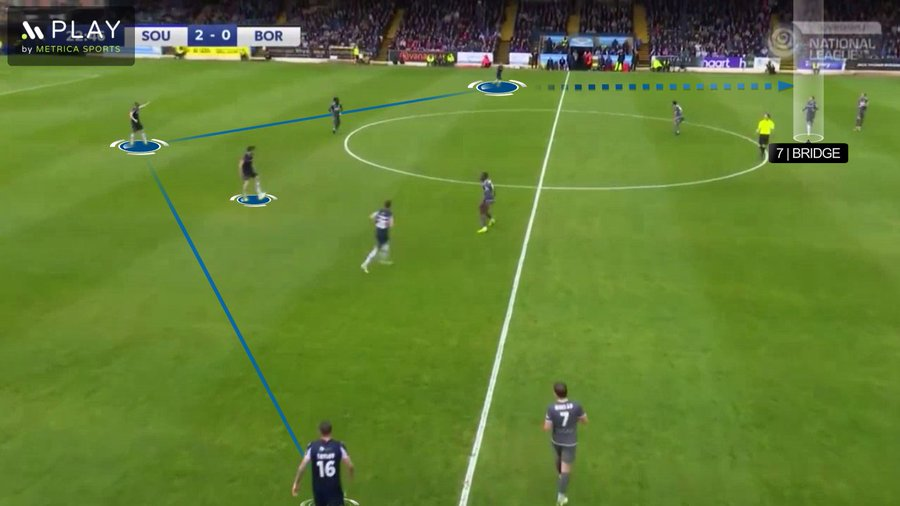
Bridge received a pass in midfield and kept possession ticking over, with Coxe close-by. However once the ball had gone out to our left-side, and Coxe began to retreat into Boreham Wood’s mid-block, he left Bridge, who maintains his position in central-midfield. We can see this in the two images below.
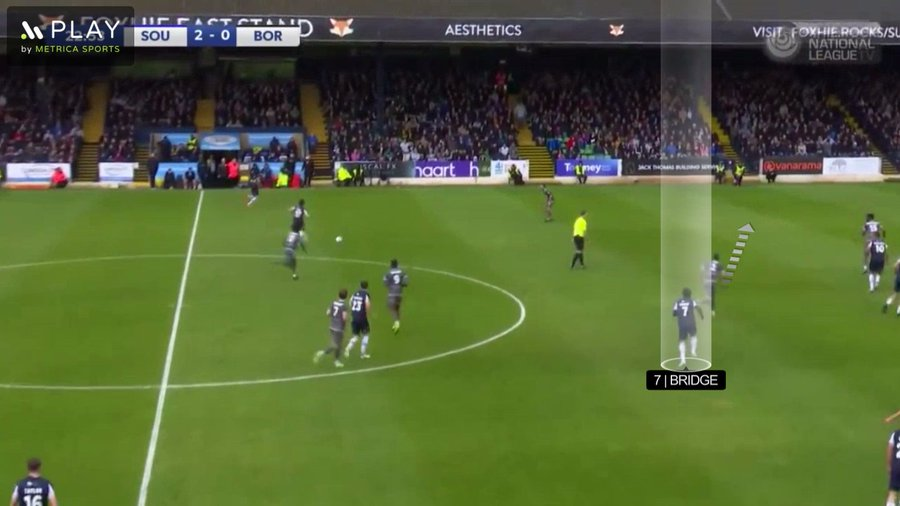
Once we moved the ball back inside the pitch, Bridge was in a lot of space because he had helped to overload the midfield (4v3) by maintaining his position. Coxe attempted to press him again, but Bridge had too much time on the ball and could easily play a forwards pass.
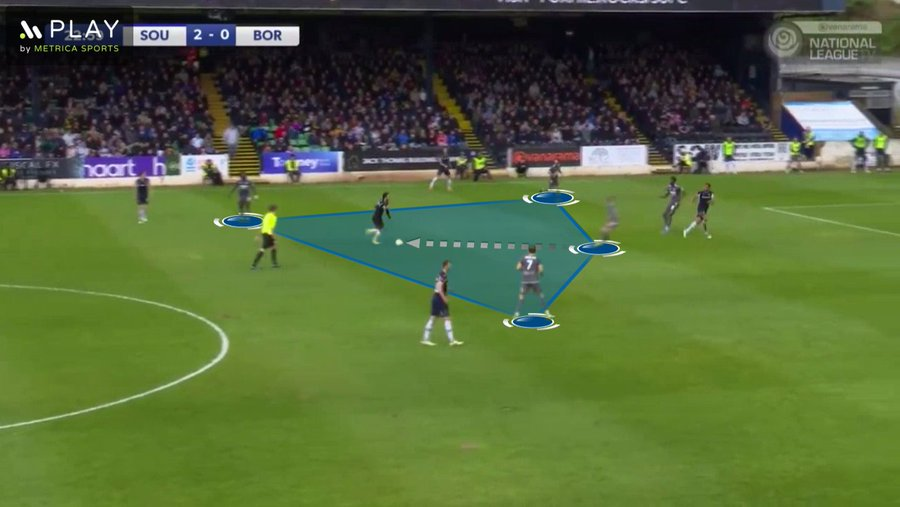
Cardwell received this pass from Bridge, and moved it onto Scott-Morriss. Because we switched play from left to right quickly, Scott-Morriss was in a bit of space and could cross the ball into the penalty area, rather than needing help from others to create separation from his marker. The cross was initially met by a Boreham Wood player, but the second-ball fell to Bridge, who again maintained his central positioning, and finished.
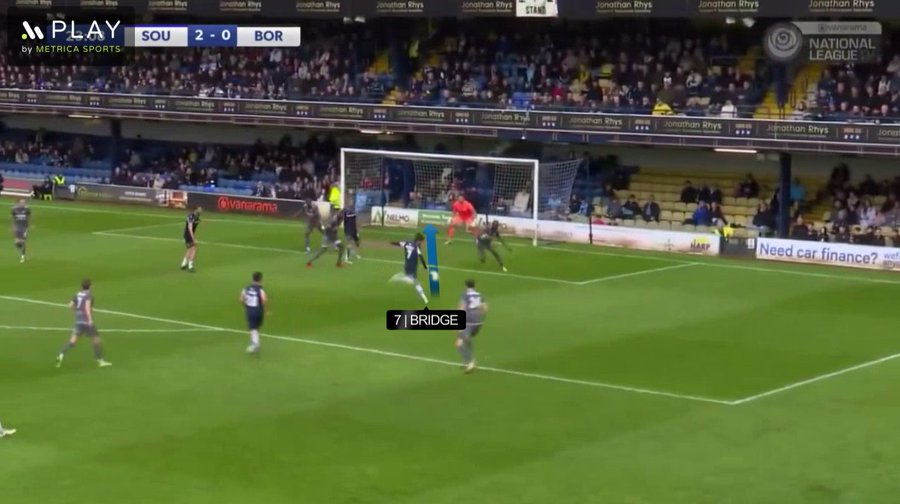
These two components demonstrated the importance of positional rotations in disrupting a man-marking pressing scheme. Overload the deeper areas, pass and move into space, and confuse the opposition as to who should be marking who.
And against a physical side like Boreham Wood, it shows how important it is to keep the ball. If we went long too much, we’d often lose duels, fail to exert control, and have to defend more transitions and attacks. That’s our first league win versus them in the past two seasons.
 Shrimper Stats
You must be logged in to post a comment.