Ebbsfleet United midfielder Toby Edser is a player who I have admired for a while now. After first identifying him as a potential transfer target for Southend United back in December, he has gone on to show some very impressive performances to help Ebbsfleet move away from the National League relegation zone.
This article will be split into two sections. The first will be a basic scout report, focussing on Edser’s technical, physical, tactical and mental profiles. The second part of this article will go into detail about how Edser would, in my opinion, be a good fit specifically for Southend’s system.
Technical profile
Edser is a left-footed central-midfielder, and normally lines up as the left-sided #8 in Ebbsfleet’s 3-5-2 formation, or as the #10 in their 3-4-1-2 shape.
Whilst often being the midfielder who is positioned furthest forwards during Ebbsfleet’s build-up phase, and therefore not always offering a consistent second-phase presence, Edser is still comfortable dropping deeper to receive passes from his teammates.
He is an excellent ‘scanner’, enabling him to move into space to regularly offer passing options to teammates, and monitor the proximity of his opponents.

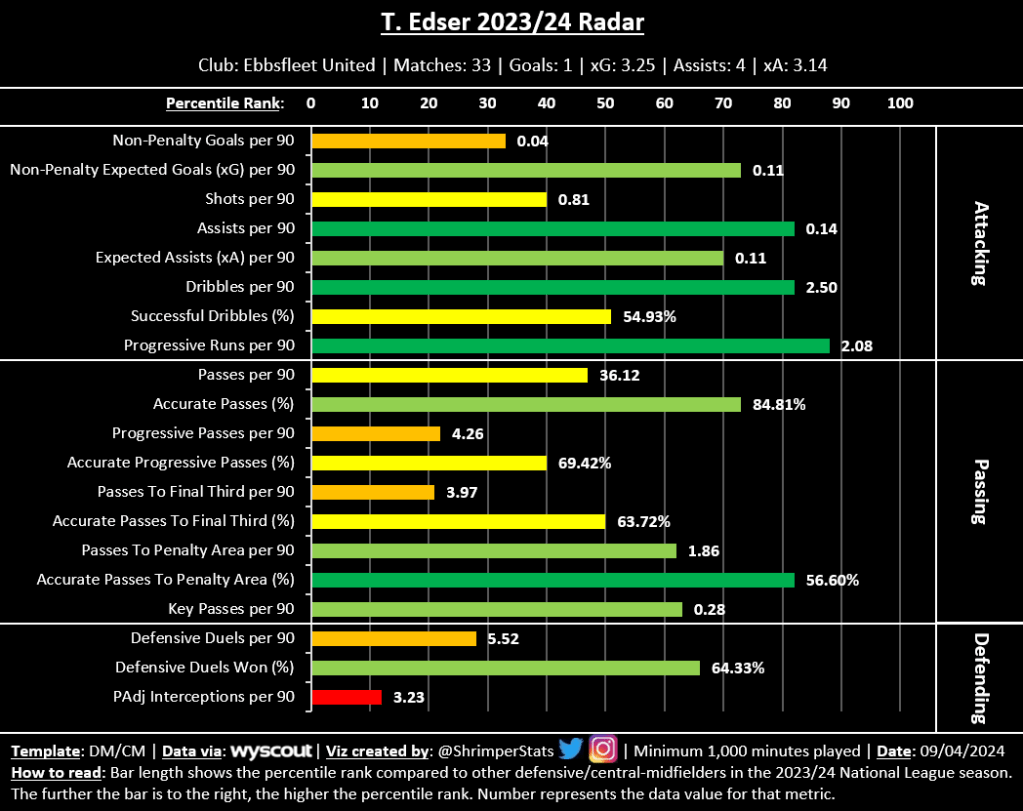
In addition to the above, Edser often has a clean first-touch, and demonstrates good decision making, allowing him to keep possession ticking over instead of always attempting riskier passes. This is illustrated by Edser’s 84.81% pass completion rate – which is particularly impressive for an advanced midfielder.
Edser is agile and has excellent close-control, which is needed in order for him to receive the ball in tight spaces, pass at a range of angles and change direction quickly.
He is also an excellent dribbler of the ball, and shows good bursts of pace to allow him to create separation from his opponents. In one particular moment in a recent match versus Southend, Edser carried the ball forwards at pace towards Southend’s goal, drawing out an opposing defender to press him. Edser then played a nice, weighted through pass beyond Southend’s defence, for a teammate to run onto.

During settled attacks and offensive set-pieces, Edser (at 5’9″ tall) often positions himself on the edge of the penalty area rather than being a target to aim for from crosses. There are, consequently, moments where Edser can demonstrate his crossing ability.
However, these crosses are sometimes inconsistent. Although regularly put into dangerous areas, his crosses are often floated into the penalty area rather than whipped in at pace, making them easier to defend.
Physical profile
Edser is 5’9″ tall, and has a fairly slight frame. Although not possessing immense physical attributes in terms of his height and strength, Edser works very hard out-of-possession and is aggressive in duels – impressively winning 64.33% of his defensive duels, despite his lack of physicality. Edser isn’t very strong in the air, winning just 41.67% of his aerial duels, but again, he shows full commitment during these moments.
To ensure that he isn’t pushed off of the ball easily, Edser intelligently uses his arms to shield the ball from opponents. Combined with his low centre of gravity and aforementioned close-control, opponents often find it difficult to win the ball from him.
Edser leads Ebbsfleet’s press well from the front with great intensity, using his acceleration to quickly arrive at the ball-carrier as soon as they have received a pass.

However, potentially as a result of this, he is often inconsistent with how he retreats into Ebbsfleet’s mid-block. Edser does demonstrate a willingness to run back towards his own goal in defensive transition when he recognises that there are opponents in space.
However, when there are already teammates back, he often is slow to retreat. Perhaps this is instructed through his coach, or perhaps he’s unable to consistently retreat into the mid-block because of how hard he works in the high press or counter-press, and how much ground he has to cover if this press is unsuccessful.
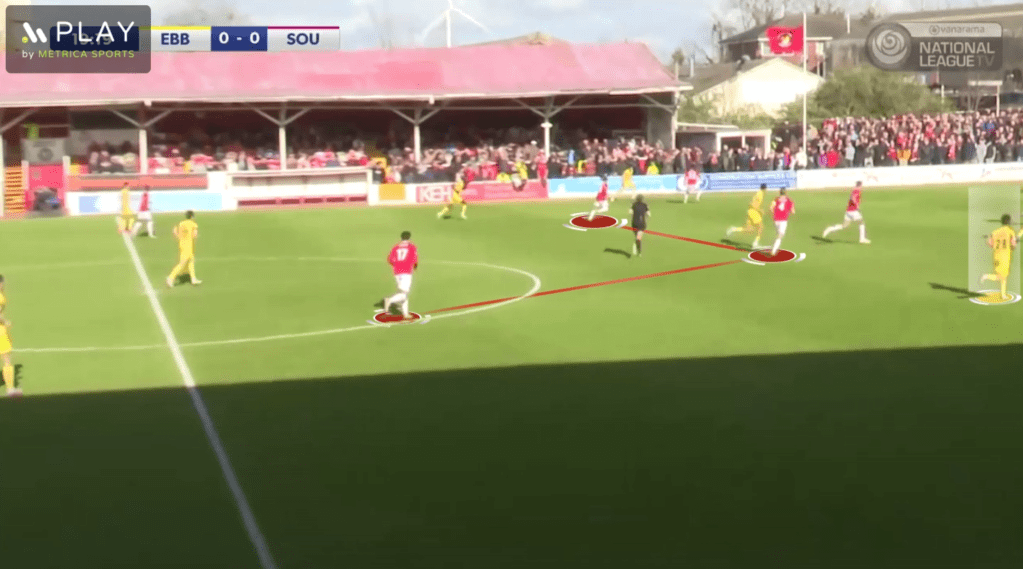
Edser is also inconsistent with how he acts during offensive transitions. Similar to above, when he recognises that there is space to be exploited, Edser shows a willingness to get forwards at pace to help the Ebbsfleet attack.
However, there are moments when play has progressed at speed after he had dropped deeper during deep build-up, or if there are already enough teammates forwards to support the transitional attack, when Edser is slower to get forwards. As a result, however, Edser can use his ‘scanning’ ability to arrive in the penalty area in space late-on, rather than already occupying this space, therefore going unnoticed by opposing players.
Tactical profile
Edser has an incredible sense of his proximity to his teammates and opponents, and where the space is. Aided by his quick burst of acceleration, he uses this throughout the duration of matches to drop deeper to assist Ebbsfleet’s deep build-up, help during offensive or defensive transitional moments, and to arrive unmarked in space in the opponent’s penalty area, for example.
In a few instances in a recent match versus Southend, Edser recognised that there was space in-between Southend’s backline to be exploited. He made forward runs beyond the opposition defence in order to receive through passes from his teammates, to cause problems for Southend.
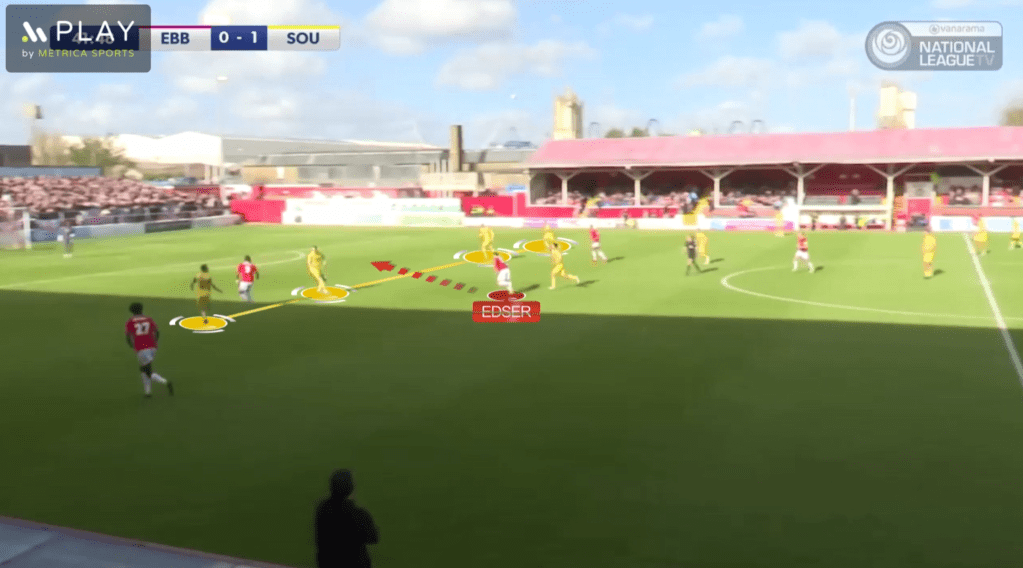
Edser was also able to recognise, during one transitional attack, that his two midfield teammates had joined the Ebbsfleet attack. This, therefore, had emptied their midfield, and Ebbsfleet were potentially vulnerable in the event of a Southend turnover. Despite being the recognised ‘attacking midfielder’ on the pitch for Ebbsfleet, Edser stayed back during this attack in order to make his side more compact in the event of a defensive transition.
As previously mentioned, Edser likes to drop deeper to assist Ebbsfleet’s deep build-up. As well as being able to move into space, he also recognises his role in moving opponents around the pitch to create space and passing lanes for his teammates. Even when he drops deeper and doesn’t receive the ball, he is still able to influence the way that Ebbsfleet build play from defence.
Mental profile
Despite just turning 25-years-old, Edser is a leader. He constantly talks to his teammates to tell them where to be positioned, who to pass to, and who to press. He’s incredibly vocal on the pitch, and shows a great deal of passion, irrespective of what the score line may be.
He leads by example, as illustrated by his ability to lead Ebbsfleet’s high press with intensity. Edser also doesn’t shy away from taking responsibility, and demonstrates a confident, match-winning aura – which has helped to drag Ebbsfleet away from potential relegation danger.
Where may Edser fit into Southend United’s system?
Edser is someone who I am desperate for Southend to sign. I envisage him playing in either #8 role in our 3-5-2 formation, next to our single #6, Cav Miley.
During build-up, he wouldn’t be the primary passing option, as most of our play would still go through Miley. However, Edser would still be able to drop deeper to receive the ball or position himself higher, between the opposition’s defensive and midfield lines, whilst being able to fulfil both requirements adequately. This would increase our tactical flexibility, and would make us more difficult to prepare for, from an opposition perspective.
Further forwards, Edser would be able to replicate Wes Fonguck’s effectiveness in the final-third, in terms of his underlapping/overlapping runs beyond our left wing-back, Jack Bridge. This would still be able to create space for Bridge to cut into, onto his stronger right-foot.
However, if Edser received a through pass from Bridge, he would be able to cross the ball into the penalty area first-time with his stronger left-foot, rather than having to cut-back onto his right-foot, or cross with his weak foot, as is the case currently with Fonguck.
If Edser were to play in the right-sided #8 role, his ball-carrying ability would drawer out opponents to press him. Theoretically, this could create space for our right wing-back Gus Scott-Morriss to cross the ball into the penalty area. Currently, we find it difficult to create space for Scott-Morriss to cross the ball effectively, and as a result, we’re much more threatening down our left-side against settled defensive blocks.
Additionally, because Edser is left-footed, it would give us different crossing angles on our right-side (with one right-footer in Scott-Morriss, and a left-footer in Edser).
Edser’s ‘box crashing’ ability (i.e. the ability to arrive in space late-on in the penalty area, rather than already occupying that space), is also something that we don’t see enough of from our current central-midfielders, in my opinion.
As earlier mentioned, Edser works hard out-of-possession, presses with intensity, and is aggressive in defensive duels. Despite this, there would be more physical central-midfielders out there, but perhaps none with the same balance of physical and technical ability as Edser, particularly in the final-third.
And finally, in defensive transition. It’s vitally important for a Southend United central-midfielder to retreat quickly into our mid-block, if our high press or counter-press is unsuccessful. Edser does show a willingness to run back towards his own goal in transition, but he is inconsistent with how he executes this action.
Perhaps this is through his current coach’s instructions, or perhaps not. Either way, I’d like to think that this part of Edser’s game would be able to become much more consistent if he were to be signed, especially when we consider that he already shows a willingness to retreat into the mid-block for Ebbsfleet, just not consistently enough, in my opinion.

Conclusion
Whilst Edser and Fonguck are very similar profiles, and I have highlighted Fonguck’s role and his importance a number of times this season, I believe that the signing of Edser would be an upgrade. And with Fonguck out of contract in the Summer, it could be the perfect time to make the change.
Edser is more tactically diverse, in the sense that his awareness of those around him enables him to drop deeper or play higher up between the lines to a top standard. He also seems to complete his in-possession actions smoother than Fonguck does.
He would, theoretically, also be able to replicate Fonguck’s best part of his game: his off-the-ball movement and subsequent link-up with Bridge. Edser would also be in prime position to cross the ball into the opposition penalty area first-time with his stronger left-foot.
Also, as Fonguck has almost exclusively been used in the left-sided #8 role, it contributes to our over-reliance on our left-side. We don’t have a similar profile who can offer us greater threat from our right-side from central-midfield. And without wingers in our formation, persisting with this exact system may mean we’re still over-reliant on our left-side when attempting to break down settled opposition defensive blocks, going into next season.
Edser’s ball-carrying ability and left-footedness could help to strengthen our right-side if he played in the right-sided #8 role for us. However, Fonguck did seem to play there when he was subbed on versus Boreham Wood recently, so I may have to reconsider this point once the season has reached its conclusion.
 Shrimper Stats
You must be logged in to post a comment.