Eastleigh’s number nine, Paul McCallum, has had a remarkable season. The striker scored 31 goals in 38 National League matches, finishing as the top scorer in the division. He has also been linked with a potential move to Southend United this Summer.
In this article, I will assess McCallum’s technical, physical, tactical and mental profiles; as well as suggest how he could potentially fit into Southend’s system.
Technical profile
Playing at the top of the pitch for Eastleigh, McCallum isn’t regularly tasked with dropping deeper to assist their build-up. Instead, he is positioned centrally in the last line of attack, where he occupies opposing centre-backs. As such, the striker doesn’t need to have excellent close-control to be able to receive the ball in tight spaces.
Regardless, when Eastleigh do play the ball into McCallum, he does possess a clean first-touch and the ability to hold the ball up; maintaining possession for his side, allowing them time in order to commit bodies to the attack.
Because McCallum’s profile doesn’t allow him to offer a huge deal in terms of build-up play, in the same way that a smaller, second-striker profile may be able to; he should be judged more on his physical attributes – and as a striker, also on his goal return.
McCallum consistently strikes through the ball cleanly, with power and accuracy. He is a proven goal-scorer at National League level. Although he scored 31 goals this season, when compared to his expected goals (xG) figure of 19.20, we can infer that he’s unlikely to score quite as many again next season.
However, over the past five seasons, McCallum has averaged 0.50 xG per 90 minutes, actually scoring at a rate of 0.51 goals per 90. When we consider his availability, where McCallum has averaged just over 3,000 minutes per season in that same timeframe (which is equivalent to just over thirty-three 90 minutes), it’s fairly safe to suggest that he should still be scoring around 20 goals next season – if he continues to stay fit.

Physical profile
At 6’3″, and with a strong build, McCallum is an excellent target-man. Eastleigh can play long passes towards him if they decide to go long during build-up, and he can effectively challenge opponents in aerial duels. He can use his height to win these duels, or his strength to create separation from his marker in order to hold the ball up for his side.
McCallum also gives Eastleigh a target to aim for from crosses into their opponents’ penalty area. Incredibly, 15 of his 31 goals this season have been scored through headers. His aerial ability also allows McCallum to be effective during offensive and defensive set-pieces.
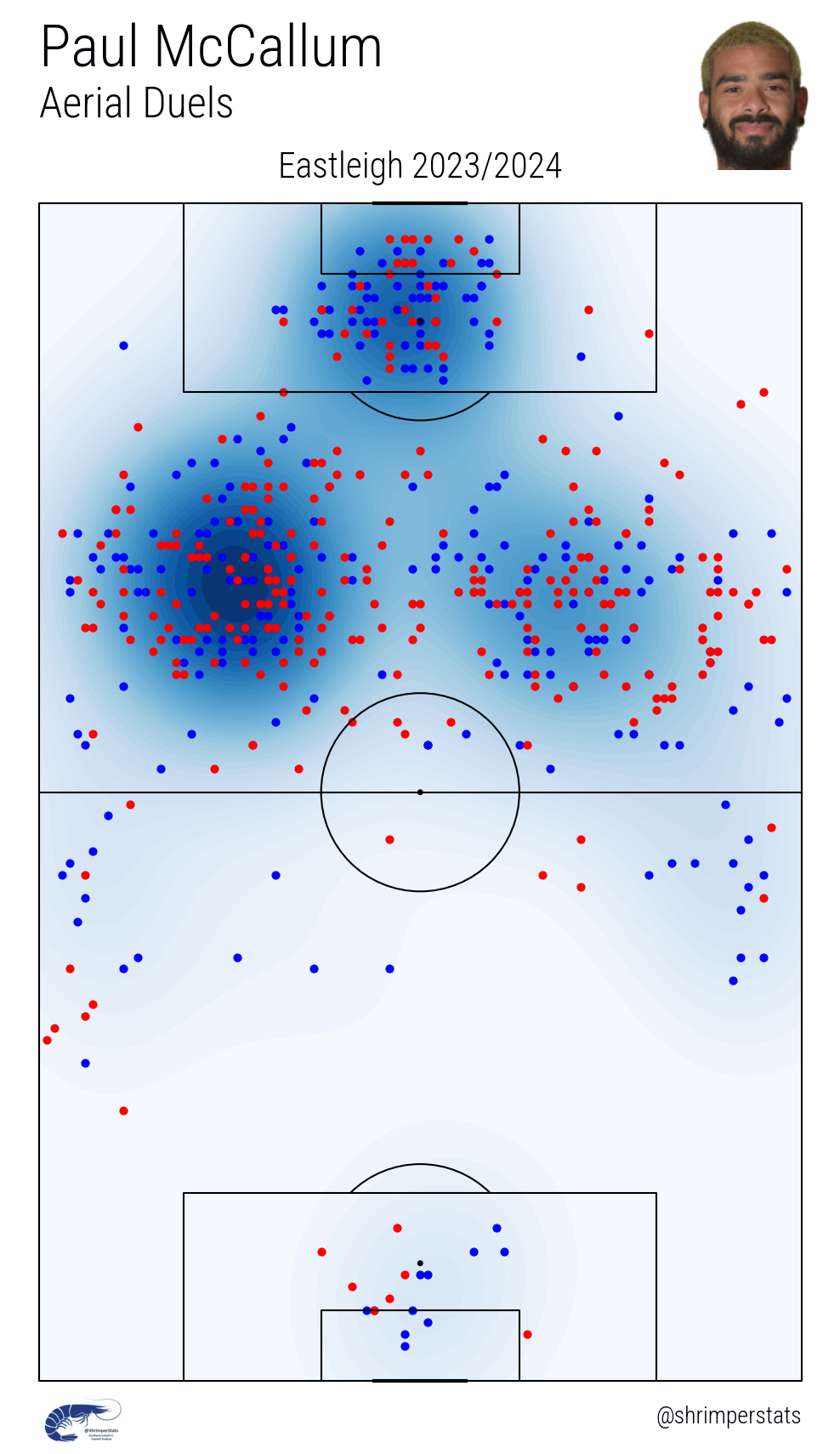
Although he possesses decent acceleration over shorter distances, McCallum isn’t the same athlete as our current first-choice #9, Harry Cardwell. Cardwell not only is a target to aim long passes towards, but his pace over longer distances also enables us to play long passes beyond opposing defences for him to run onto. McCallum isn’t the same profile, in this sense. However, with Cardwell and Danny Waldron already under contract for next season (who can both offer us this athleticism), it isn’t a huge issue – if McCallum were to sign for Southend.
However, it remains to be seen if McCallum can replicate Cardwell’s pressing intensity when his side are out-of-possession. Eastleigh are a side who are happy to sit in their mid-block, rather than press high up the pitch with intensity. They allow their opponents on average 13.27 passes per defensive action (PPDA) before they make a challenge, which ranks them 20th in the National League.
Southend, on the other hand, regularly look to employ a high press. And when we consider that we often only press with our two strikers in the first-line of our press (in the absence of wingers), it means our forwards must be able to cover a lot of ground quickly – making their athleticism all the more important.
If McCallum does sign for Southend, it will be interesting to see if he fits in with our high pressing style; and if he does, whether this increased workload will have an affect on the amount of minutes that he’s able to play.
Tactical profile
In addition to the earlier mentioned question marks about his fit into a high pressing system, McCallum’s physicality enables him to be a very useful player to have against sides who press high with aggression, and against those who sit deeper.
Against high presses, as previously stated, McCallum would allow Southend to play long passes towards him if our opponents were aggressive, and didn’t allow us to progress the ball safely. However, McCallum’s profile doesn’t make him as tactically diverse as Cardwell, because he lacks the pace required for us to play long passes beyond defences for him to run onto.
Versus low-blocks, where the amount of control that we could exert would be inherent, McCallum would be an effective target to aim our many crosses towards. This season in the National League, Southend attempted the most crosses in the division (19.08 crosses per 90 minutes).
By analysing McCallum’s player radar chart (below), we can see that he doesn’t really excel at much other than aerially, and in-front of goal.
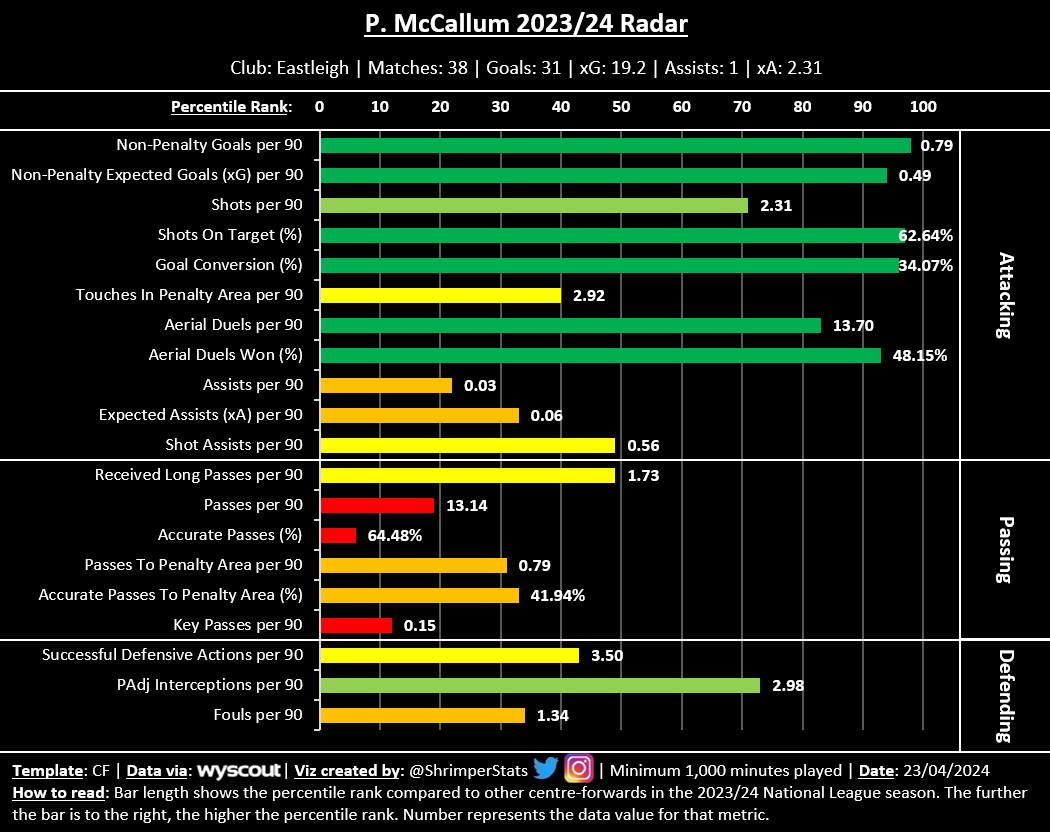
McCallum’s movement and intelligence makes him an expert at finding space in the opposition penalty area to create separation from his marker, in order to receive high-quality chances.
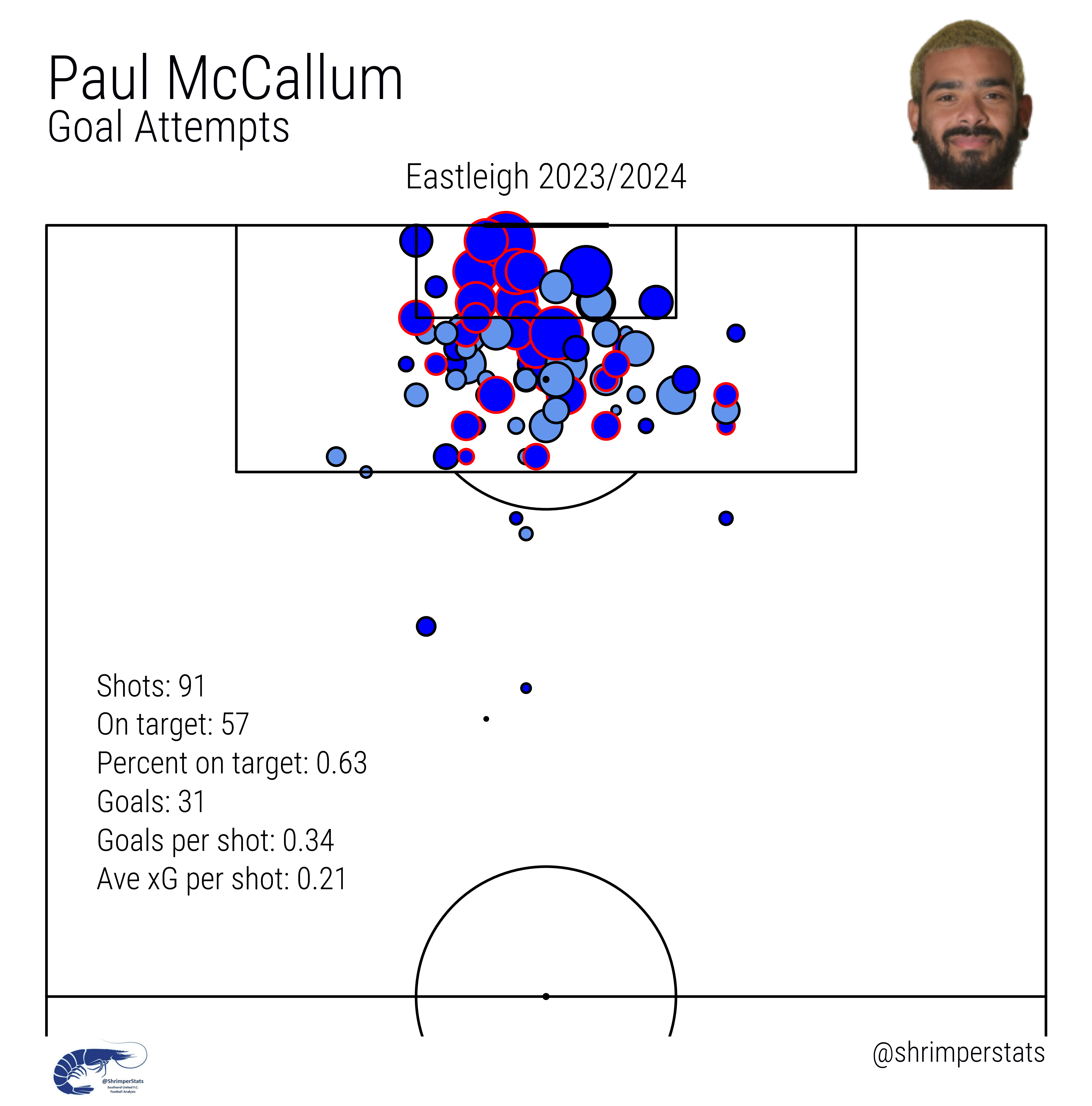
From the below shot map, we can see that McCallum attempted a high volume of shots from in and around his opponents’ six-yard box, with a great deal of these on-target, and resulting in goals. In terms of expected goals, over the last five seasons, the average xG of all of McCallum’s shots is 0.220 xG per Shot. This means that he’d be expected to score a goal just under once in every five of his shots.
Mental profile
McCallum has a great deal of confidence in his own ability. He expects to score every time he steps onto the pitch. He has scored 87 goals in the last five seasons in the National League, and goalscoring is second nature to him.
This confidence gives him a real ‘match-winner’ mentality; the type of mentality which is required to play for sides who are in a fight – whether that be in a relegation battle, a play-off push, or title challenge.
When things aren’t going right, or if it’s late-on in the season, or in a critical match, you need your big players to step up. McCallum has this mindset, and thrives off of the pressure to succeed.
Conclusion
To conclude, Paul McCallum, who will turn 31-years-old in July, is a proven, clinical striker at National League level. His physicality allows his side to play long passes towards him to bypass opposition presses, and aim crosses into the oppositions’ penalty area towards him. He is excellent at creating separation from his marker in the penalty area, to get on the end of high quality chances.
Although he doesn’t quite possess the same athleticism that Harry Cardwell or Danny Waldron do, in terms of running onto long passes which are aimed beyond opposing defences, McCallum is a real ‘match-winner’. He also shows an impressive availability record, although there may be a question mark about whether this is sustainable if he were playing for a high pressing side, where he would have a higher workload.
Whilst he isn’t the same athlete as Cardwell or Waldron, if Southend were to sign McCallum, I still believe that he would be an excellent fit. We already have two ‘athletes’ in the #9 role in Cardwell and Waldron, and McCallum wouldn’t, therefore, have to be an exact replica. Also, because Cardwell is such a complete #9, his profile is almost impossible to replicate. It therefore depends what you want to sacrifice if you’re looking to recruit similar players: his physicality, athleticism or goal-scoring ability.
It’s incredibly clear where Southend need to strengthen if we are to have a real push for the title next season. In the 2023/24 season, we scored 70 goals versus an expected goals (xG) figure of 85.48. When we also consider that our post-shot xG (which takes into account our shot trajectory) was 73.58, it suggests that our under-performance in-front of goal was largely due to poor finishing. This signing could be the one that takes us to the next level – all we’re missing is more composure in-front of goal.
I would like Southend to sign two strikers this Summer: another #9 to compliment Cardwell and Waldron, and a second-striker/#10 profile. I think that this #9 should, ideally, be a proven National League player – especially as Waldron is still fairly new to the level.
Therefore, it’s incredibly difficult to overlook such a proven goal-scorer at this level in McCallum, just because he may not have all of the necessary attributes that our #9’s would ideally have. As such, McCallum is my first-choice suggestion for the #9 role this Summer, although it’s an incredibly unoriginal pick!
 Shrimper Stats
You must be logged in to post a comment.