Southend United recently announced the signing of Burton Albion striker Josh Walker on a two-year contract for an undisclosed fee. The 26-year-old became Southend’s first signing of the summer since the lifting of the transfer embargo.
In this article, I will analyse Walker’s playing profile; assess how he could fit into Southend’s system; and determine whether, on paper, he will be a good fit.
Playing profile
Walker is a striker and, as such, doesn’t have a particularly great influence on his side’s build-up play. The below visualisation shows Walker’s percentile ranks for a range of metrics compared to other strikers in the 2022/23 National League season. The higher the rank, the further each bar is to the right. We can see that Walker doesn’t rank particularly well at any possession metrics, including: passes per 90, passes to the penalty area per 90, and expected assists (xA) per 90.
He also ranks fairly average at received long passes per 90, aerial duels per 90, and aerial duels won (%). Considering Walker is just 5’9″ tall, this isn’t surprising.
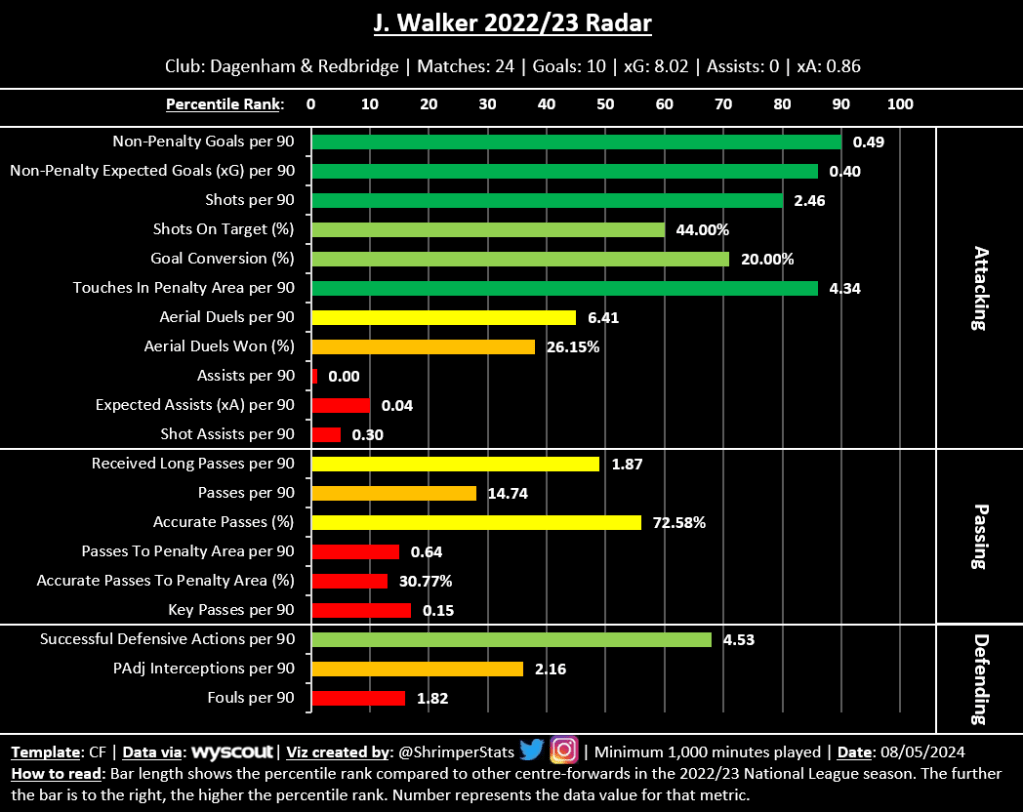
However, Walker does rank very well at a range of goal-scoring metrics. He scored 10 goals in 24 matches for Dagenham & Redbridge in the 2022/23 season, against an expected goals figure of 8.02 (xG). He played a little over 1,800 minutes that season before securing a move to Burton at the end of the January transfer window – which is the equivalent of just over 20 full ninety minutes.
This video compilation of Walker’s give us a better idea about the type of goals that he is capable of scoring. A great deal of his goals have been from transitional moments, where Walker can use his speed to move at pace towards the opposition goal.
This threat in transition is something that Walker acknowledges himself. He sees himself as an “off-the-shoulder” type of striker, who positions himself on the shoulder of the last defender before making runs beyond defences to get on the end of through passes. He is also able to initiate attacks himself due to his ball-carrying ability, rather than just needing to run onto through passes.

Walker is also capable of finishing off chances which are presented to him in and around the six-yard box. The below visualisation shows his goal attempts for Dagenham & Redbridge in the 2021/22 and 2022/23 seasons. Each dot represents one of Walker’s shots at goal, with the stars indicating which shots were converted into goals.
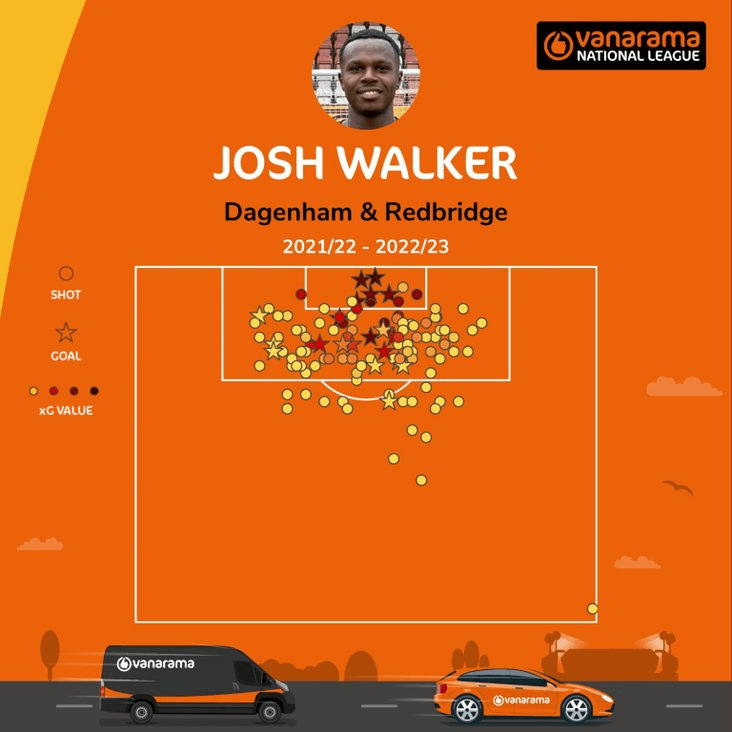
The darker the colour represents the higher the expected goals (xG) value of that shot; and the higher the xG, the better the quality of that chance. As we can see, there are a large number of goals that Walker scored with a high xG value. This allows us to infer that Walker is able to find space well, in order to receive high-quality chances with a high likelihood of those chances being converted into goals.
Out of possession, Walker has the necessary athleticism required to be an effective presser of the ball. He is very quick and agile, and can cover a large amount of ground at pace.
To summarise, Walker is a final-phase striker who will get on the end of chances and offer a great threat in offensive transition; although he may not be the type of player who will contribute a great deal during the build-up phase. He also has the potential to be effective out of possession.
Now we know what type of player Walker is, we can assess how he may fit into Southend’s system.
How Walker could fit into Southend’s system
Former striker Callum Powell recently left the club to join National League newcomers, Braintree Town. Powell is a very hard worker both in and out of possession, offers a threat in transition, and is agile enough to be able to receive the ball in tight spaces. In fact, he’s a very similar profile to Walker.
Where they differ, however, is their composure in-front of goal. Powell was injured for the vast majority of the 2023/24 season, but when we look at his numbers from 2022/23, he scored 8 goals in 40 matches, against an expected figure of 11.85 (xG). Per 90 minutes, Powell scored at a rate of 0.31 goals per 90, compared to 0.45 xG per 90. This represents a significant under-performance in-front of goal. Walker, on the other hand, scored at a rate of 0.49 goals per 90, compared to 0.40 xG per 90.
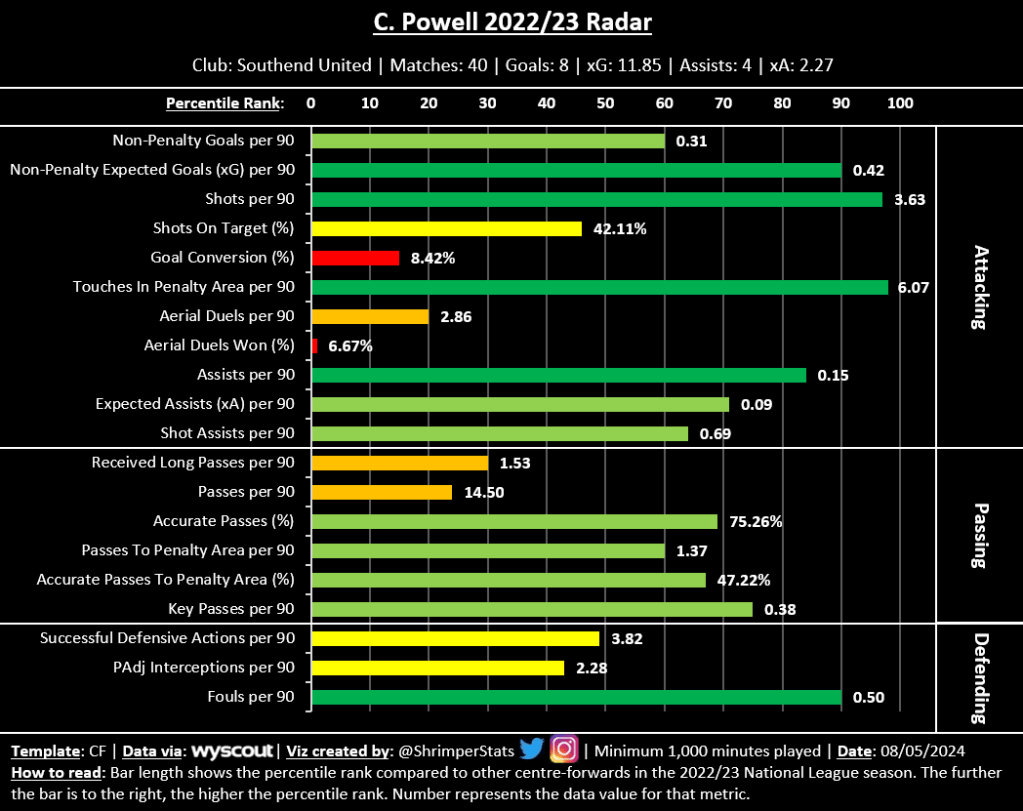
These under or over-performances in-front of goals could be down to any of the following: finishing ability, goalkeeping performance, or luck. However, when we look into the numbers a bit further, the picture becomes clearer.
When his shot trajectory is taken into consideration, Powell had a post-shot xG of 0.25 per 90. When compared to his pre-shot xG of 0.45 per 90, it’s clear that by shooting, Powell reduced the likelihood of his shots being converted into goals. This indicates poor finishing. Walker’s post-shot xG per 90 was 0.38, which isn’t an awful lot different from his pre-shot xG of 0.40 per 90. Because these figures are much closer together, it allows us to infer that Walker didn’t particularly reduce the likelihood of scoring by attempting shots from the chances that were created for him. This means that he seems to be a pretty good finisher.
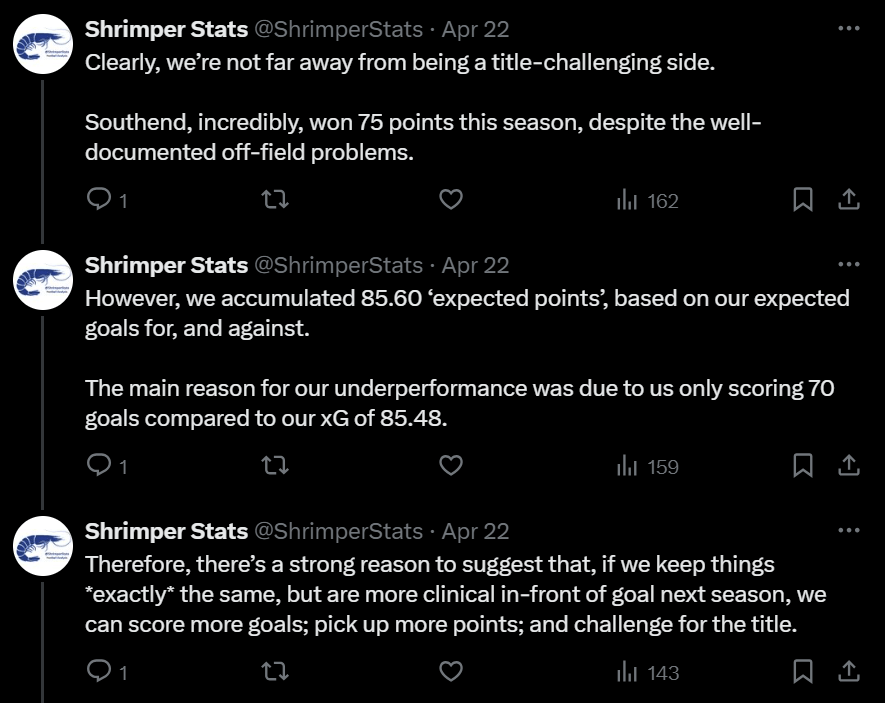
Last season, Southend accumulated the fourth-highest expected goals figure in the division (85.48 xG), but only scored 70 goals (joint-tenth). If we’re to progress to the next level, we must score at a rate much closer to our expected levels, and subsequently improve our finishing. Powell scored 12 league goals for Southend compared to his expected number of 17.89 (xG), in the equivalent of just over 39 ninety minutes.
Although he possessed some very important attributes in terms of his work-rate, athleticism and link play, Powell didn’t do enough in his time here to prove to me that he will score the number of goals required to help us challenge for the league title, and consequently make the step up to League Two – which should be the aim next season.
Ensuring that we’re more clinical in-front of goal next season is vital to allowing us to be in title contention. Without that, we will fall short. Walker’s previous numbers when playing at this level suggest that he can contribute to us being more efficient. This signing looks like an upgrade on what we’ve previously had available, which is needed if we’re to improve.
If head coach Kevin Maher is to continue with his 3-5-2 formation next season, having strikers who are able and willing to work hard against the ball are vitally important. Because we regularly defend with five players in the last line, it often leaves our front-two having to cover a lot of ground quickly to put pressure on opposing defences during the high-press.
Implementing an intense high-press has been a constant throughout Maher’s time as head coach, and allows us to exert control on matches. An aggressive off-ball approach allows sides to prevent their opponents from spending too much time with the ball, and is conducive to playing possession-based football; controlling matches; limiting the frequency at which you have to defend deep in your own half; and, ultimately, challenging for league titles.
Southend still need to sign one more striker this summer. Depending on who this is, I expect Walker to be the first-choice option to partner Harry Cardwell in the front-two. Therefore, it’s important that he can be used at different game-states.
Although he can find space in the penalty area to receive chances, I think that, due to his size, Walker may not be the most effective striker against low-blocks when he’s in a crowded penalty area, and is asked to get on the end of crosses. However, Walker has the pace to run in-behind defences if we’re forced to ‘go long’ versus aggressive high-presses; and can also drop into the midfield against mid-block sides, although this isn’t the strongest part of his game.
Walker is also athletic enough to work hard against the ball against opponents who are patient in their build-up play, and will give us an outlet in offensive transition during matches where we are forced to defend deep for long spells.
Conclusion
In conclusion, Josh Walker seems to be a very similar profile to former striker Callum Powell. His efficiency in-front of goal looks to be an upgrade on what we have previously had available, which is necessary if we are to take our project to the next step.
Walker should be able to fit into our aggressive off-ball approach, will give us an outlet when we have to defend deep, and will be a threat in offensive transition.
His agility enables him to drop deeper and receive the ball in tight spaces; although this part of his game isn’t his main strength. However, Walker can still be used in a number of different game-states, and should be a good fit for Southend’s system.
 Shrimper Stats
You must be logged in to post a comment.