National League title favourites Barnet beat Southend United at The Hive on Saturday afternoon. Goals from Harry Chapman and Mark Shelton either side of a Gus Scott-Morriss equaliser gave the hosts the three points.
In this in-depth article, I’ll analyse how each side looked to build play from defence; assess the effectiveness of each side’s pressing structure; and explain why this had a material affect on the result.
Southend’s build-up
Southend ‘went long’ from goal-kicks via closed-kicks, with the entire team pushed up to the halfway line. However, from open-play they formed a ‘3-1’ shape during the build-up.
Barnet pressed in a ‘5-2-3’ shape. Their front-three pressed Southend’s back-three in man-to-man fashion, and one of their #6’s man-marked Noor Husin. The other #6 was responsible for both shadow-marking Oli Coker as well as jumping to press Southend’s #6, Cav Miley – as illustrated below.
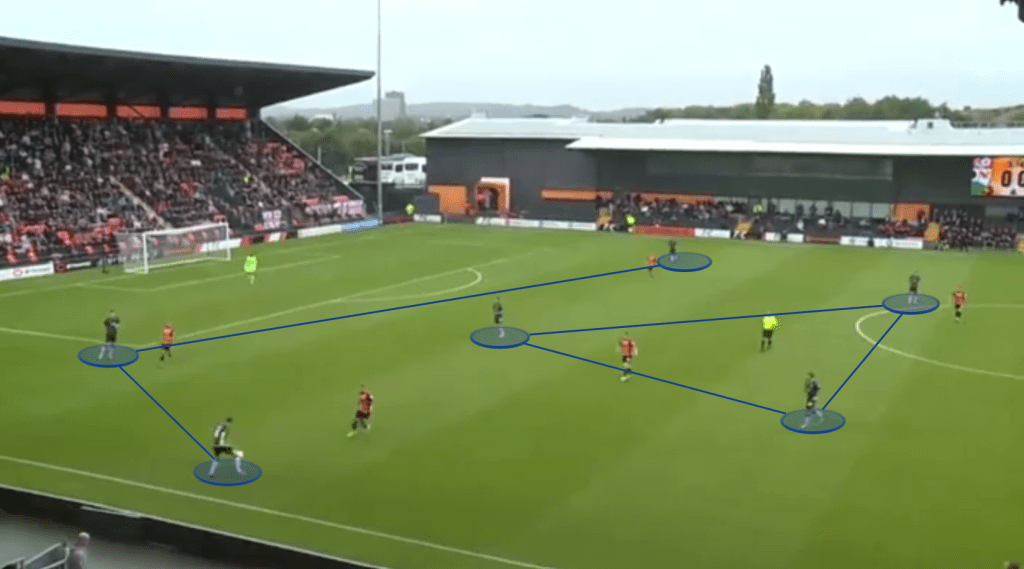
This left Barnet with a 5v4 numerical advantage in the last line. To begin with, Southend didn’t persist with attempting to ‘play out’ from defence. As a result, when they ‘went long’ towards their forwards, Barnet’s numerical advantage gave them the upper hand when it came to winning the loose-ball duels.
On the occasions where Southend did win these loose-ball duels, they could initiate attacks high up the pitch; however these moments didn’t occur regularly and Barnet controlled the majority of the first half, albeit without creating a great deal of high quality chances. Barnet accumulated just a 0.26 expected goals (xG) value in the first half.
Barnet’s opening goal was initiated via their high press. Southend goalkeeper, Collin Andeng Ndi, was put under pressure when receiving the ball, and his clearance barely left his penalty area. Southend did well to reorganise and get back into a decent defensive shape, but Chapman picked up the ball on the edge of the area and struck a 25 yard shot into the bottom corner.
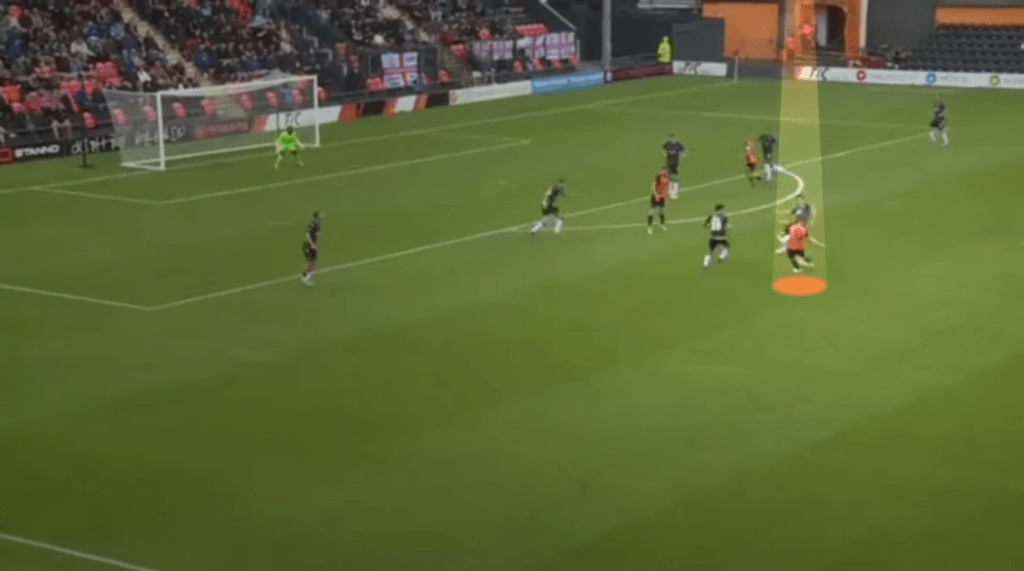
With Southend predominantly ‘going long’ from defence, it put them in a position where, if play broke down, they could press Barnet high up the pitch because they had a lot of players behind the ball. Although they could press aggressively, there were structural issues with Southend’s press which allowed Barnet to progress safely with consistency, as I will now explain.
Barnet’s build-up
Barnet formed a ‘4-2-5’ shape from goal-kicks by using goalkeeper, Nick Hayes, as a situational central centre-back. Their double-pivot of Shelton and Anthony Hartigan sat ahead, with their outside centre-backs, Joe Kizzi and Myles Kenlock, out wide. Further forward, Barnet’s two #10’s and wing-backs pushed into the last line, and Callum Stead was the #9.
Southend pressed in a ‘5-1-2-2’ shape. Their strikers, Harry Cardwell and Danny Waldron, would be positioned between the outside centre-backs and the central centre-back or goalkeeper, and their #8’s, Coker and Husin, would man-mark Barnet’s double-pivot – as illustrated below.
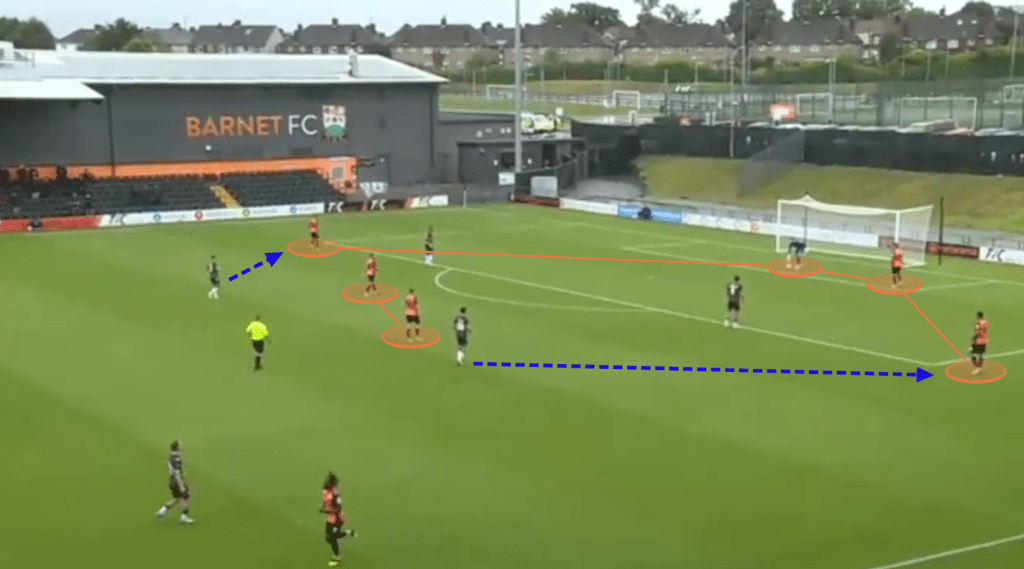
Within the first minute of the match Barnet had a goal-kick. Central centre-back, Nikola Tavares, passed to Hayes, and Southend’s strikers arced their runs to block the passing lanes to the outside centre-backs. With these players now unable to receive a pass, the double-pivot being aggressively man-marked, and Southend’s strikers closing in, it forced Barnet to ‘go long’ from the goal-kick.
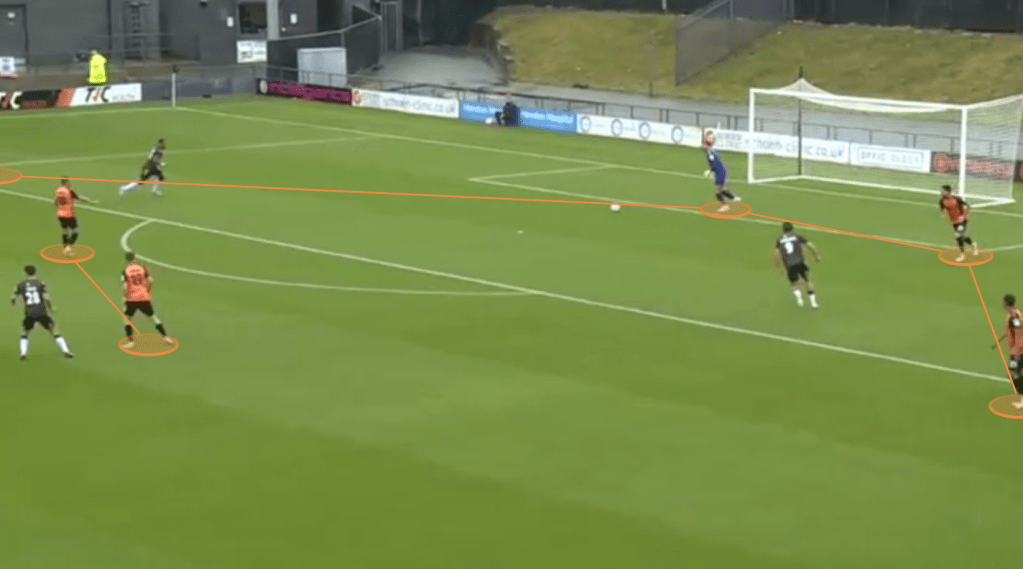
However just two minutes later, Barnet head coach Dean Brennan made a tactical switch. From their second goal-kicks, Hayes passed to Tavares. This was significant as Cardwell was now less inclined to arc his run to block the pass out to Kenlock, and pressed Tavares instead. This allowed Kenlock to receive the pass, drawing out Coker to press him. As Coker was previously man-marking a Barnet #6, he was now free and could receive the ball to help Barnet progress (below).
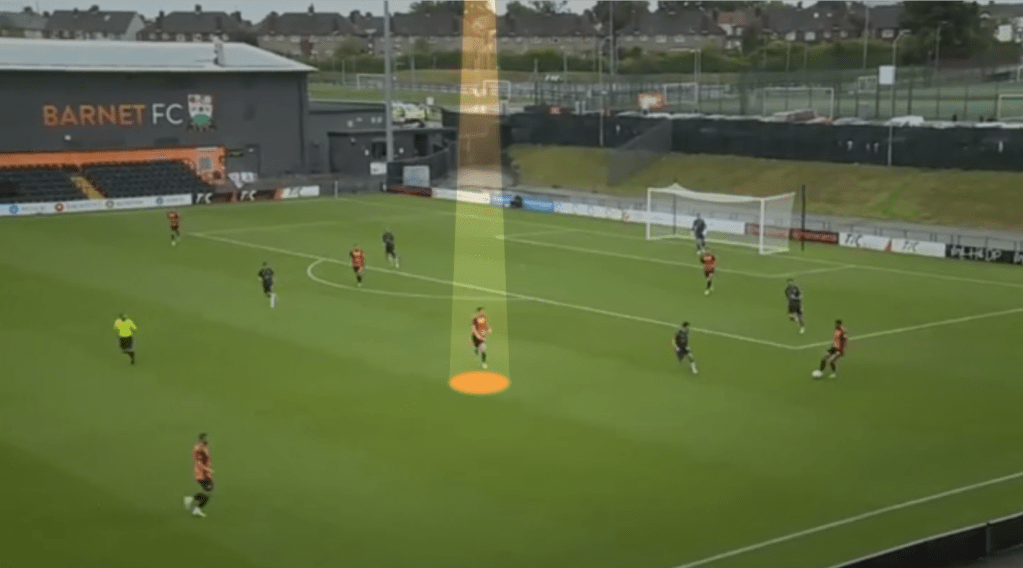
Because Coker was no longer able to man-mark the #6, Cardwell should have been responsible for dropping back to man-mark the now vacant #6. However, he is much more effective at leading the press as opposed to strictly man-marking a central-midfielder.
As the second half went on, Southend managed to find the spare man in their build-up more often, and could sustain attacks of their own. Scott-Morriss was on the end of a cross into the Barnet penalty area to equalise.
Nevertheless, Barnet did have some difficulty with ‘playing out’ from defence to begin with. Brennan then re-positioned his double-pivot so that Hartigan was now the lone #6, with Shelton positioned slightly further forward. This again caused Southend some confusion, as their #8 weren’t sure who should be pressing him. This meant that Hartigan had an initial moment of time on the ball before he was pressed which, for a player of his quality, is enough.
Barnet were also able to create dangerous moments through the means of artificial transitions. These are moments where a side attack at speed with a change of tempo, similar to a transitional moments, but where there has been no turnover of possession. These ‘transitions’ have, therefore, been created artificially. With five dynamic players pushed into the last line, pinning Southend into a back-five, Barnet could drag Southend’s man-marking defenders out of position, play beyond their defensive line, and create dangerous moments to get up the pitch.
These last two points – the ‘staggered’ positioning of Barnet’s double-pivot, and their 5v5 in the last line – contributed to Barnet’s winning goal. Barnet found Kenlock in space during their deep build, and he passed towards a #10. This dragged out Harry Taylor into the midfield (below) and created space in Southend’s defensive line. This eventually led to Barnet progressing into the penalty area and winning the decisive penalty kick.
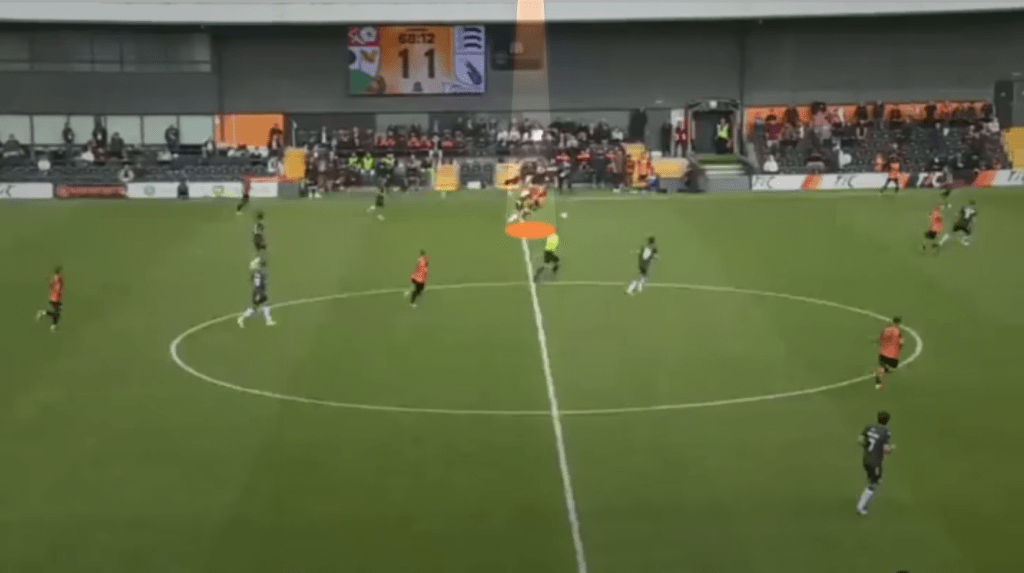
Alternatively, a Barnet #10 could drop deeper into space. Southend’s outside centre-backs were tasked with following these #10’s into the midfield to press. However, these #10’s would sometimes drop very deep, into an unfamiliar area for Southend’s centre-backs, causing some confusion as to whether they should be aggressive and press, or be passive and keep their position. If the centre-backs were cautious, Barnet had an overload in the build-up and could progress.
But it wasn’t just the movement of Barnet’s #10’s which caused confusion for Southend’s centre-backs. Stead, who was playing as the #9 for Barnet, would regularly drift wide and drop into the midfield. This lack of constant positioning meant that Southend’s central centre-back, Adam Crowther, would often be dragged out of position due to his aggressive nature.
Because they could reliably play through Southend’s press, Barnet managed to create settled attacks fairly well. This allowed them to push their players high, counter-press when play broke down, and sustain attacks.
After Southend had won possession back in their own defensive third, they would often look to initiate a quick counter-attack. However, this involved trying to force risky passes over long distances and, because the attack was too quick and direct, possession was often lost soon after. This allowed Barnet to regain possession and build another attack.
Conclusion
To summarise, Barnet’s press forced Southend to ‘go long’ during the first half rather than safely build attacks, and their overload in their build-up allowed them to progress forward and sustain attacks. This gave Barnet a 56% possession share in the first half; although they only generated an xG of 0.26. The opening goal was a direct result of Barnet’s press.
In the second half, Southend started to find the spare man in the build-up more regularly, and had the momentum. They were able to sustain pressure much better, and scored an equaliser as a result of this pressure.
Barnet’s winning goal was a direct result of them managing to find the spare man in their deep build, as well as creating an artificial transition by having a 5v5 in attack.
Barnet’s total xG of 1.3 (inclusive of the penalty), and Southend’s 0.71 xG is symbolic of how the match wasn’t full of high quality chances; although Barnet won the tactical battle and had the quality to be on the right end of the result.
 Shrimper Stats
You must be logged in to post a comment.