On Saturday afternoon, two of the National League’s promotion favourites went head-to-head, as Rob Elliot’s Gateshead faced Dean Brennan’s Barnet.
In this article, I’ll break down the tactical battle and analyse how Gateshead picked up a huge three points.
Gateshead’s build-up
As the contest was between two possession-based sides, their respective methods to facilitate and prevent ball-progression was vital to dictating who managed to gain control of the match.
Gateshead built play from defence in a ‘3-diamond-3’ shape and, from goal-kicks, formed a back-four by using their goalkeeper, Harry Moss, in the first line of build-up. To counter this, Barnet pressed in a 5-1-3-1 shape.
Their centre-forward, Callum Stead, pressed Gateshead’s central centre-back, Robbie Tinkler; whilst their two #10’s, Zak Brunt and Harry Chapman, shadow-marked Gateshead’s #8’s, Callum Whelan and Ben Worman. One of Barnet’s central-midfielders, Mark Shelton, was positioned higher to mark Gateshead’s #6, Regan Booty; whilst their other, Anthony Hartigan was positioned deeper to mark Gateshead’s #10, Jacob Butterfield. This would leave Barnet with a 5v3 numerical advantage in the last line of defence.
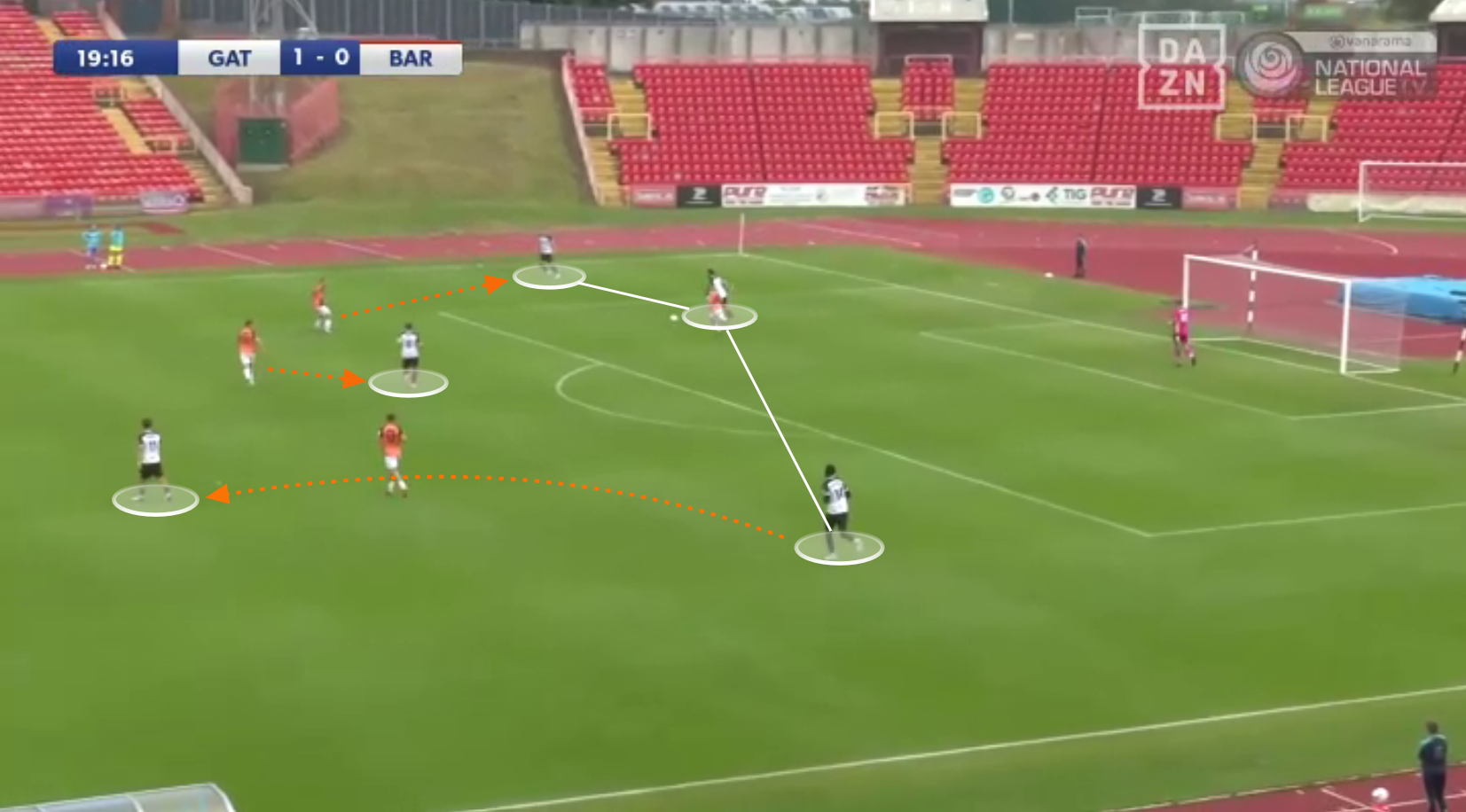
Once Gateshead had built down one side of the pitch, it was the responsibility of Barnet’s ball-side #10 to press whichever of Gateshead’s outside centre-backs had the ball. Barnet’s far-side #10 was then supposed to shift across and mark the far-side #8. This zonal turned man-to-man press of Barnet’s would leave Gateshead with just two spare players in the build-up: their goalkeeper; and their far-side outside centre-back, who could only receive the ball if Gateshead switched play with a risky pass across their own goal.
If a Barnet #10 couldn’t press the outside centre-back, their ball-side wing-back would jump to press him instead, whilst still leaving them with a 4v3 in the last line.
During their deep build, Gateshead would use ‘keeper Moss as a situational centre-back in a back-four. This gave Stead an additional player to press. If he wasn’t able to cover the distance from one player to the other quickly enough, a Barnet #10, usually Chapman, would jump to press the spare player instead. This acted as the trigger for a Barnet outside centre-back, Myles Kenlock in this instance, to step into the midfield to mark the Gateshead #8 who had been left by Chapman.
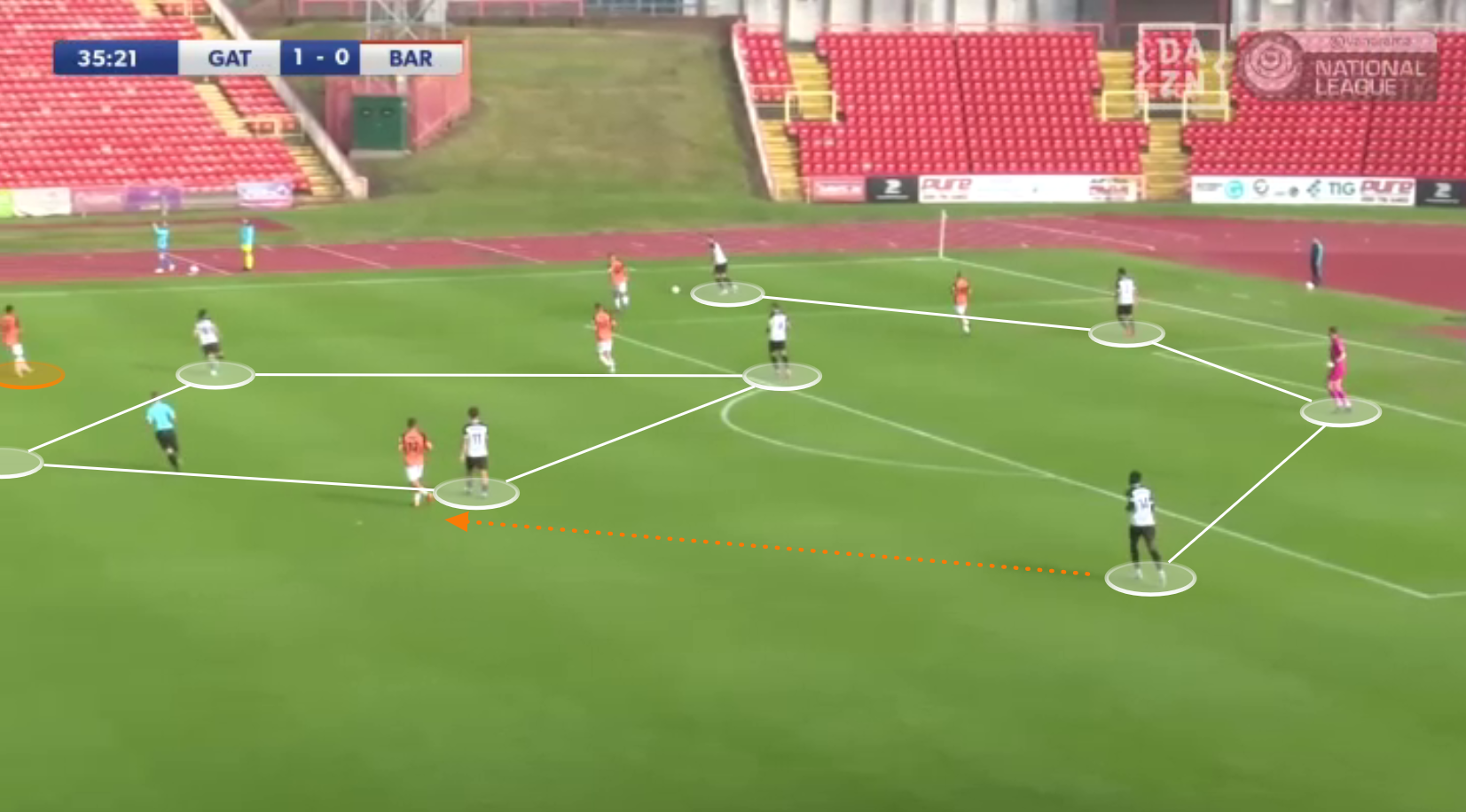
However, this wasn’t just any side Barnet were up against. Rob Elliot’s Gateshead have elite technicians all over the pitch and, combined with their patient approach, could still find the spare man in the build-up to progress play, and sustain pressure in Barnet’s third.
Nevertheless, Barnet still did a pretty good job of forcing Gateshead to ‘go long’ towards their centre-forward, Owen Oseni. This method of ball-progression is riskier than safely progressing through the thirds, as there are more duels that have to be challenged for.
Barnet’s press forced Gateshead to launch 43% of their goal-kicks (above their season average of 33%), and ‘go long’ with 15.69% of their total passes (their highest percentage so far this season, above their average of 10.79%). These statistics are significant as it limited Gateshead to just a 53% total possession share – their lowest of the season so far (below their average of 62%).
Although this is more advantageous for Barnet, forcing Gateshead to ‘go long’ rather than allowing them to build safely, Gateshead have more than one way of creating danger. After playing over the press towards Oseni, he could either hold play up to bring onrushing Gateshead players into play, or challenge for aerial duels.
Gateshead were then aggressive in these loose-ball duels to win their fair share of them, regain possession, and cause Barnet problems in the large spaces that were there. From here, they could either use their dynamic players to create chances in transition; or keep the ball, wait to get the rest of their players forward, and sustain pressure on the edge of Barnet’s penalty area.
Barnet’s build-up
Barnet built play in a 3-2-2-3 shape, with Gateshead opting for a zonal 4-2-3-1 press. Gateshead’s centre-forward, Oseni, pressed the central centre-back, Adebola Oluwo; whilst their wide players, Whelan and Kain Adom, pressed the outside centre-backs. Gateshead’s #10, Butterfield, marked Barnet’s #6, Hartigan, who was positioned deeper. Gateshead’s two central-midfielders, Booty and Worman, marked zonally, with Barnet’s two #10’s and Shelton all in close proximity; and they were left with a 4v3 numerical advantage in the last line.
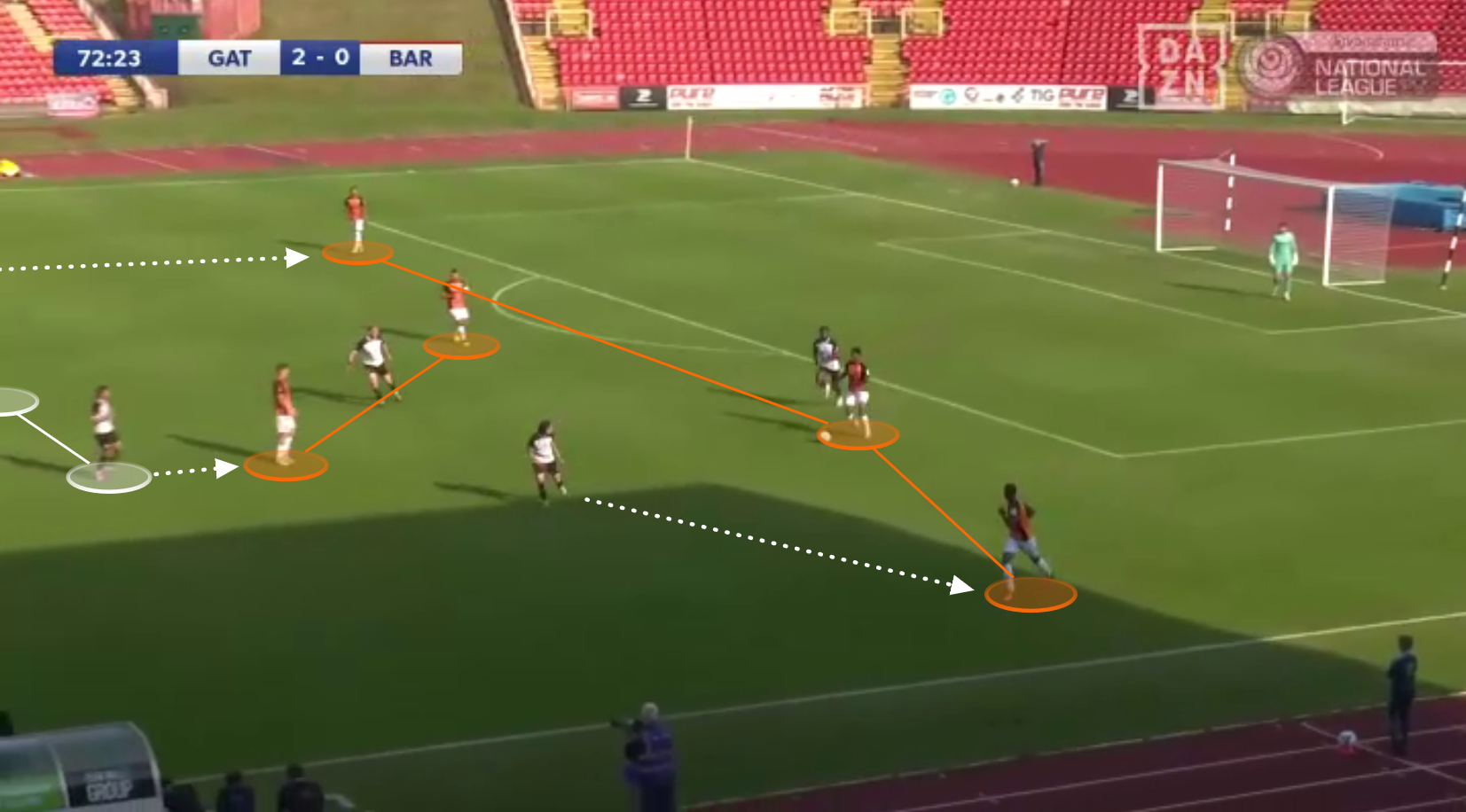
Because Gateshead could easily press with a front-three versus Barnet’s back-three; Barnet’s #6, Hartigan, was taken care of; and they were less inclined to use their goalkeeper in the build-up; Barnet ‘went long’ more than Gateshead. This, again, meant that they struggled to progress safely and sustain attacks.
Gateshead’s press forced Barnet to launch 70% of their goal-kicks (above their season average of 37%), and ‘go long’ with 19.06% of their total passes (their highest percentage so far this season, above their average of 12.20%). These statistics contributed to Barnet managing just a 47% total possession share – their lowest of the season so far (below their average of 64%).
However, Barnet still had chances to at the very least make the score-line less convincing. They accumulated an expected goals (xG) figure of 2.00; compared to Gateshead’s 1.28 xG.
Conclusion
As a battle of two of the division’s best sides, at controlling matches through possession and in terms of quality, the pressing structures implemented by each coach were always going to be vital to dictating who would manage to control the match.
It was a high-level tactical battle between two top coaches, with neither side dominating the match. Gateshead were on the right end of the result due to their aggression in the counter-press and loose-ball duels, which allowed them to attack more frequently; but Barnet still had enough chances themselves and on another day could have picked up a result.
The reverse fixture promises to be just as fascinating from a tactical perspective, and I expect both sides to still be towards the top of the table when that day comes.
 Shrimper Stats
You must be logged in to post a comment.