Ollie Kensdale has missed Southend United’s last five matches, and I believe that his absence from the side has huge implications both in and out-of-possession.
In this in-depth article, I’ll analyse Kensdale’s profile; explain how it differs to Southend’s other centre-backs, including the man who has stepped into his position, Adam Crowther; and assess how suitable Kensdale’s profile is to the central centre-back role.
Kensdale’s in-possession profile
The first thing that is noticeable when watching Kensdale play, is how comfortable he is on the ball for a centre-back. Below, look how he elegantly places his studs on top of the ball. This may seem insignificant; but it epitomises just how calm, composed and thoughtful he is when in possession of the ball. He always wants to make the ‘right’ pass, and doesn’t like to be rushed into making the wrong decision; but can increase the tempo when needed.
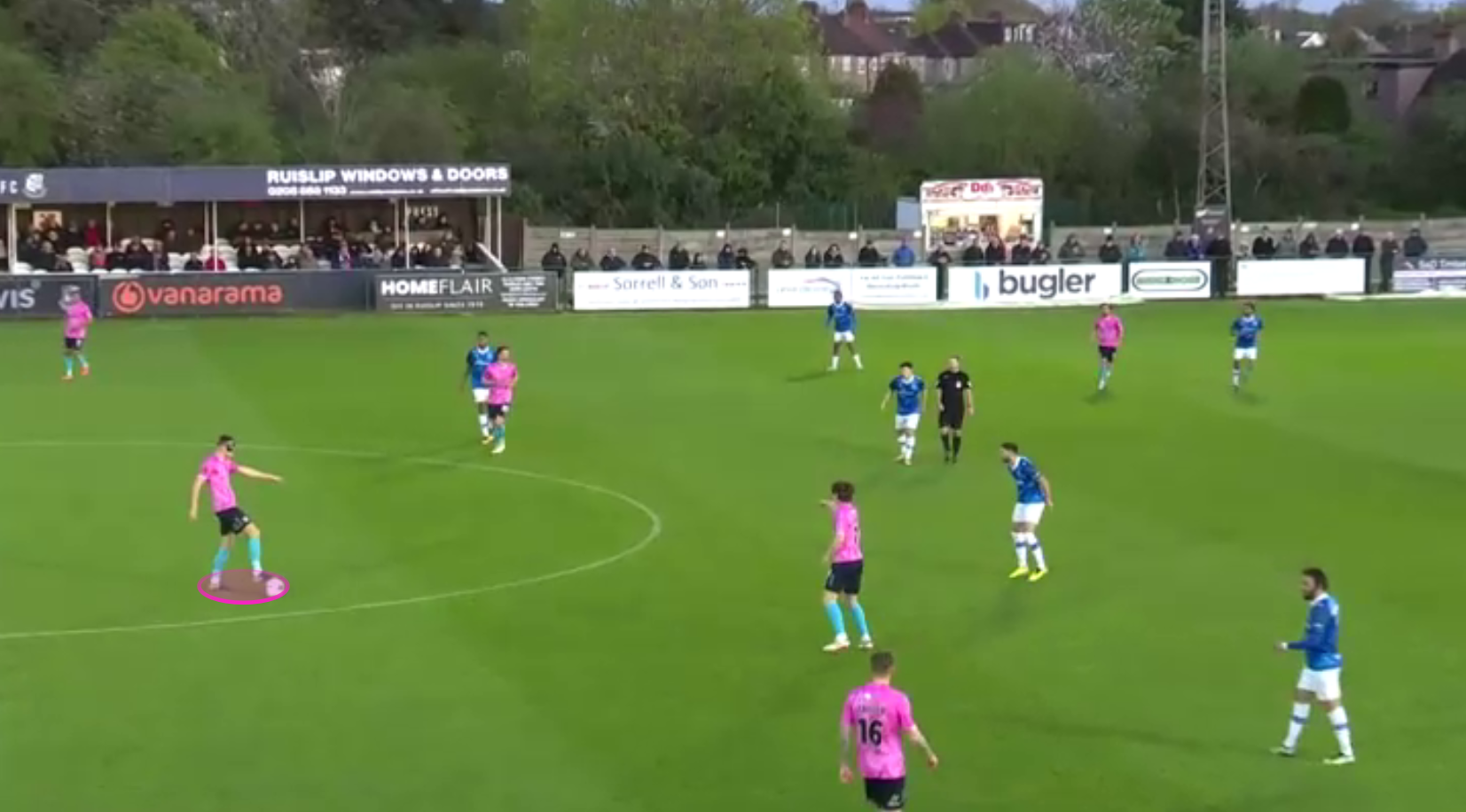
With his studs on top of the ball, Kensdale’s weight is evenly distributed, allowing him to quickly manipulate his feet, despite his height, and shift to either side depending on where he is pressed from. The fact that Kensdale is comfortable using either foot assists him in this instance; and his composure on the ball increases his press-resistance, which allows him to bait the press from an opponent, drawing them out, before finding the spare player in the build-up.
Kensdale’s calmness on the ball is felt by the rest of the team. It’s not unusual to see him asking for the ball in his own penalty area. Take the below example, for instance. After Harry Taylor won the ball deep in Southend’s half to stop an opposition attack, rather than just launching the ball forwards at the earliest opportunity, which may have allowed another attack to materialise, he instead passed to Kensdale. Although he was put under immediate pressure, Kensdale still managed to pass forwards into the midfield, and Southend could initiate an attack of their own.
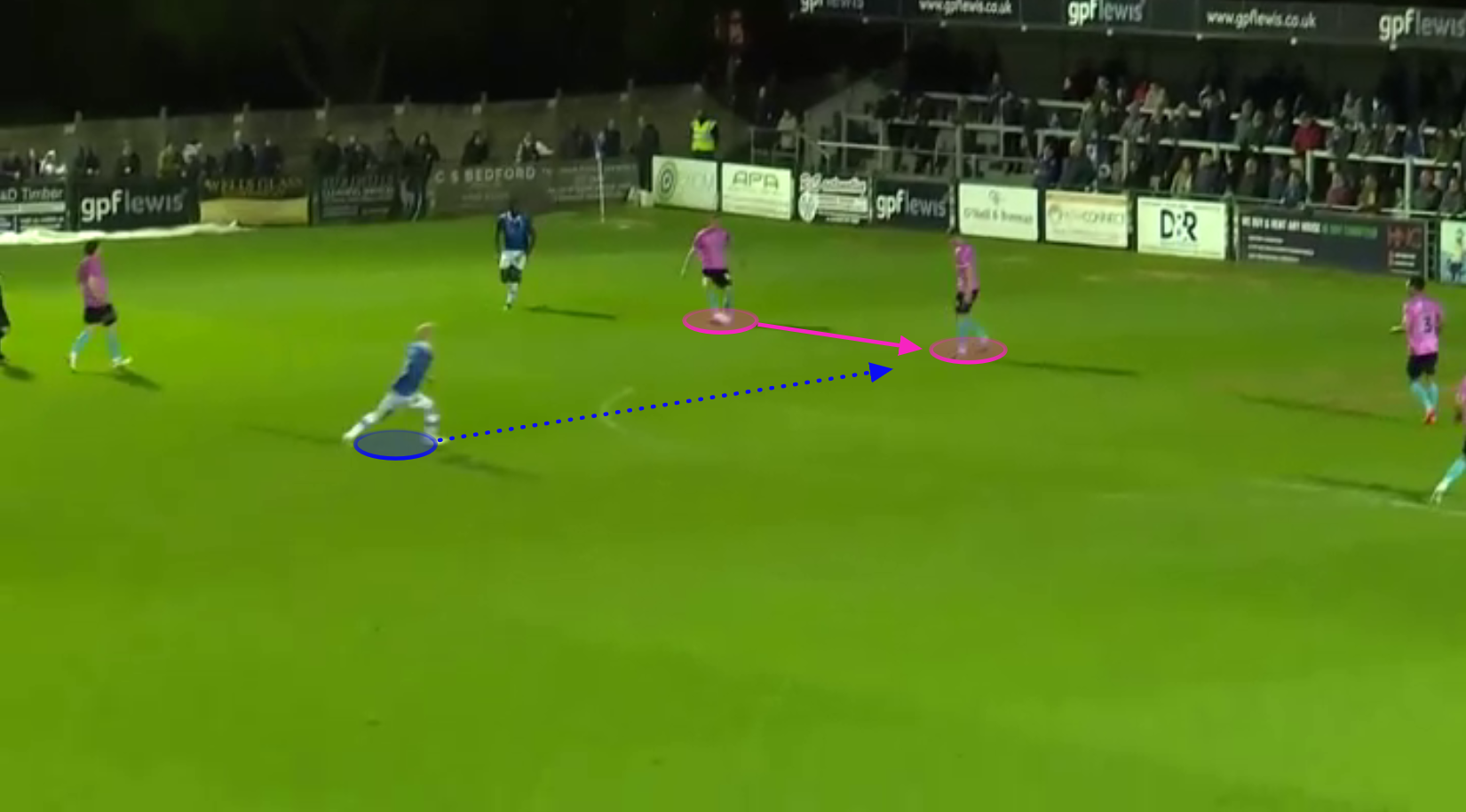
Kensdale doesn’t tend to ‘force’ risky passes. He prioritises ball-retention, which is important for a possession-based team like Kevin Maher’s Southend, especially for someone in the central centre-back role.
However, Kensdale doesn’t just make safe, side-way passes. He can pass laterally, attempt line-breaking passes or carries into the midfield, hit big switches of play, or ‘play over’ the opposition for forwards to run onto.

Although he is right-footed, Kensdale’s passing range allows him to play on the left-side of defence. Here, he can position his body to face the entire pitch, which gives him more passing options. This means that, if he was used as part of a back-four, he would suit the left-sided centre-back role better than the right-sided role. It would be more difficult to make use of his passing range if positioned on the right-side as, due to right-footedness, there would be fewer passing options to find. This would make his pass selection more aggressive, and potentially lead to more turnovers.
Kensdale is a technically elite player for National League level. He oozes class on the ball, and is quite clearly one of the very best ball-playing centre-backs in the whole division.
Of course, he may be guilty of ‘over-playing’ or making mistakes. However, he is still a non-league player at the end of the day, and at 24-years-old, he’s still a long way from reaching his peak. With more time, his maturity will likely improve further; but the attributes are already there for him to succeed.
Kensdale’s out-of-possession profile
However, it’s not just Kensdale’s in-possession profile that makes him a good fit for the central centre-back role.
Kensdale generally likes to position himself slightly behind the rest of the defensive line, which allows him to assess the whole picture and have a head-start on opponents. His positioning allows him to deal with passes played in-behind the defensive line by sweeping up, and lets him be proactive rather than reactive when defending.
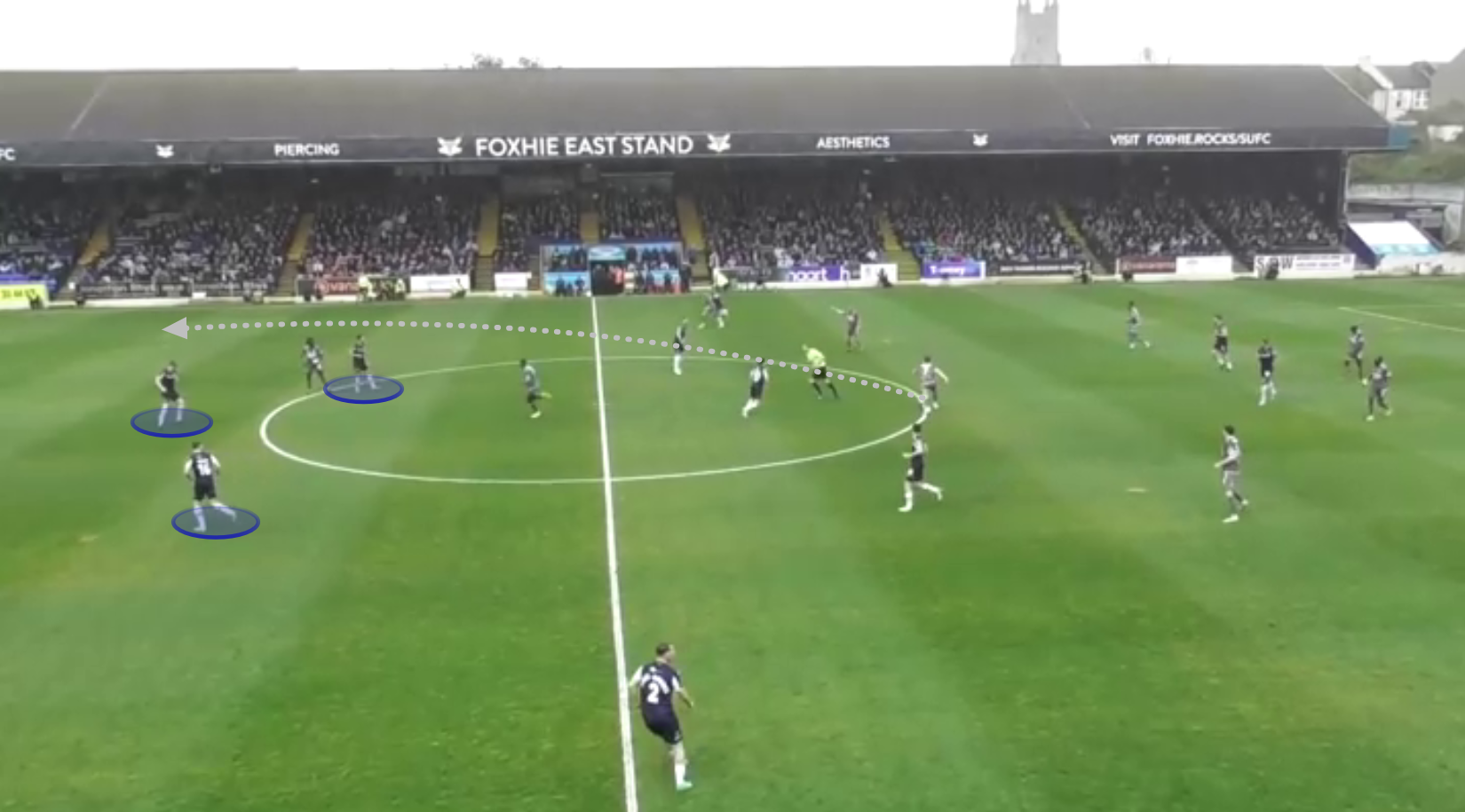
Let’s have a look at a couple of examples…
Versus Ebbsfleet United last season, a through pass was played beyond Taylor, for Toby Edser to run onto. Because Kensdale was initially positioned slightly behind the defensive line, he was able to have a head start, shift across to the right-side and get to the ball before Edser. Kensdale’s positioning meant that he was proactive, rather than being reactive and defending as and when the issue occurred in the moment.
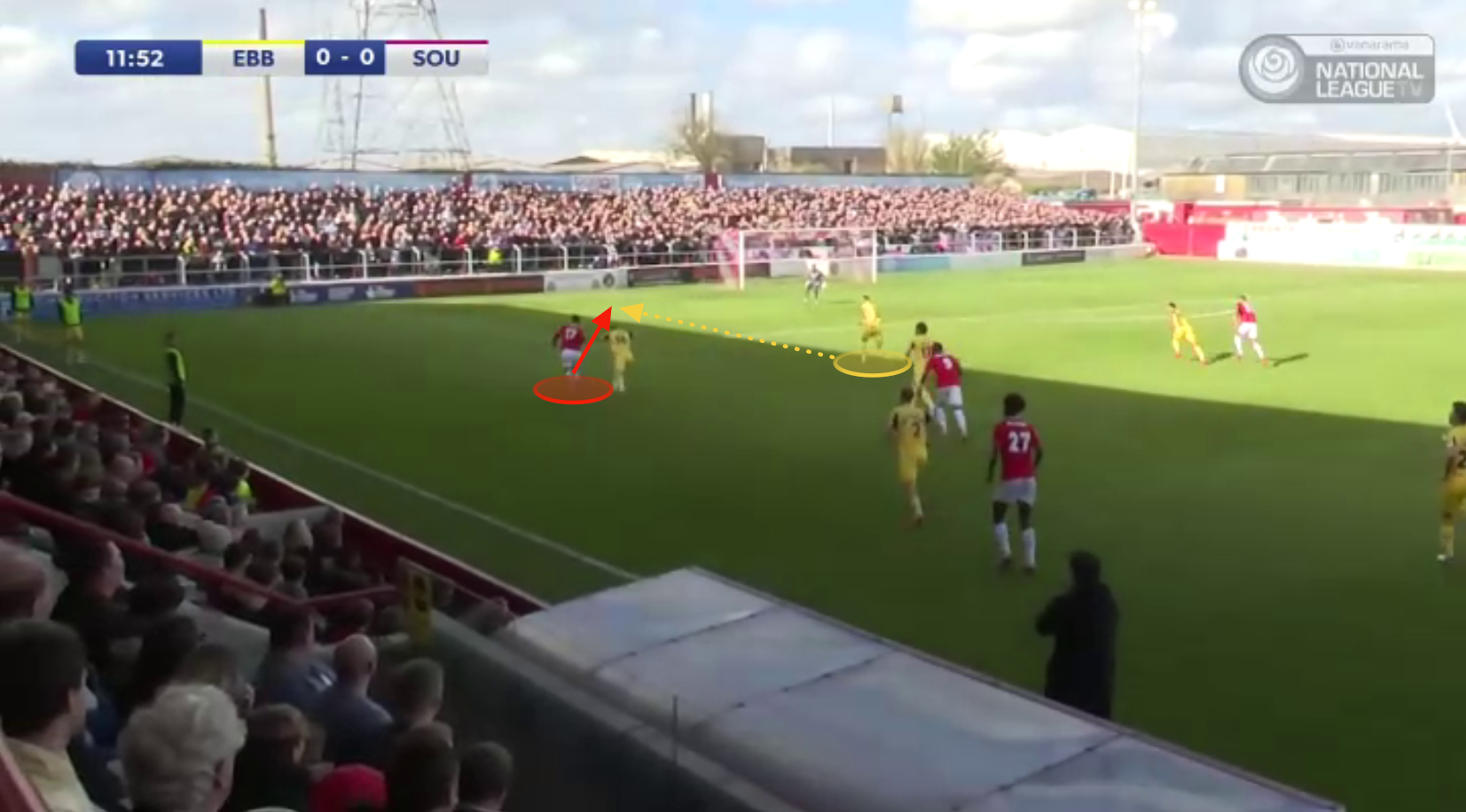
Here’s another example. Versus Wealdstone, there was a transitional moment and Southend were forced to defend whilst running back towards their own goal. Kensdale was the last defender but, rather than engaging in a defensive duel, he sat off the ball-carrier and forced him to go wide. With Wealdstone forced slightly wider, it gave a couple of additional Southend players time to get back and defend. Wealdstone were forced to shoot from an unfavourable position, and the shot was saved by goalkeeper, Collin Andeng Ndi.
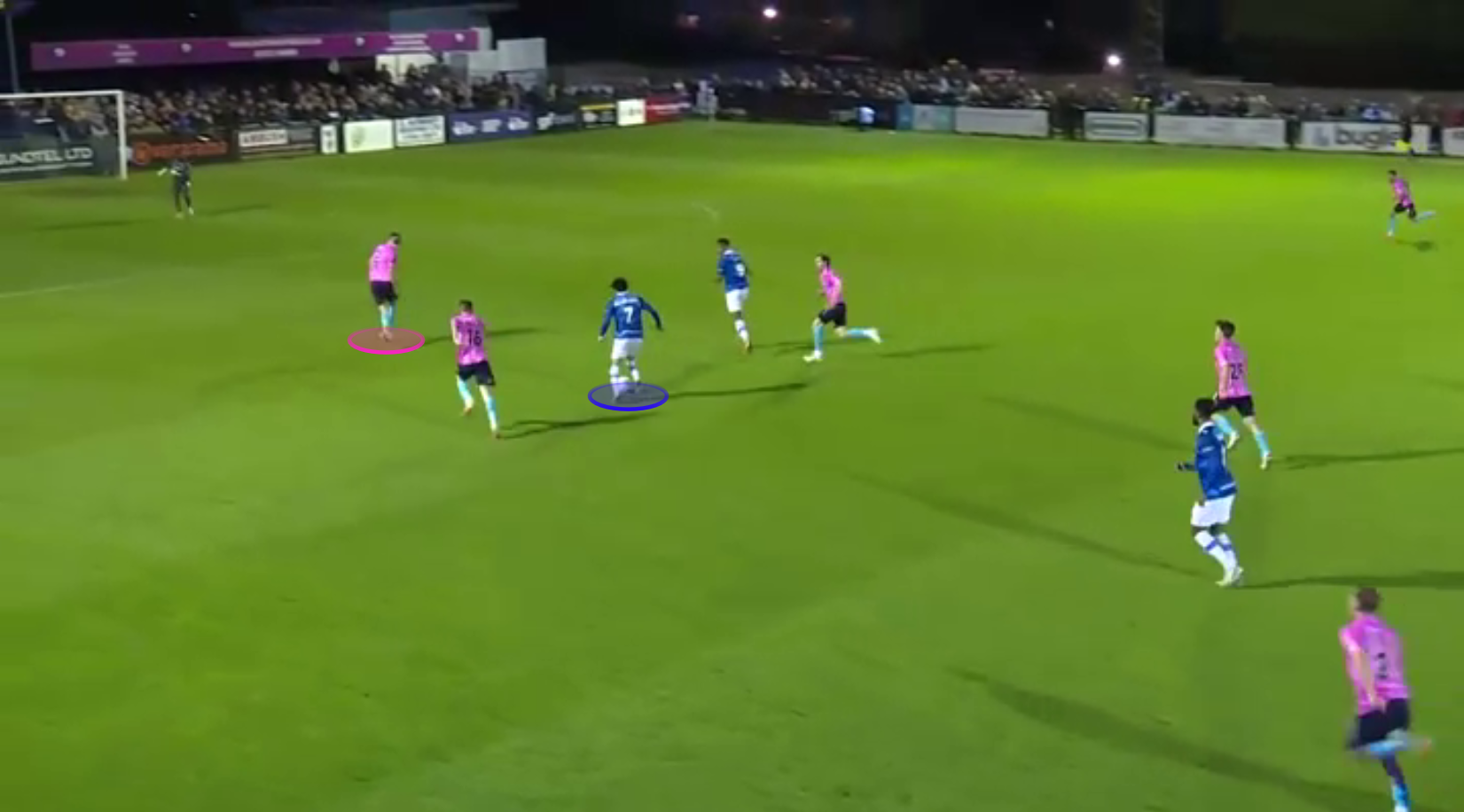
If Kensdale had stepped forward and engaged in the defensive duel in that moment, it would have left a huge space in-behind the defensive line for the other Wealdstone player to run into, and a goal would have looked far more likely. Although Kensdale perhaps isn’t the most effective when it comes to duels (more on that shortly), it’s these subtleties which make his defensive style useful, without it necessarily showing up in the data.
Kensdale also possesses the leadership qualities required to manage the defensive line from his central position. This is helped by his ‘hanging back’ style which allows him to assess the whole picture. Again, though, he still hasn’t reached his peak, so this part of his game may develop even further.
His positioning typifies his defensive mindset – to be cautious rather than aggressive. He doesn’t unnecessarily dive into duels, which makes him the perfect profile for the central centre-back role. This can be quantified when we consider that, last season, Kensdale only attempted 0.25 slide tackles per 90 minutes. This is a very small amount, and meant that he only dived into duels once in every four matches.
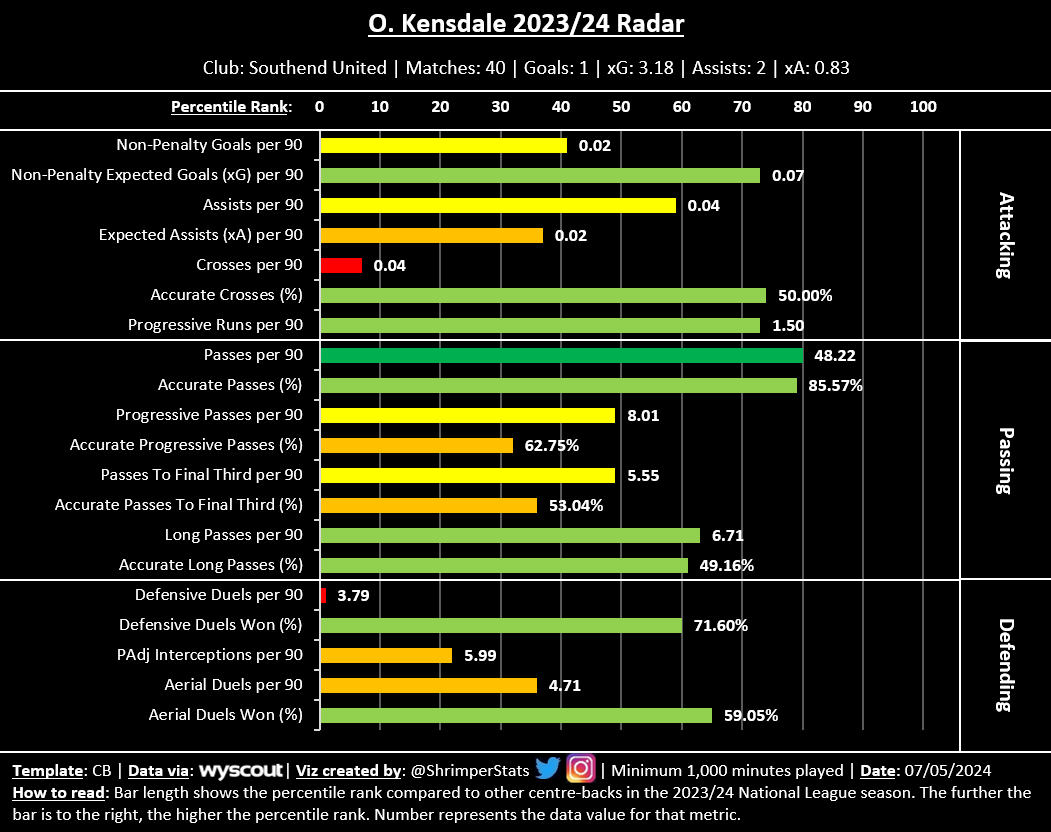
However, what about when he does have to challenge for duels? Using data from the 2023/24 National League season, Kensdale attempted just 3.79 defensive duels per 90 minutes, but won an impressive 71.60% of those. It’s a similar story when we investigate his effectiveness aerially. Kensdale attempted 4.71 aerial duels per 90, but was successful with 59% of them.
Using the below player visualisation chart, we can see how, compared to the rest of the National League’s centre-backs last season, Kensdale ranked poorly at defensive and aerial duels attempted, but ranked well at the success rates. However, Kensdale is still not physical enough to be considered a truly elite National League centre-back. He’s technically elite, not physically. His profile suits his role requirements perfectly; he is elite technically, albeit with a few mistakes here and there; and is a good defender. But one of the things holding him back from playing higher up the pyramid is a lack of top physical presence in the duels.
How Kensdale’s profile differs to Southend’s other centre-backs
Adam Crowther has stepped into Ollie Kensdale’s central centre-back role in his absence. However, they are very different profiles, who bring different things to the side, as I will now explain.
Crowther isn’t as composed on the ball as Kensdale, and is more reliant on his right foot, making him easier to press. He also has a tendency to rush his passes slightly, and attempts slightly riskier passes than Kensdale, who values ball-retention more. Overall, Crowther isn’t at the same level as Kensdale technically; although he’s still a decent ball-playing centre-back for this level.
But it’s not just his in-possession profile that differs from Kensdale.
Take the third goal that Sutton United scored at Roots Hall on Saturday for example. Sutton won the ball in the middle third of the pitch and drove towards Southend’s defensive line. Our central centre-back, Crowther, decided to step forward and engage in the defensive duel; but this left a huge space in-behind the defensive line which was then exploited.
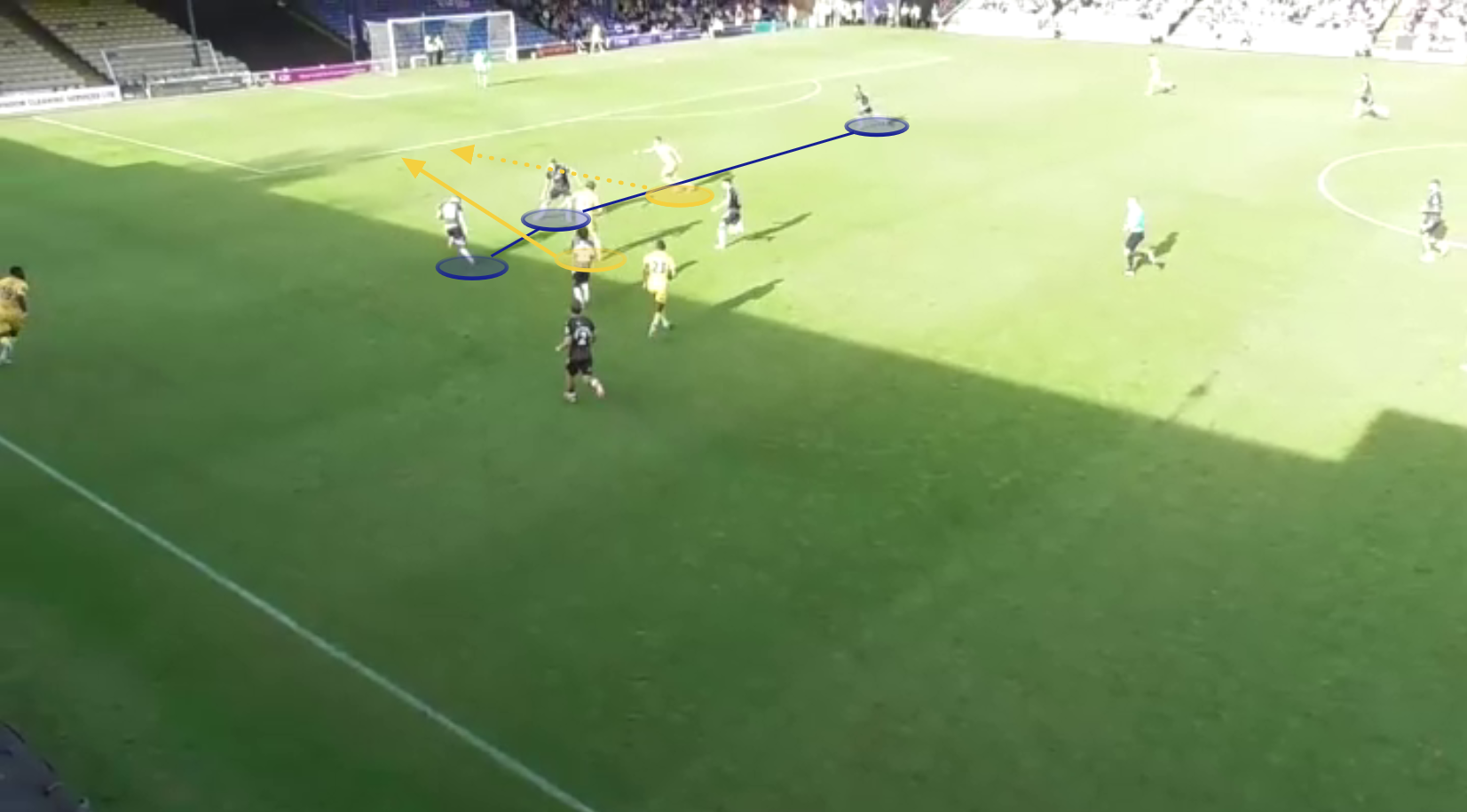
If the duel was won, then fine; but if not, our defence is vulnerable. That’s not a criticism of Crowther, it’s just an observation that his profile is different to Kensdale’s. Crowther is more of an old-fashioned, ‘battler’ centre-back, and likes to challenge for defensive and aerial duels. Kensdale’s defensive approach is different, however, in the sense that he’s much more passive than Crowther, and likes to position himself slightly behind the rest of the defensive line, which allows him to be proactive rather than reactive.
This passive, proactive approach to defending makes Kensdale the perfect profile for the central centre-back role, when he’s partnered with aggressive outside centre-backs either side of him, who can step into the midfield or challenge for defensive duels in the wide areas – like Harry Taylor and Nathan Ralph.
That’s not to say that Crowther can’t play in the central centre-back role – he can, he just defends in there differently to how Kensdale does. When he does have to challenge for duels, his additional physicality makes him better suited than Kensdale at defending them. Crowther is also better suited to defending set-pieces, or crosses into the penalty area when we’ve been pinned back, for instance.
Crowther isn’t as aggressive as Taylor or Ralph, who have to play on the outside of the back-three. He’s more of a balanced profile: not as aggressive as Taylor, but not as passive as Kensdale. This means that he’s able to play in either the right-sided or central centre back role for Southend. Last season, Crowther attempted 4.19 defensive duels per 90 minutes; whereas Taylor attempted 8.03 per 90, and Kensdale 3.79 per 90.
With a back-three of Taylor, Kensdale and Ralph, the aggressive/passive balance was perfect. Taylor and Ralph could challenge for duels, and Kensdale could sweep up behind them. With Crowther now in there instead, it tips the balance slightly the wrong way, in my opinion.
I actually think that to profile Crowther correctly would be to use him as the right-sided centre-back within a back-four, next to an equally balanced profile. Perhaps a back-four build-up could soon be on the cards for Southend; with Gus Scott-Morriss still positioned high and wide on the right-side; and Jack Bridge moving out to the left-side during the build-up, from a central-midfield position.
 Shrimper Stats
You must be logged in to post a comment.