Southend United are still yet to reach the levels of consistency that were on display last season. In this in-depth article, I examine why that has been the case; delving into player availability issues, recruitment and tactics; and detail my solution.
Pre-season
First of all, let’s rewind to the summer. Southend had just accumulated 75 points (only not qualifying for the National League play-offs due to a points deduction), and had finished on 69 points in 2022/23. A play-off level squad had already been assembled.
Out went wing-back Jason Demetriou and forward Callum Powell, and in came George Wind and Josh Walker. Two good replacements. Joe Gubbins was added for extra depth in the left-side of defence, and goalkeeper Dave Martin was replaced by James Hillson and more recently Zach Jeacock.
Going into the season, another #8 was still needed to replace Wes Fonguck; and another #9 to complement Walker, Harry Cardwell, Danny Waldron and Jack Wood; after Henry Sandat and Marcus Dackers’ loans had expired.
Midfielders George Moncur and Keenan Appiah-Forson then joined after the season had started.
Recruitment was delayed due to the club’s takeover not completing until after pre-season had started, another #9 was still needed, and it was going to take a while to get players up to speed, but the squad was in decent shape.
Then, at the end of August, Cardwell and Ollie Kensdale both departed the club.
Those were two hugely important players for Southend. Kensdale was part of the best defence in the division in 23/24; Cardwell scored 18 goals in that same season; they were mainstays in the XI, starting 85 and 60 matches, respectively, over the previous two seasons; and Southend didn’t have the profiles in the squad to replace the attributes that made them so vital to the system.
In came strikers Bim Pepple and, shortly after, Macauley Bonne. More late recruitment, which couldn’t be helped. There was always, therefore, going to be a period of transition whilst all these new players got up to speed, and it’s impossible to predict how long this will last. Walker, Waldron, Cav Miley and Oli Coker have also spent considerable time out through injury this season.
However, we’re now almost half-way through the season and Southend have a near fully fit squad. So why are the performance levels still not where we would’ve expected them to be?
To answer that question we must consider the tactics…
Tactics and recruitment go hand in hand. Therefore, when we consider the tactics, we also have to evaluate the profile of players at disposal.
Defence
Let’s start with the defence.
Kensdale’s ‘replacement’ in the centre of the back-three, Adam Crowther, isn’t as suited to defending in a high line as Kensdale. He’s more of an aggressive type, who’s brave and wants to commit to duels.
That’s fine if he’s defending his penalty area, where he can tackle and make clearances; but if he’s defending on the half-way line, commits forward to engage, and loses the duel, the space left in-behind can be exposed.
Crowther’s also not athletic enough to man-mark opposing forwards who may be more dynamic, and lacks the recovery speed necessary to keep up with opponents when the opposition play long passes beyond the defensive line.
Consequently, it makes sense for Southend to defend in a deeper block with a back-five, where Crowther can create a +1 against opposition front-fours.
However, this means that Southend can’t press high in the same way that they could with a high defensive line, because there’d be too much space left between the lines which could be exposed. You can’t press high with a low defensive line. They have to complement each other.
In-possession, Crowther’s easier to press than Kensdale because he doesn’t possess the same technical quality. This makes it more difficult for Southend to ‘play out’ from defence, build and sustain attacks, and control possession. My analysis of the differences between Crowther and Kensdale’s profiles can be found here.
Southend have averaged a 52.56% possession share so far this season (down from 55.79% last season), and have attempted fewer passes (407.7 per 90, versus 441.78 last season). This relinquishment of control, through passing and pressing, means Southend spend more time without the ball and have more defending to do.
This more passive approach could still work, but Southend struggle in transition as the 5-3-2 block only leaves two players high up the pitch when defending deep.
This has knock-on effects for winger Jack Bridge. With Southend spending less time with the ball, he’s asked to defend deep as a wing-back more often – which doesn’t suit his profile.
Then, in attack, he’s not as effective in transition, partly because he’s asked to defend in the back-five, and needs to play higher regularly to be at his most dangerous. Possession needs to be sustained for this to happen – through building attacks safely and pressing.
Midfield
That brings us on nicely to the midfield.
Fonguck’s profile helped Southend’s left-side to thrive. His ability to play ahead of the ball and make forward runs took players away from Bridge, and made it easier for him to create separation from his marker. Their understanding of each other’s game was also incredibly well-drilled.
It was always going to take time to replicate the previous automatisms the left-side had after Fonguck’s departure.
However, no direct replacement was recruited in the summer.
Moncur, although a qualitative upgrade on Fonguck, is another ‘to feet’ player who doesn’t replicate Fonguck’s forward runs, which crowds space for Bridge. Other new midfield signing Appiah-Forson has exclusively been used in the right-sided #8 role, instead. As a result, it’s now easier for opponents to ‘double-up’ on Bridge because there isn’t as much off-ball movement to take players away from him.
This makes it more difficult for Bridge to create separation from his marker, and it has a direct influence on how effective he is. Last season Bridge accumulated 0.34 expected assists (xA) per 90 minutes through the chances he created, and registered 11 assists; whereas this season it’s halved at 0.16, and he only has one assist so far.
Irrespective of who plays in the left-sided #8 role, next to Bridge, there’s too much right-footedness on that side. Moncur and Noor Husin are both right-footed, as is Bridge; and left-footers Miley and James Morton are natural #6’s, instead, who are more effective in the first two thirds of the pitch. The angles, therefore, become a bit too predictable.
Additionally, the right-footedness of these players often forces them to face inside the pitch. This enhances the number of passing options, making it easier to retain possession and sustain attacks. However, the additional passing options can lead to a lack of directness in the final-third, making Southend less penetrative.
That’s why I was desperate for Southend to sign a left-footed #8 to replace Fonguck in the summer. Players attacking on their ‘natural’ side reduces the passing options, and the angles force them to be more aggressive with their pass selection. Too much directness would lead to too many turnovers; but in the final-third, and next to Bridge, who’s profile favours ball retention rather than an overly direct approach, the balance would be fine.
Attack
Finally, in attack.
Pepple is a good Cardwell replacement profile-wise and allows Southend to use him in the same way, tactically. However, he’s not yet as proven as Cardwell at this level, has less of an ‘engine’, and struggles to be effective for the full 90 minutes.
Bonne hasn’t contributed enough yet, and Waldron is still returning to full fitness after coming back from injury and hasn’t had a full season at this level.
The squad is qualitatively weaker in attack without Cardwell. So far this season, Southend have scored 1.1 goals per 90 minutes, compared to 1.52 per 90 last season. In terms of expected levels, this season Southend have created 1.21 expected goals (xG) per 90 compared to last season’s 1.86 xG.
Cardwell’s ability to lead the press is also absent in the remaining strikers in the squad. In addition to the previously detailed issues in the defensive line, this means Southend can’t press high with the intensity necessary to reliably control matches. It becomes even more difficult to do so with only two players high up the pitch to press from the 5-3-2 block.
Southend have allowed their opponents an average of 11.36 passes for every defensive action (PPDA) attempted, up from 10.74 last season – illustrating a slightly less intense high press.
Solution
To summarise, the late recruitment of players (which couldn’t be helped), injuries, and departures of Kensdale and Cardwell have played a huge part in Southend’s inconsistent start to the season.
Without those two players in the XI, Southend are qualitatively weaker, and struggle to build play and press with the same reliability – negatively impacting the ability to control matches through possession. Therefore, Southend have to defend in a deeper block, but often struggle in transition because only two players are left high up the pitch when defending deep in the usual 5-3-2.
In attack, the failure to replace Fonguck with a similar profile has negatively impacted Bridge’s ability to create separation and subsequent goal-scoring chances.
That’s why I think, tactically speaking, Southend have been inconsistent this season; although tactics aren’t everything. There are no longer the players to control matches to a greater degree, the 3-5-2 formation limits the effectiveness in transition, and the left-side final-third dynamics from last season haven’t been replicated.
This begs the question, what is the solution?
Southend’s squad has been built to include wing-backs. There are no natural right width-holders in the squad, other than the still fairly unproven Wood and, at a push, Appiah-Forson. In addition, Bridge is the only player in the whole squad who can play wide left in a 4-3-3 or 4-4-2 formation with reliability.
Therefore, I don’t believe either the 4-3-3 or 4-4-2 is a possibility in the medium-term – unless new players are recruited to fit either system.
This is because, when defending with just a back-four, there’s a greater responsibility on the wingers to track all the way back to help support the full-backs, compared to having an additional player deep that a back-five would provide. This doesn’t suit the profile of a striker – for instance, Walker or Pepple.
My assessment of how the profile of Southend’s players fit into a back-four build-up structure and, more specifically, a 4-3-3 formation can be found here.
I understand that Southend ended the recent match versus Forest Green Rovers in a 4-3-3 formation, and started with the same system against Woking. However, different game-states or opponents will allow for different systems. It’s a short-term fix.
There’s a difference between switching to a 4-3-3 for the final 30 minutes of a match when you’re behind, to starting with it against a side who will be able to pin you back and force you to defend deep for long spells, for instance.
Therefore, there would need to be more specific recruitment to mould Southend’s squad into one that can fit a 4-3-3 or 4-4-2 in the long-term, which takes time – especially with many players under contract until 2026.
This squad building has restricted the number of suitable formations that head coach Kevin Maher can use in the medium-term to just two. Either the 3-5-2, which I have already detailed why I believe it’s less effective this season, and the 3-4-3 (or 3-4-2-1).
My solution would be to make a short-term switch to the 3-4-2-1 formation. This would allow Southend to keep the back-three structure that has been so well-drilled into the players, and position an extra player deep in the build-up. This would enable greater proximity in the build-up, providing more passing options for Crowther.
Within this system would be a low/mid-block, with less of an aggressive press; but there would be an extra player left high up the pitch. This would make it easier to get good pressure on the ball and, after defending deep, Southend would be a greater threat in transition.
There are also the players in the squad to fit this system. Bridge and, because of the lower requirement for the wingers to defend deep due to the back-five, Walker would be able to play on the left-side; with Walker, Appiah-Forson and Wood the options for the right-side.
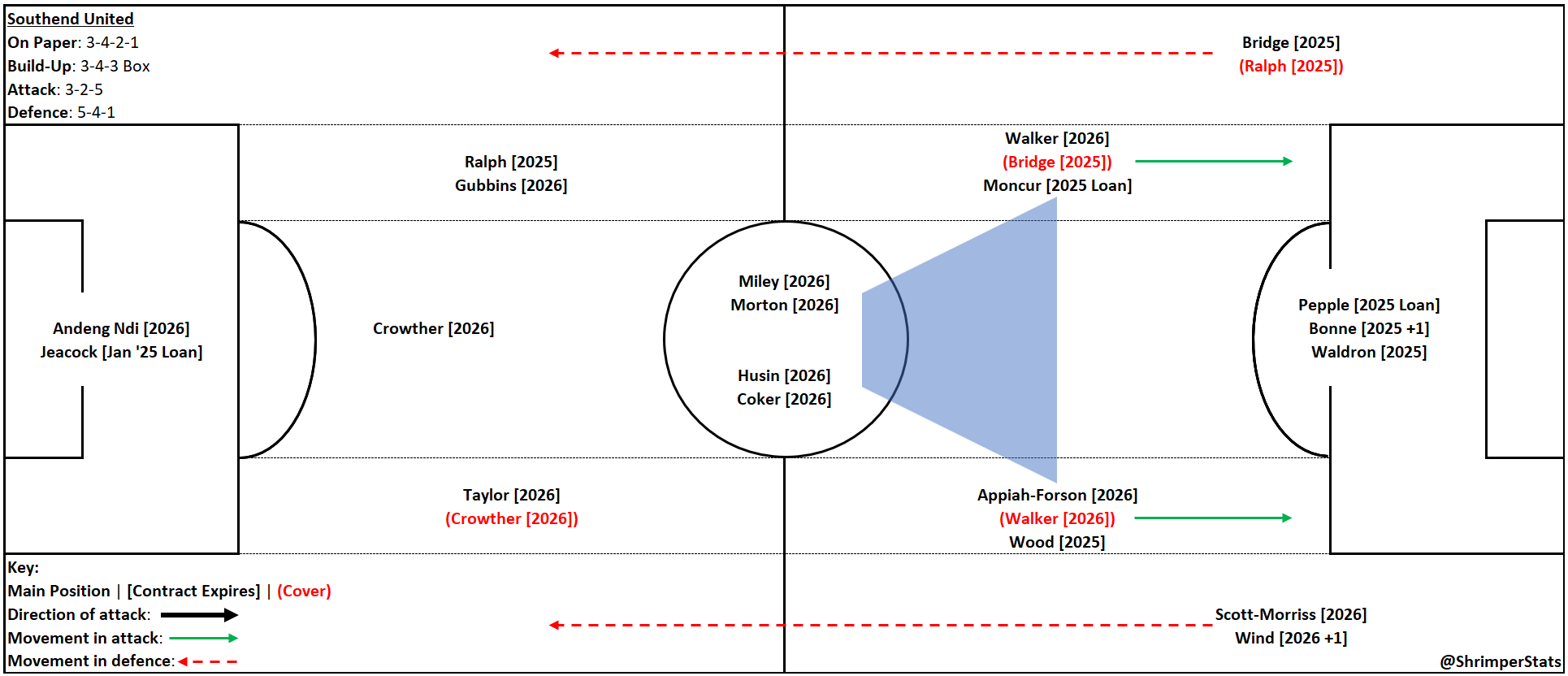
This would allow there to be continuity with the back-three structure, and all of the issues that I’ve identified with Maher’s current iteration of his 3-5-2 system could be fixed. More proximity in the build-up to help Crowther, better pressure on the ball high up the pitch, and a greater threat in transition.
Then, if effective replacements are brought in of the same profiles to Kensdale and Cardwell, Southend can return to the 3-5-2 system that has worked so well for the past two years, which only needed additional quality to move on to the next step.
 Shrimper Stats