I’ve spoken about Adam Hinshelwood’s build-up at York City a lot! As well as being a very well-coached side with tactically intelligent players, the reason their structure is superior to sides such as Barnet and Rochdale centres around their use of a back-four.
Dean Brennan’s Barnet and Jim McNulty’s Rochdale both typically build play in a 3-2-5 shape, with their wing-backs pushed high & wide either side of their front-three. This can also be interpreted as a 3-2-2-3 if the #10’s are slightly deeper, between the lines.
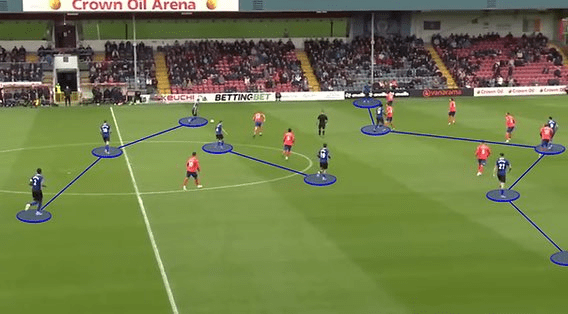
This shape allows for good positional play, as all five vertical zones are consistently occupied in attack. As well as having players spread nicely across the pitch, they’re evenly distributed vertically, too. Five players are positioned deep (the ‘3-2’), with five higher up.
The five deeper players provide consistent proximity in the build-up, which helps to retain possession & exert control, and allows for quick combinations.
Then, in the final-third, the front-five can overload opposition back-fours with ease; the two #10’s can drop deeper to overload the midfield; and, because they have players spread evenly across the pitch, the front-five can quickly combine and interchange positions.

Although both of these sides require their wing-backs to hold the width in attack who, typically, don’t pose as much of a wide threat as a natural winger would; for the previously mentioned reasons, both Brennan and McNulty’s structures are very good.
However, where these structures fall short of Hinshelwood’s York is through the lack of rotations and subsequent unpredictability that they can create for the opposition.
Back-three structures are inherently less fluid than back-fours. All you can really do to deviate away from the back-three is to push an outside centre-back forwards, leaving two centre-backs, and drop the far-side wing-back deeper to form a back-four (4-2-4).
However, this would then weaken the positional play as only four players would be left in attack. Besides, neither Barnet or Rochdale do this anyway. Instead, they ‘split’ their double-pivot, with the #6’s positioned at different ‘heights’…
Barnet often drop one of their #6’s, Anthony Hartigan, deeper to provide an overload in-front of the opposition’s block. With him in the first line of build-up, Barnet form a back-four that way (4-1-5).

The ‘split’ double-pivot can be difficult for opponents to both mark and effectively screen their defences. Consequently, the pivot players can either go unmarked, or passing lanes can open up into the players ahead of the ball.

However, the ‘split’ double-pivot often empties the midfield. As a result, the build-up can lack proximity which makes it more difficult to retain possession, exert control and use quick combinations. This can also leave sides vulnerable in transition once play has broken down.
Positioning their double-pivot at different ‘heights’ is about the only rotation that Brennan and McNulty can implement in the build-up at Barnet and Rochdale, respectively. As a result, it makes them slightly too predictable to prepare to face, as you know how they’ll set up.
This isn’t a huge issue. Besides, both teams are right up there in terms of averaging high possession shares – so they’re still good at exerting control on matches.
But they’re not on the same level as Hinshelwood’s York. On paper they line up in a 4-1-4-1 formation, but they can use a variety of build-up shapes…
Here, we can see York in what appears to be a standard 4-2-4 shape, with Alex Hunt forming a double-pivot alongside Dan Batty. However, Marvin Armstrong (the other #8) and Ollie Pearce, who were both positioned centrally, could both drop deeper to overload the midfield.

This leaves the wingers to stretch the pitch horizontally and vertically, and it provides the opposition with tactical issues… How do you deal with the two ‘false-nines’? Do you man-mark them which can create space in the defensive line; or allow them to overload the midfield?
Below, Batty has dropped deeper, between the two centre-backs, to form a 3-3-1-3 shape. Similarly to Hartigan of Barnet, in this ‘quarterback’ role, Batty can give his side an overload in-front of the opposition’s block, and use his passing range to hit big switch passes.
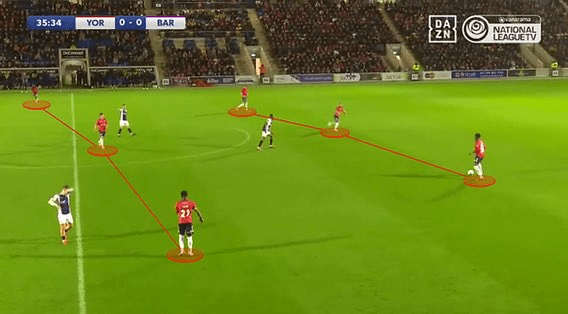
But the real key to the unpredictability of Hinshelwood’s build-up structure is Joe Felix. If York build with a standard back-four (or in the 3-3-1-3), Felix can be used at either right-back or left-back. But this shape can vary again, depending on Felix’s positioning…
Felix can invert alongside York’s #6 to form a double-pivot; with the #8’s, Armstrong and Ricky Aguiar, pushing higher to form a 3-2-5. Felix can do this irrespective of whether he starts at right-back or left-back.
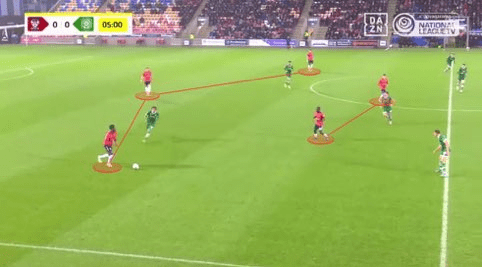
Again whether from right-back or left-back, Felix can push into the last line, leaving the remaining defenders and Batty & Hunt to form the ‘3-2’ base. Here, Felix can either play high & wide; or tuck into the half-space (which is superior, because a natural winger can then hold the width).

Hinshelwood’s latest iteration of his 3-2-5 involves using Aguiar at left-back where he can use his passing range, right-footedness and subsequent body positioning to help switch the play from left-to-right.

Although all three sides mentioned attack in a 3-2-5, York demonstrate far more fluidity in arriving there than both Barnet and Rochdale, and a huge factor stems from the fact that York use a back-four as opposed to a back-three – a structure with more potential to be fluid.
The variety of shapes that York can use makes them very difficult to prepare to face, as it’s almost impossible to predict how they’ll set up. In a close title race, that could be the difference in the search for marginal gains.
It’s for the above reasons that there isn’t another coach in the National League who’s on the same level as Adam Hinshelwood, tactically. His build-up structure is similar to the elites of the game, and I’m certain he’s destined to manage at a far higher level.
 Shrimper Stats